

All Solutions
Page 53: Questions
If $a>0$ the parabola opens upwards.
If $a0$ The shift is upwards.
If $k0$ The shift is to the left.
If $h1$ the parabola is stretched.
If $a<1$ the parabola is compressed.
The values for $a<1$ compress the graph vertically. because they decrease the value of $y$
If $h>0$ The shift is to the left.
If $h<0$ The shift is to the right.
If $k>0$ The shift is upwards.
If $k<0$ The shift is downwards.
If $a0$ The shift is upwards.
If $k0$ The shift is to the left.
If $h1$ the parabola is stretched.
If $a<1$ the parabola is compressed.
$y=(x+9)^2$ (Given)
The coordinates of the vertex is: $(-9, 0)$
$a=1>0$ the graph opens up.
$a=1$ There is neither vertical stretch nor compression.
$y=x^2+7$ (Given)
The coordinates of the vertex is: $(0, 7)$
$a=1>0$ the graph opens up.
$a=1$ There is neither vertical stretch nor compression.
$y=3x^2$ (Given)
The coordinates of the vertex is: $(0, 0)$
$a=3>0$ the graph opens up.
$a=3>1$ There is a vertical stretch with the factor of 3.
$y=dfrac {1}{3}(x-1)^2$ (Given)
The coordinates of the vertex is: $(1, 0)$
$a=dfrac {1}{3}>0$ the graph opens up.
$a=dfrac {1}{3}>1$ There is a vertical compression with the factor of $dfrac {1}{3}$.
$y=-(x-7)^2+6$ (Given)
The coordinates of the vertex is: $(7, 6)$
$a=-1<0$ the graph opens down.
$a=-1$ There is neither vertical stretch nor compression.
$y=2(x+3)^2-8$ (Given)
The coordinates of the vertex is: $(-3, -8)$
$a=2>0$ the graph opens up.
$a=2>1$ There is a vertical stretch with the factor of 2.
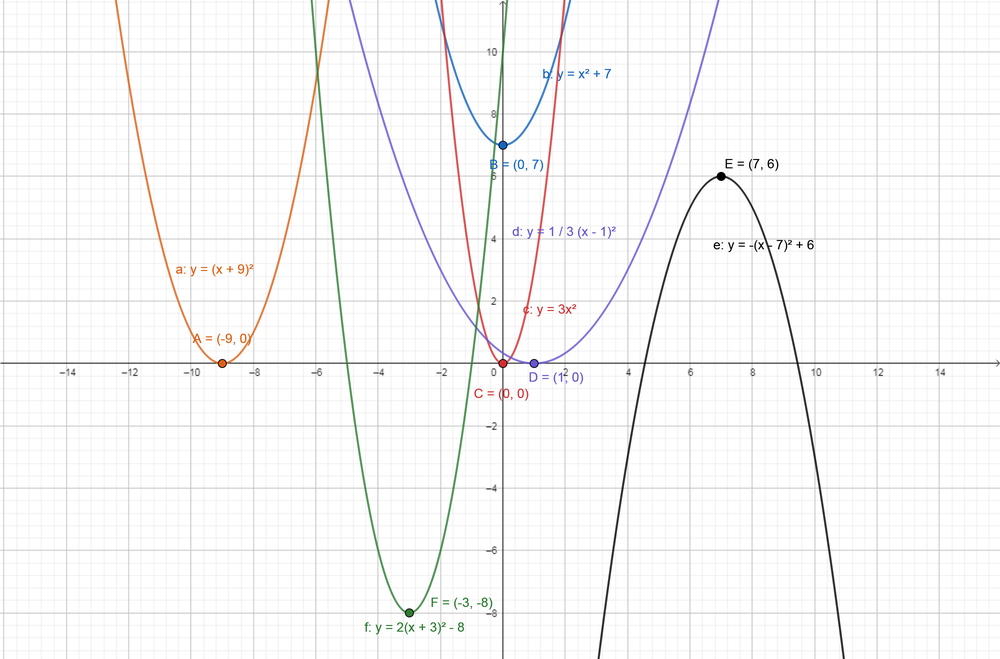
b- Vertex is: $(0, 7)$. Opens up. There is no stretch or compression.
c- Vertex is: $(0, 0)$. Opens up. There is a stretch with the factor of 3.
d- Vertex is: $(1, 0)$ Opens up. The compression is with a factor of $dfrac {1}{3}$
e- Vertex is: $(7, 6)$ Opens down. There is no stretch or compression.
f- Vertex is: $(-3, -8)$ Opens up. There is a stretch with the factor of 2.
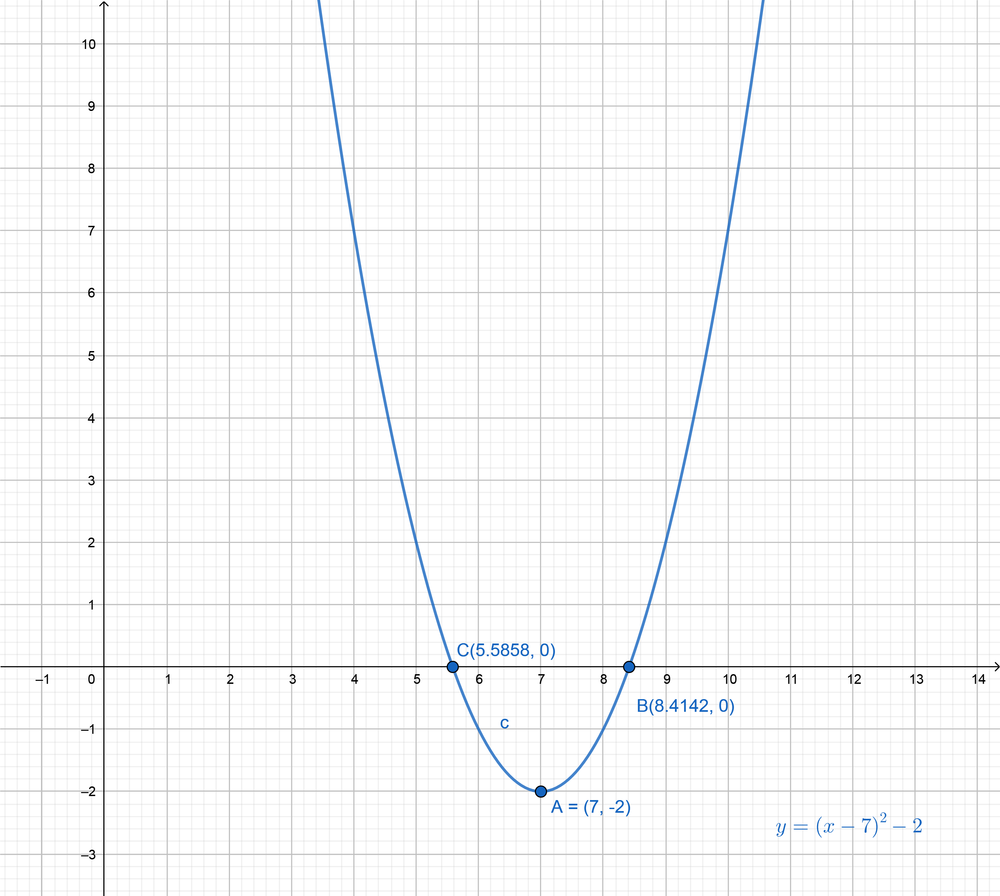
$y=(x-7)^2-2$ (Given)
$a=1$
$h=7$
$k=-2$
The vertex is the point $(7, -2)$
$a=1>0$. The parabola opens up.
$y=0.5(x+3)^2+1$ (Given)
$a=0.5$
$h=-3$
$k=1$
The vertex is the point $(-3, 1)$
$a=1>0$. The parabola opens up.
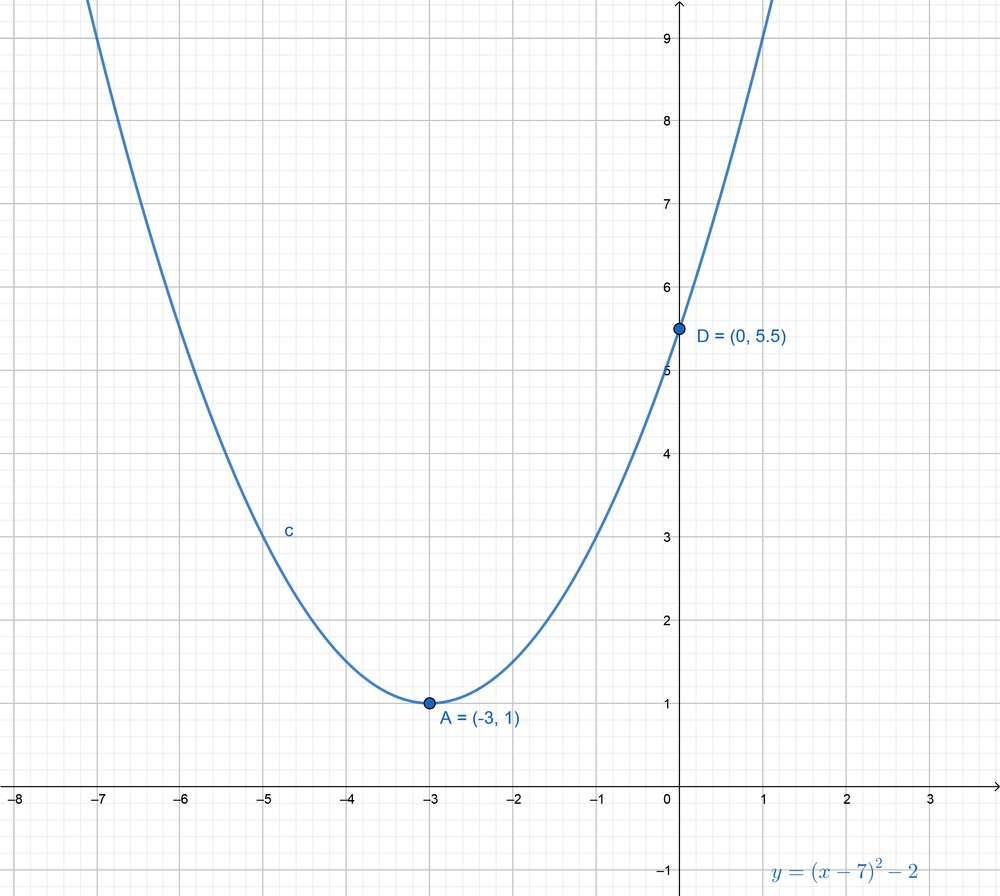
b- Vertex is the point $(-3, 1)$ $a=1>0$. The parabola opens up.
$y=2x^2+4x-30$ (Given)
$a=2>0$, So, the parabola opens upwards.
We can reflect the parabola to open in the opposite way by multiplying it by -1.
The stretch factor of $y=2x^2+4x-30$ is 2.
To justify this, we convert it to the graphing form.
$y=2x^2+4x-30$
$y=2(x^2+2x-15)$
$y=2(x^2+2x+1-1-15)$
$y=2(x^2+2x+1-16)$
$y=2(x^2+2x+1)-32$
$$
y=2(x+1)^2-32
$$
The stretch factor $a=2$
It is not possible to identify the vertex of $y=2x^2+4x-30$ by looking at the equation.
We can conclude the vertex as follows:
x-coordinate of the vertex can be calculated by the formula:
$x=dfrac {-b}{2a}$
$x=dfrac {-4}{2 cdot 2}=-1$
y-coordinate of the vertex is $y(-1)$:
$y(-1)=2-4-30=-32$
The vertex is the point $(-1, -32)$
$2x^2+4x-30=0$
$$
(2x-6)(x+5)=0
$$
$2x-6=0$ or $x+5=$
x-intercepts are $x=3$ and $x=-5$
ii. The vertex is located in the middle between the x-intercepts.
x-coordinate of the vertex is:
$x=dfrac {3-5}{2}=-1$
iii. y-coordinate of the vertex is $y(-1)$:
$y(-1)=2-4-30=-32$
The vertex is the point $(-1, -32)$
The graphing form of the equation is:
$$
y=2(x+1)^2-32
$$
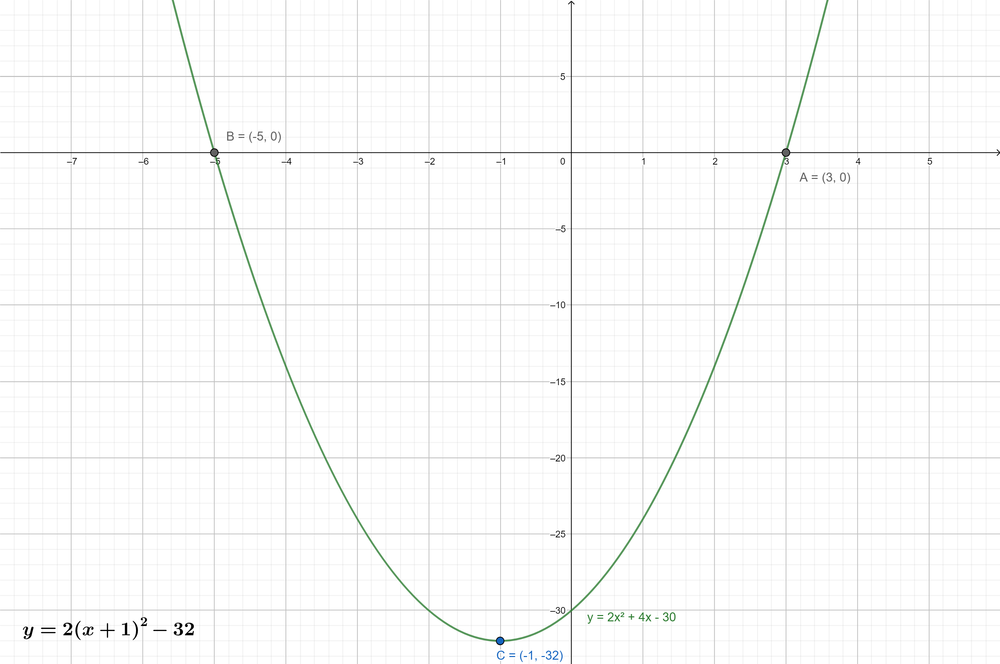
b- The stretch factor of $y=2x^2+4x-30$ is 2.
c- It is not possible to identify the vertex by looking at the standard form of the equation.
i. x-intercepts are $x=3$ and $x=-5$
ii. The vertex is located in the middle between the x-intercepts.
iii. y-coordinate of the vertex is $y(-1)$:
$p(x)=x^2-10x+16$ (Write the equation)
x-coordinate of the vertex: $x=dfrac {-b}{2a}$
$x=dfrac {10}{2}=5$
y-coordinate of the vertex $p(5)$
$p(5)=5^2-10(5)+16$
$p(5)=25-50+16=-9$
The vertex is $(5, -9)$
The graphing form of the equation is:
$$
p(x)=(x-5)^2-9
$$
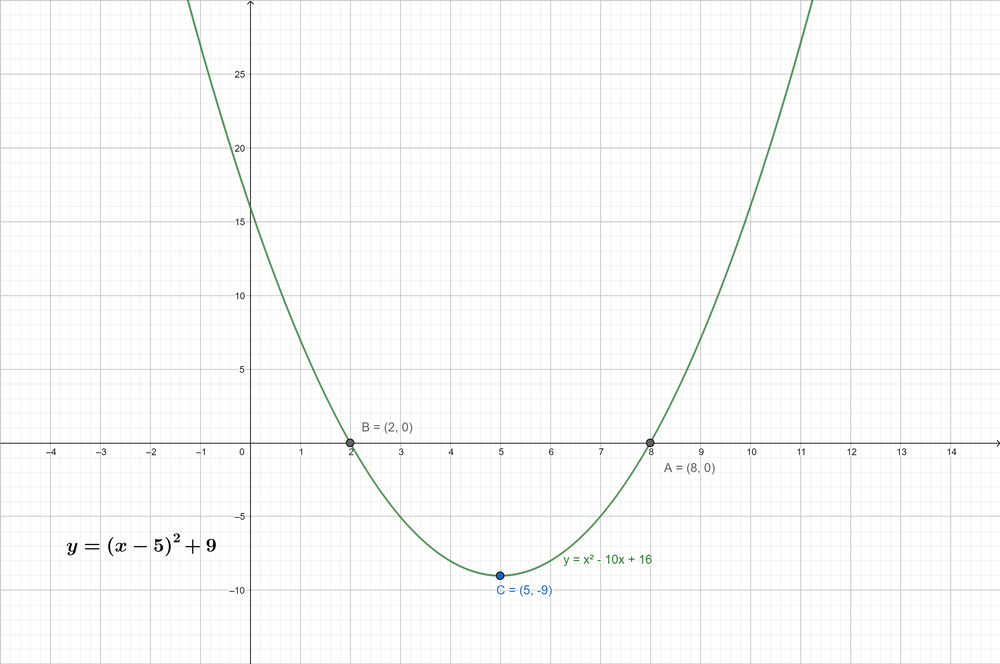
$f(x)=x^2+3x-10$ (Write the equation)
x-coordinate of the vertex: $x=dfrac {-b}{2a}$
$x=dfrac {-3}{2}=-dfrac {3}{2}$
y-coordinate of the vertex $f(-dfrac {3}{2})$
$f(-dfrac {3}{2})=dfrac {9}{4}-dfrac {9}{2}-10$
$f(-dfrac {3}{2})=dfrac {9}{4}-dfrac {18}{4}-dfrac {40}{4}=-dfrac {49}{4}$
The vertex is $(-dfrac {3}{2}, qquad -dfrac {49}{4})$
The graphing form of the equation is:
$$
f(x)=left(x+dfrac {3}{2} right)^2-dfrac {49}{4}
$$
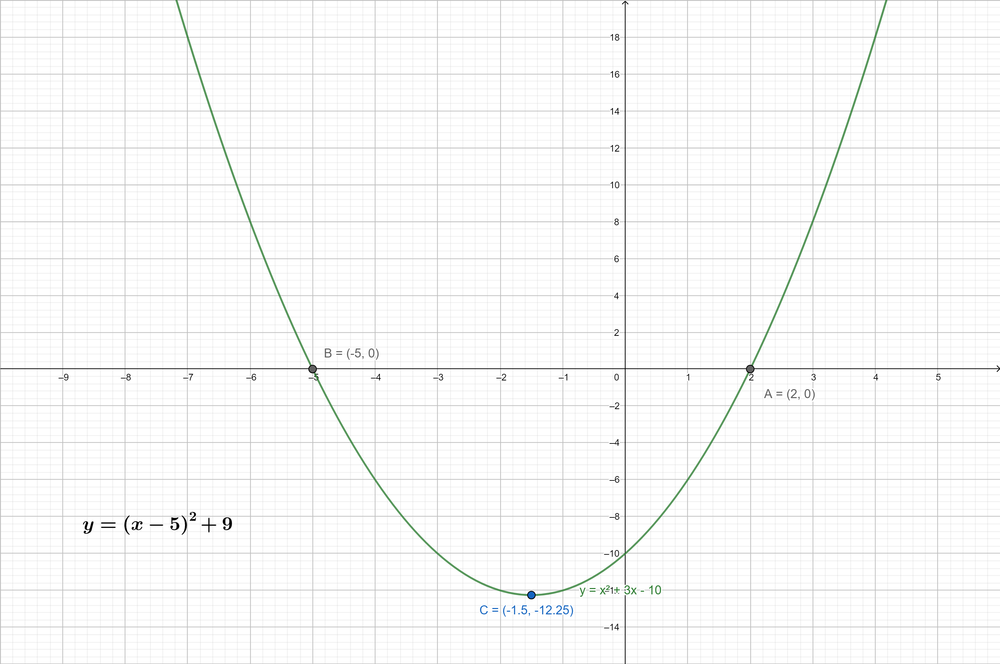
$g(x)=x^2-4x-2$ (Write the equation)
x-coordinate of the vertex: $x=dfrac {-b}{2a}$
$x=dfrac {4}{2}=2$
y-coordinate of the vertex $g(2)$
$g(2)=4-8-2$
$g(2)=-6$
The vertex is $(2, -6)$
The graphing form of the equation is:
$$
g(x)=(x-2)^2-6
$$
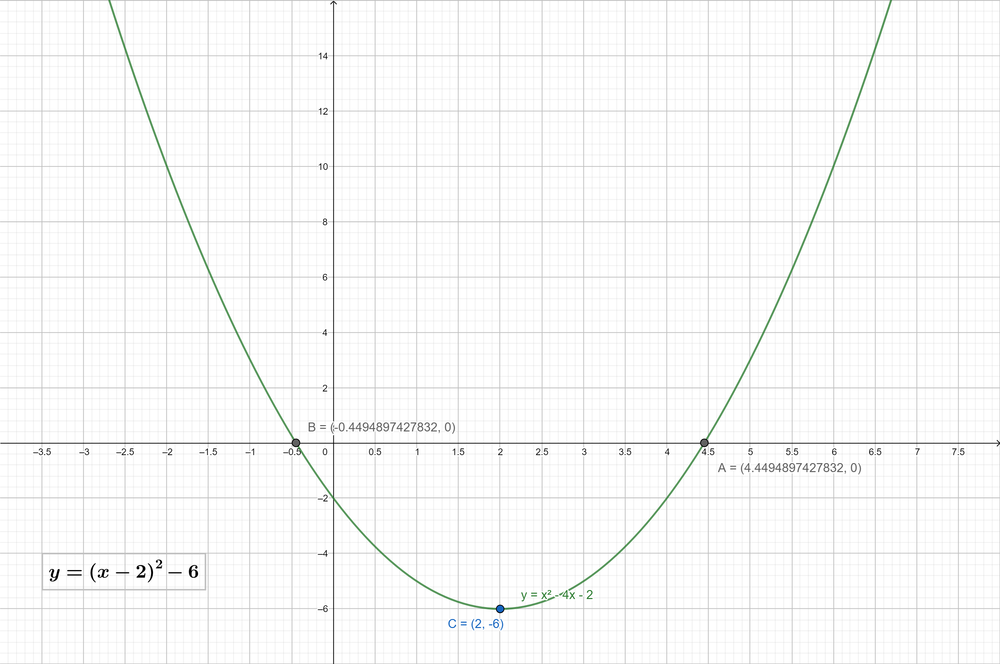
$h(x)=-4x^2+4x+8$ (Write the equation)
x-coordinate of the vertex: $x=dfrac {-b}{2a}$
$x=dfrac {-4}{-8}=dfrac {1}{2}$
y-coordinate of the vertex $h(dfrac {1}{2})$
$h(dfrac {1}{2})=-4 times dfrac {1}{4}+4 times dfrac {1}{2}+8$
$h(2)=-1+2+8=9$
The vertex is $left(dfrac {1}{2}, 9 right)$
The graphing form of the equation is:
$$
g(x)=left(x-dfrac {1}{2} right)^2+9
$$
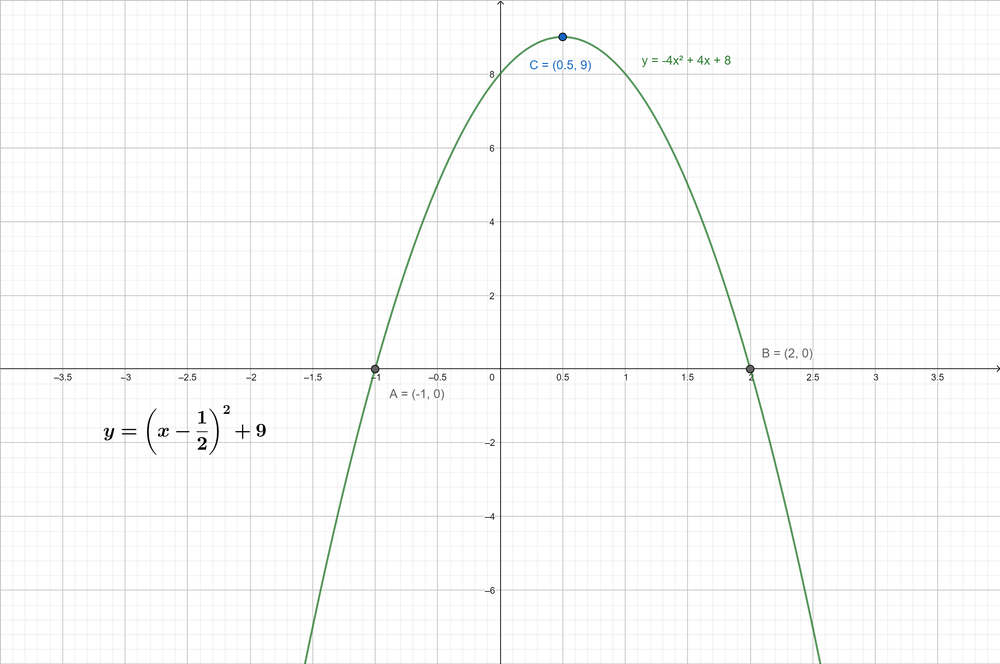
b- $f(x)=left(x+dfrac {3}{2} right)^2-dfrac {49}{4}$
c- $g(x)=(x-2)^2-6$
d- $g(x)=left(x-dfrac {1}{2} right)^2+9$
$y^2-6y=0$ (Write the equation)
$y(y-6)=0$ (Factor out $y$)
$y=0$ or $y=6$
$n^2+5n+7=7$ (Write the equation)
$n(n+5)=7-7$ (Factor out $n$
$n(n+5)=0$
$n=0$ or $n=-5$
$2t^2-14t+3=3$ (Write the equation)
$2t(t-7)=3-3$ (Factor out $2t$
$2t(t-7)=0$
$t=0$ or $t=7$
$dfrac {1}{3}x^2+3x-4=-4$ (Write the equation)
$dfrac {1}{3}x cdot (x+9)=4-4$ (Factor out $dfrac {1}{3}x$
$dfrac {1}{3}x cdot (x+9)=0$
$x=0$ or $x=-9$
All the above equations after rearranging their terms have the parameter $c=0$
and that what makes the zero is on of the solutions of each of them.
b- $n=0$ or $n=-5$
c- $t=0$ or $t=7$
d- $x=0$ or $x=-9$
$y=(x-3)(x-11)$ (Given)
For x-intercepts, $y=0$
$(x-3)(x-11)=0$
x-intercepts are $x=3$ and $x=11$
$x$ coordinate of the vertex $=dfrac {11+3}{2}=7$
$y$ coordinate of the vertex $y(7)=(7-3)(7-11)=4 cdot -4=-16$
The vertex is: $(7, -16)$
The graphing form of the equation is:
$$
y=(x-7)^2-16
$$
$y=(x+2)(x-6)$ (Given)
For x-intercepts, $y=0$
$(x+2)(x-6)=0$
x-intercepts are $x=-2$ and $x=6$
$x$ coordinate of the vertex $=dfrac {-2+6}{2}=2$
$y$ coordinate of the vertex $y(2)=(2+2)(2-6)=4 cdot -4=-16$
The vertex is: $(2, -16)$
The graphing form of the equation is:
$$
y=(x-2)^2-16
$$
$y=x^2-14x+40$ (Given)
$y=(x-4)(x-10)$ (Factoring)
For x-intercepts, $y=0$
$(x-4)(x-10)=0$
x-intercepts are $x=4$ and $x=10$
$x$ coordinate of the vertex $=dfrac {4+10}{2}=7$
$y$ coordinate of the vertex $y(7)=7^2-14(7)+40=49-98+40=-9$
The vertex is: $(7, -9)$
The graphing form of the equation is:
$$
y=(x-7)^2-9
$$
$y=(x-2)^2-1$ (Given)
The equation is in the graphing form.
The vertex is: $(2, -1)$
b- Vertex: $(2, -16)$ Graphing Form: $y=(x-2)^2-16$
c- Vertex: $(7, -9)$ Graphing Form: $y=(x-7)^2-9$
a- Vertex: $(2, -1)$ Equation is in the Graphing Form.
In this problem $h=2$ and $k=-1$
a- The vertex is $(2, -1)$
b- If an equation is in the vertex form $y=a(x-h)^2+k$. then the vertex coordinates are: $(h, k)$
Let us calculate $x$. We use trigonometric rations and get
$$
sin 15^{circ} = frac{text{opposite leg}}{text{hypotenuse}} = frac{x}{20}.
$$
Therefore,
$$
x=20 cdot sin 15^{circ}.= 20 cdot 0,2588 = 5,176.
$$
We can conclude
$$
color{#c34632} x=5,176.
$$
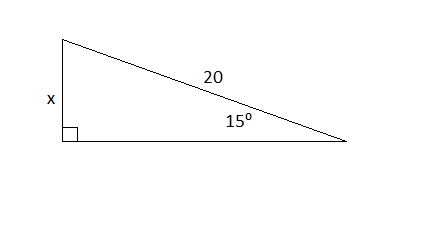
Let us calculate $x$. We use trigonometric rations and get
$$
tan15^{circ} = frac{text{opposite leg}}{text{adjacent leg}} = frac{5}{x}.
$$
Therefore,
$$
x=frac{5}{tan15^{circ}}.= frac{5}{0,268} = 18, 657.
$$
We can conclude
$$
color{#c34632} x=18,657.
$$
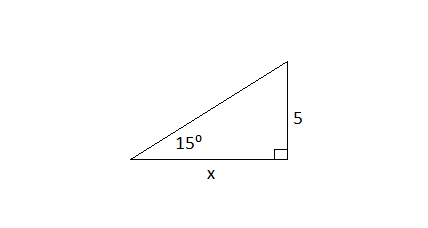
Let us calculate $theta$. We use trigonometric rations and get
$$
cos theta = frac{text{adjacent leg}}{text{hypotenuse}} = frac{10}{11} = 0,9.
$$
Therefore,
$$
theta = arccos {0,9} = 24,62^{circ}.
$$
We can conclude
$$
color{#c34632} theta=24,62^{circ}.
$$
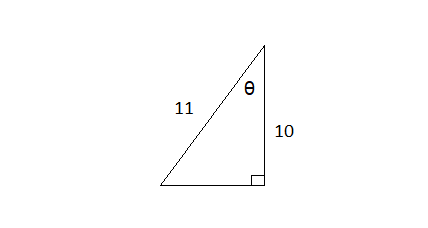
Let us calculate $x$. This time we can use the Pythagorean theorem and calculate the missing side of the given triangle. Now we have
$$
begin{align*}
x^2 &= 6^2+12^2 \ x^2 &= 36+144 \ x^2 &= 180 \ x&= sqrt{180} approx 13,4.
end{align*}
$$
We can conclude
$$
color{#c34632} x=sqrt{180} approx 13,4.
$$
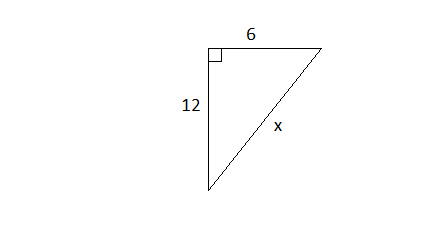
b. $x=18,657$
c. $theta = 24,62^{circ}$
d. $x = sqrt{180} approx 13,4$
$y=18x-30$ (1)
$y=-22x+50$ (2)
$18x-30=-22x+50$ (Equation both equation)
$18x+22x=50+30$ (Grouping similar terms)
$40x=80$ (Simplify)
$x=2$ (Solve for $x$)
Substituting for $x$ in equation (1):
$y=18(2)-30=36-30=6$
The point of intersection is: $(2, 6)$
$$
color{#4257b2} 10^{3x}=10^{x-8}.
$$
Since the base is the same number in order for the equality to stand the exponent must be the same too. Thereore
$$
begin{align*}
3x &=x-8 \ 3x-x&=-8 \ 2x &=-8 \ x&=-frac{8}{2} = -4.
end{align*}
$$
Therefore, the solution is
$$
color{#c34632} x=-4.
$$
Let us now check the solution. We have
$$
begin{align*}
10^{3x} &= 10^{3 cdot (-4)} = 10^{-12} \
10^{x-8} &= 10^{-4-8} = 10^{-12}.
end{align*}
$$
Hence, we can conclude that the solution is correct.
x=-4
$$
The center of Hush Puppy is $58.3$, while the center of Quiet Down is $54.85$
Shape of two cases is parabola that opens downward.
I suggest **Hush Puppy**, because it has the **minimum range**.
This information did not change my opinion, because it gives me the same expectation.
The vertex is the point $(4, 3)$
Considering the function that that represents this situation is:
$y=a(x-h)^2+k$
From the vertex: $h=4$ and $k=3$
Substituting in the equation with the point $(8, 0)$
$0=a(8-4)^2+3$
$16a=-3$
$$
a=-dfrac {3}{16}
$$
The equation that fits the situation is:
$$
y=-dfrac {3}{16}(x-4)^2+3
$$
By using the regression function in the graphing calculator, we get the same result:
$$
y=-0.1875(x-4)^2+3
$$
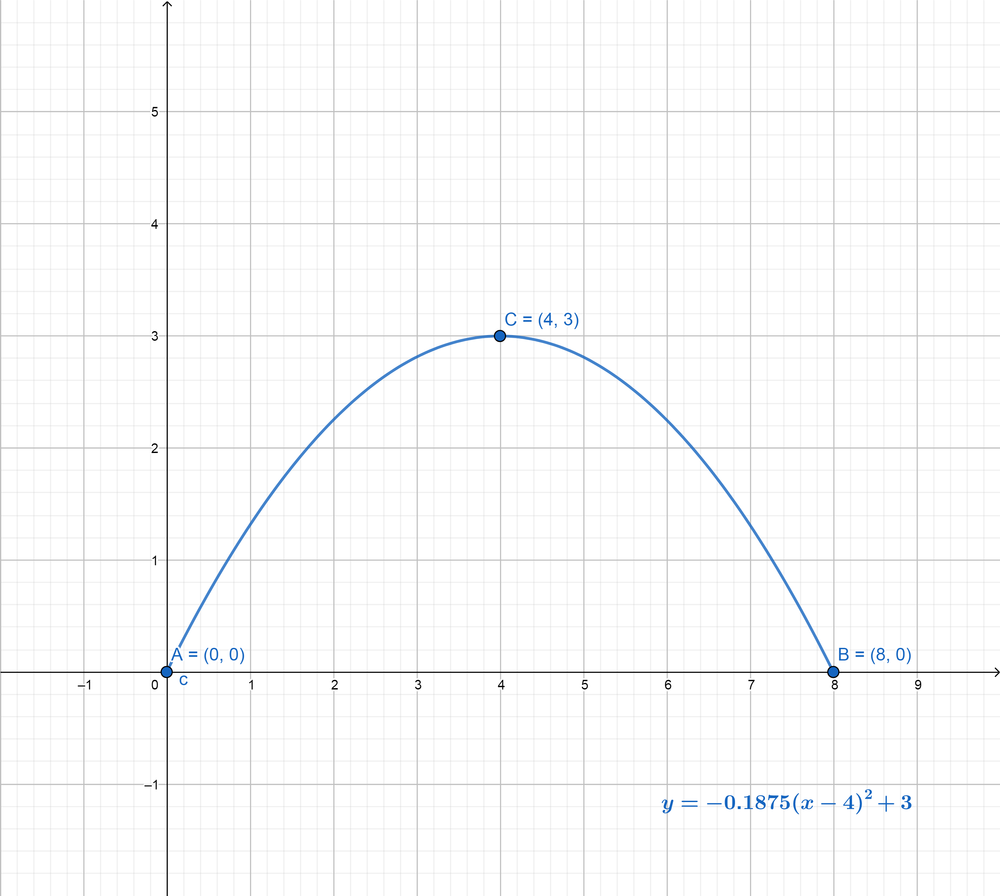
y=-dfrac {3}{16}(x-4)^2+3
$$
$$y=-dfrac{3}{16}(x-4)^2+3$$
Its graph is

Which is mean
$$h=4hspace{1cm}textrm{and}hspace{1cm}k=2.5$$
Substituting by the point $(8,0)$
$$0=a(8-4)+2.5Rightarrow 16a=-2.5Rightarrow a=dfrac{-2.5}{16}$$
The equation will be
$$y=-dfrac{2.5}{16}(x-4)^2+2.5$$
The vertex is the point $(75, 100)$
Considering the function that that represents this situation is:
$y=a(x-h)^2+k$
From the vertex: $h=75$ and $k=100$
Substituting in the equation with the point $(0, 0)$
$0=a(0-75)^2+100$
$0=5625a+100$
$$
a=-dfrac {100}{5625}
$$
The equation that fits the situation is:
$$
y=-dfrac {100}{5625}(x-75)^2+100
$$
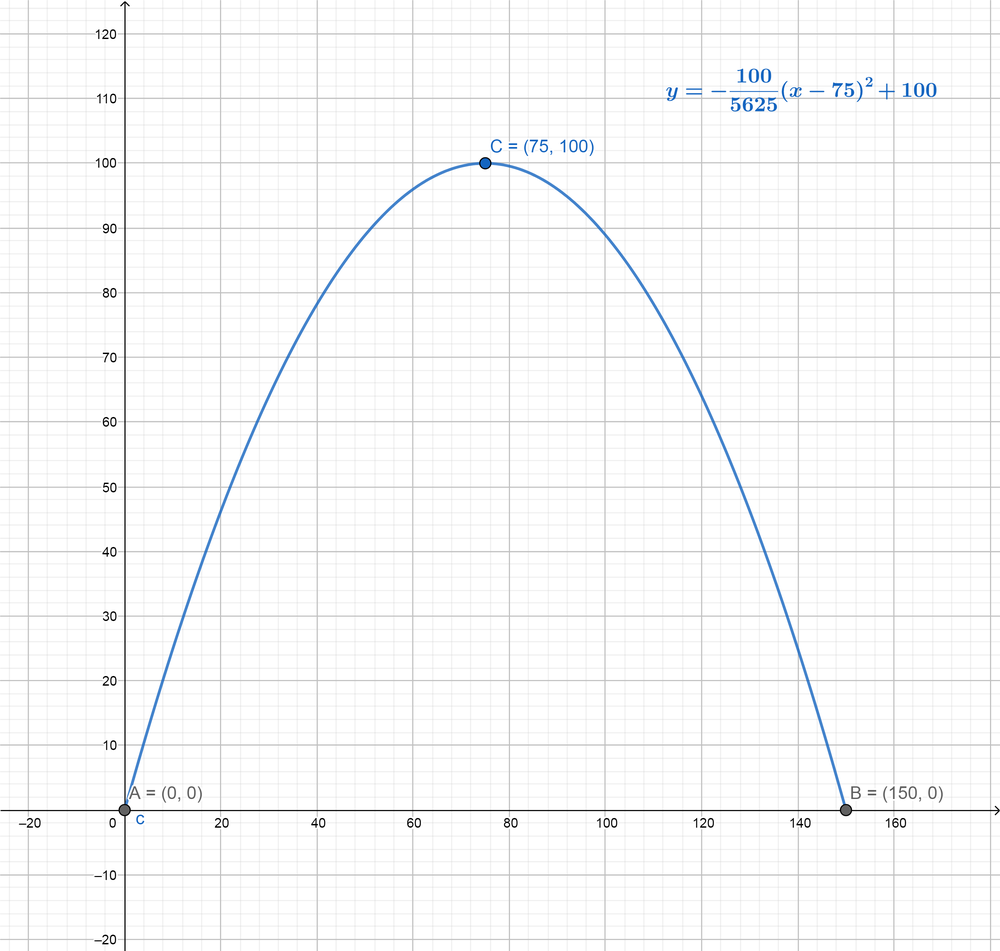
y=-dfrac {100}{5625}(x-75)^2+100
$$
The vertex is the point $(20, -15)$
Considering the function that that represents this situation is:
$y=a(x-h)^2+k$
From the vertex: $h=20$ and $k=-15$
Substituting in the equation with the point $(0, 0)$
$0=a(0-20)^2-15$
$0=400a-15$
$400a=15$
$$
a=dfrac {3}{80}
$$
The equation that fits the situation is:
$$
y=dfrac {3}{80}(x-20)^2-15
$$
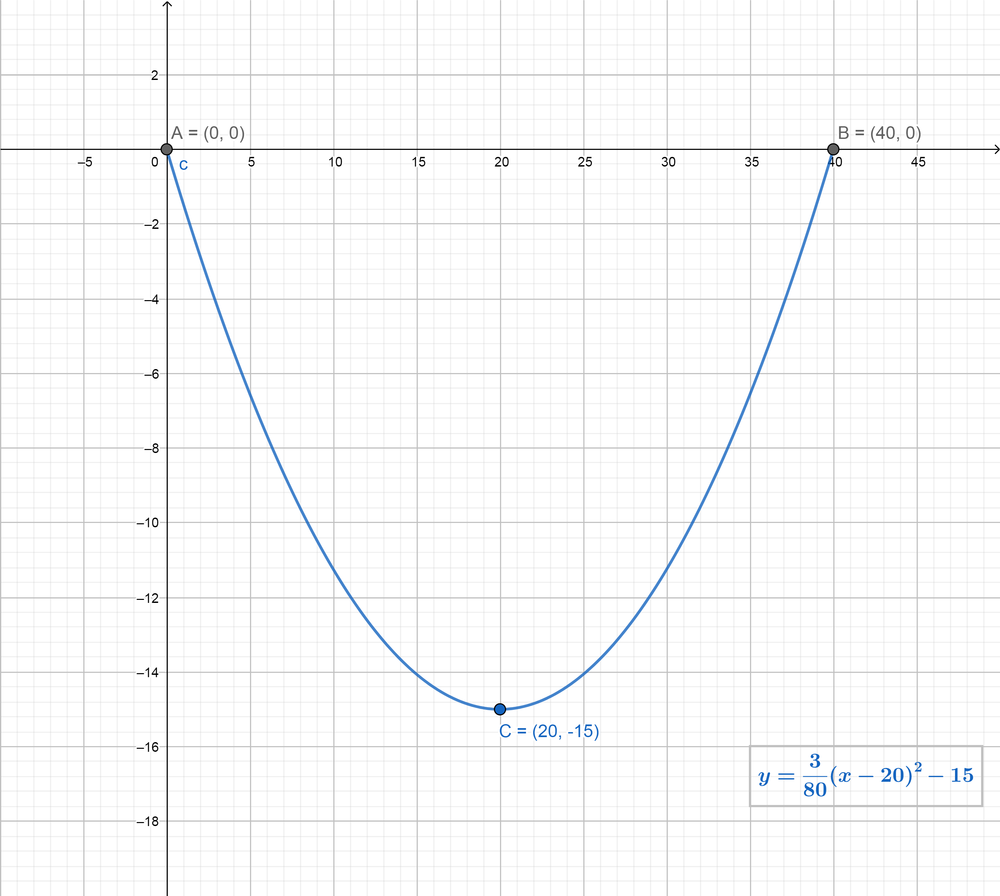
y=dfrac {3}{80}(x-20)^2-15
$$
1. Write a list of strategies you used,
2. Write decisions that you had to make to create your models.
3. Write the different models that are valid for the same relationship like: Table, graphs, equation.
4. Write an example from this lesson to illustrate your process.
The vertex is the point $(60, 50)$
Considering the function that that represents this situation is:
$y=a(x-h)^2+k$
From the vertex: $h=60$ and $k=50$
Substituting in the equation with the point $(0, 0)$
$0=a(0-60)^2+50$
$0=3600a+50$
$3600a=-50$
$a=-dfrac {50}{3600}$
$$
a=-dfrac {1}{72}
$$
The equation that fits the situation is:
$$
y=-dfrac {1}{72}(x-60)^2+50
$$
The domain of the function is: $(0 leq x leq 120)$
The range of the function is: $(0 leq y leq 50)$
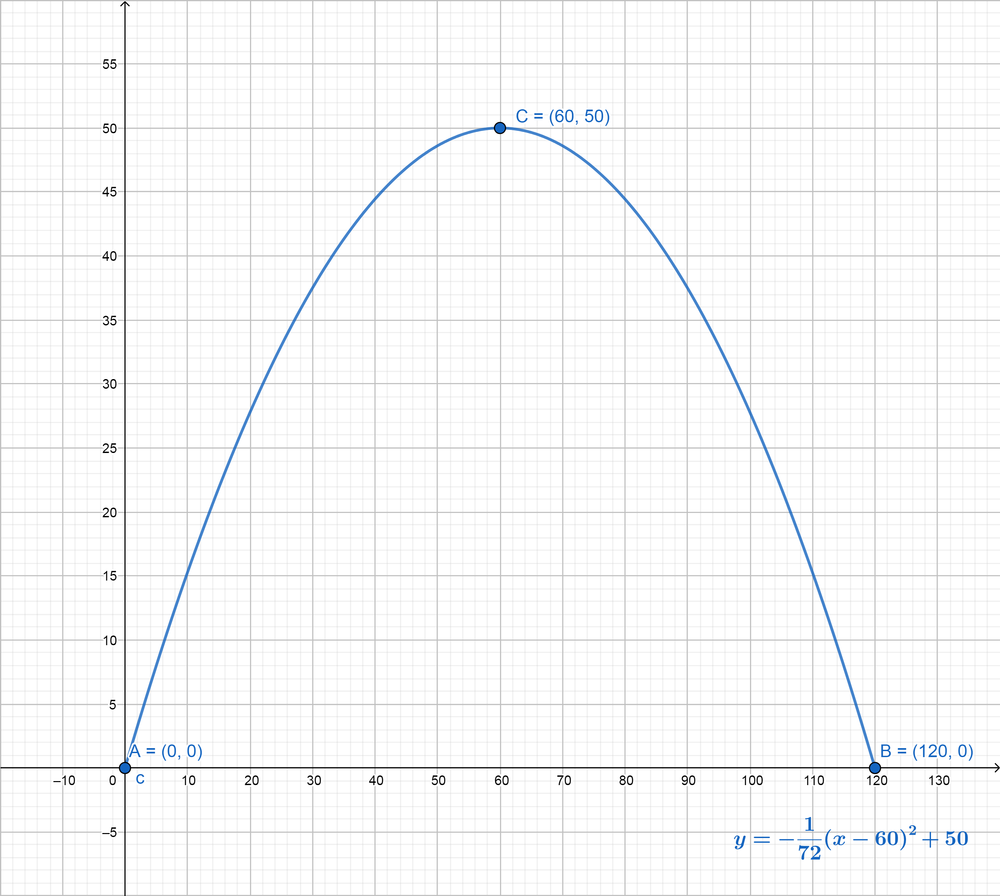
y=-dfrac {1}{72}(x-60)^2+50
$$
* The multiplier that should be used is 1.06.
* The initial value is $120,000.
*$f(x)=120,000(1.06)^x$
* The multiplier that should be used is 1.22.
* The initial value is 180.
* $f(x)=180(1.22)^x$
b- $f(x)=180(1.22)^x$
$overline {AB}=x$ (Given)
$overline {AC}=y$ (Given)
$overline {BC}=3$ units (Given)
$mangle ABC=180-155=25text{textdegree}$ (A pair of supplementary angles)
$sin B=dfrac {y}{3}=sin 25text{textdegree}$
$dfrac {y}{3}=0.4226$
$y=3 cdot 0.4226=1.2678$
The height of the slide $y=1.2678$ units
$cos B=dfrac {x}{3}=cos 25text{textdegree}=0.9063$
$dfrac {x}{3}=0.9063$
$x=3 cdot 0.9063=2.7189$
The length of the floor covered by the slide $x=2.7189$ units
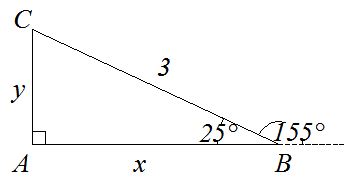
The length of the floor covered by the slide $x=2.7189$ units
Let us solve the given equation
$$
color{#4257b2} frac{3}{x} +6 = -45.
$$
We solve for $x$ and get
$$
begin{align*}
frac{3}{x} +6 = -45 implies frac{3}{x} &= -45-6 \
frac{3}{x} &= -51 \ x &=frac{3}{-51} = -frac{1}{17} approx -0,06.
end{align*}
$$
Therefore, the solution is
$$
color{#c34632} x=-frac{1}{17} approx -0,06.
$$
Let us solve the given equation
$$
color{#4257b2} frac{x-2}{5} = frac{10-x}{8}.
$$
We solve for $x$ and get
$$
begin{align*}
frac{x-2}{5} = frac{10-x}{8} implies 8 cdot (x-2) &= 5 cdot (10-x) \
8x -16 &=50-5x \ 8x+5x&=50+16 \ 13x&=66 \ x &=frac{66}{13} approx 5,1.
end{align*}
$$
Therefore, the solution is
$$
color{#c34632} x=frac{66}{13} approx 5,1.
$$
Let us solve the given equation
$$
color{#4257b2} (x+1)(x-3)=0.
$$
We can use the Zero Product Property and get
$$
begin{align*}
(x+1)(x-3)=0 implies x+1=0 hspace{3mm} &text{or} hspace{3mm} x-3 = 0 \
x=-1 hspace{3mm} &text{or} hspace{3mm} x=3. end{align*}
$$
Therefore, the solutions are
$$
color{#c34632} x=-1 hspace{3mm} text{color{default}or} hspace{3mm} x=3.
$$
begin{align*}
&text{a.} hspace{3mm} x=-frac{1}{17} approx -0,06 \
&text{b.} hspace{3mm} x=frac{66}{13} approx 5,1 \
&text{c.} hspace{3mm} x=-1 hspace{3mm} text{color{default}or} hspace{3mm} x=3 \
end{align*}
$$
We can now make the table of the function.
begin{center}
begin{tabular}{ |c|c|c|c|c|c|c|c|c|c|c|c|c| }
hline
x & -2 & -1 & 0 & 1 & 1,58 & 2 \
hline
y & -12 & -5 & -4 & -3 & 0 & 4 \
hline
end{tabular}
end{center}
And now we can draw the graph. \
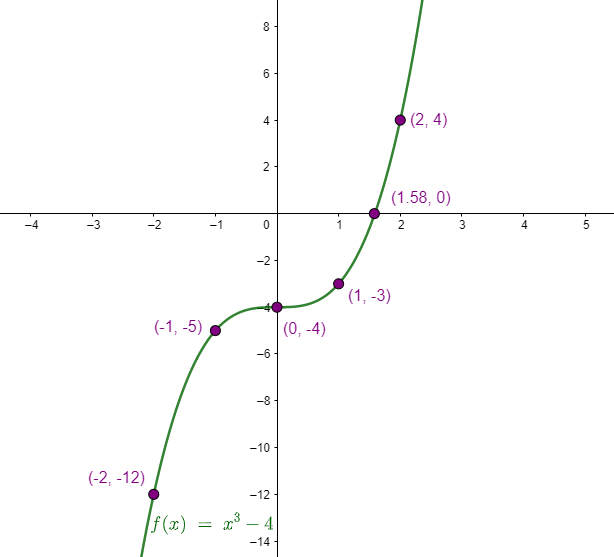
The domain of the function are all real numbers, we can write $x in (-infty, infty)$.
The range of the function are all real numbers, so we can write $y in (-infty, infty)$.
The $x$-intercept is the point $x=1,58$.
The $y$-intercept is the point $y=-4$.
The function is not symmetric.
The function does not have asymptotes.
The function is increasing for $x in (-infty, infty).$
The function does not have minimum or maximum points.
The function is continuous.
The length of the long leg $l=3x+3$ inches.
The are of the triangle $a=dfrac {1}{2}ls$
$84=dfrac {1}{2}x(3x+3)$
$168=3x^2+3x$
$3x^2+3x-168=0$
$x^2+x-56=0$
$(x+8)(x-7)=0$
$x=-8$ or $x=7$
The short leg $s=7$ inches
The long leg $l=3(7)+3=24$ inches.
The hypotenuse $h=sqrt {l^2+s^2}=sqrt {576+49}$
$h=sqrt {625}=25$ inches
The perimeter of the triangle $p=h+l+s=25+24+7=56$ inches
Points are $(3, -6)$ and $(-2, 5)$ (Given)
The distance between the two points $d=sqrt {(5-(-6))^2+(-2-3)^2}$
$d=sqrt {121+25}$
$$
d=sqrt {146} approx 12.08
$$
Points are $(5, -8)$ and $(-3, 1)$ (Given)
The distance between the two points $d=sqrt {(1-(-8))^2+(-3-5)^2}$
$d=sqrt {81+64}$
$$
d=sqrt {145} approx 12.04
$$
Points are $(0, 5)$ and $(5, 0)$ (Given)
The distance between the two points $d=sqrt {(0-5)^2+(5-0)^2}$
$d=sqrt {25+25}=sqrt {5^2 cdot 2}$
$$
d=5sqrt {2} approx 7.07
$$
b- $d=sqrt {145} approx 12.04$
c- $d=5sqrt {2} approx 7.07$
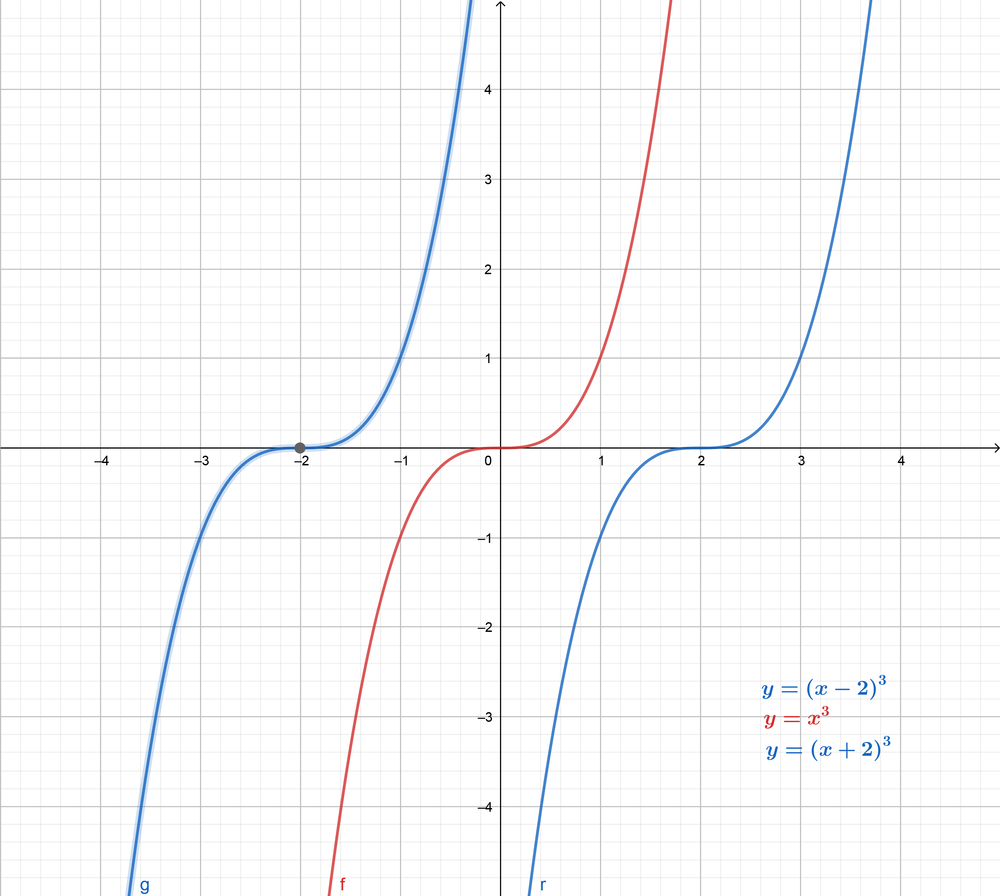
We can move the graph left for $a$ distance by adding $a$ to the $x$ variable.
$y’=(x+a)^3$
We can move the graph right for $a$ distance by subtracting $a$ from the $x$ variable.
$y’=(x-a)^3$
The domain of both original and image graphs is: $(-infty leq x leq infty)$
The range of both original and image graphs is: $(-infty leq y leq infty)$
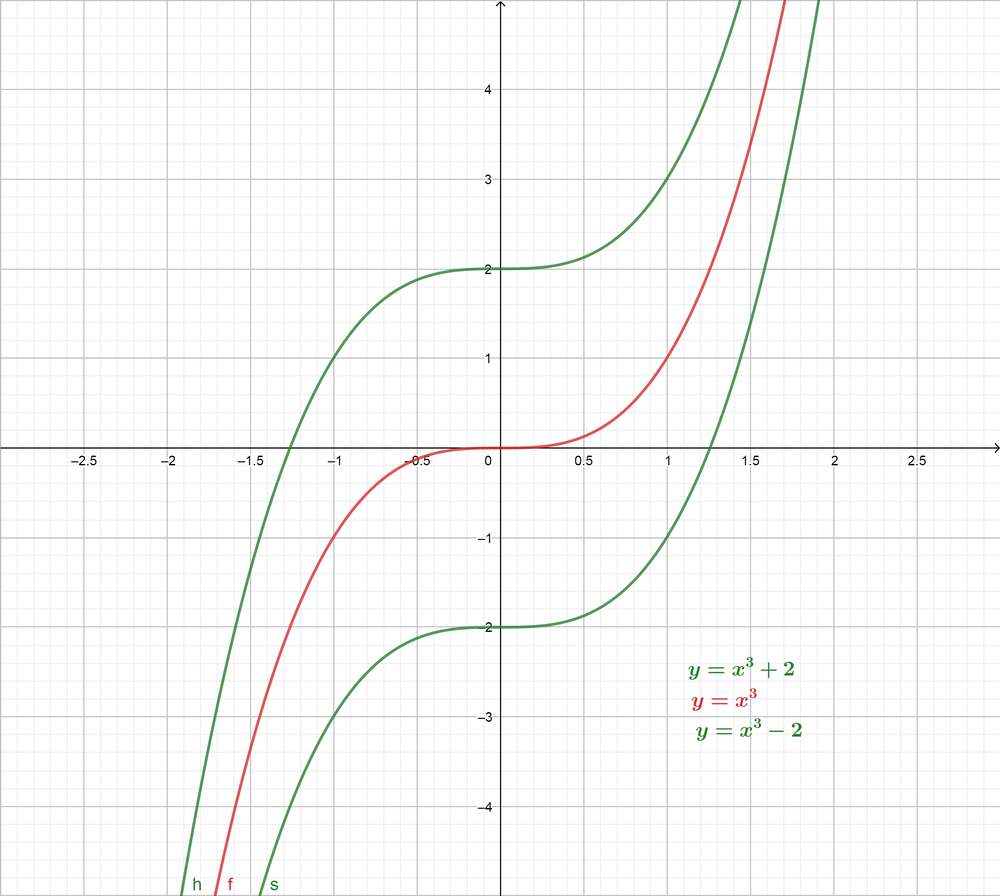
$y’=(x)^3+a$
We can move the graph down for $a$ distance by subtracting $a$ from the value of the function.
$y’=(x)^3-a$
The domain of both original and image graphs is: $(-infty leq x leq infty)$
The range of both original and image graphs is: $(-infty leq y leq infty)$
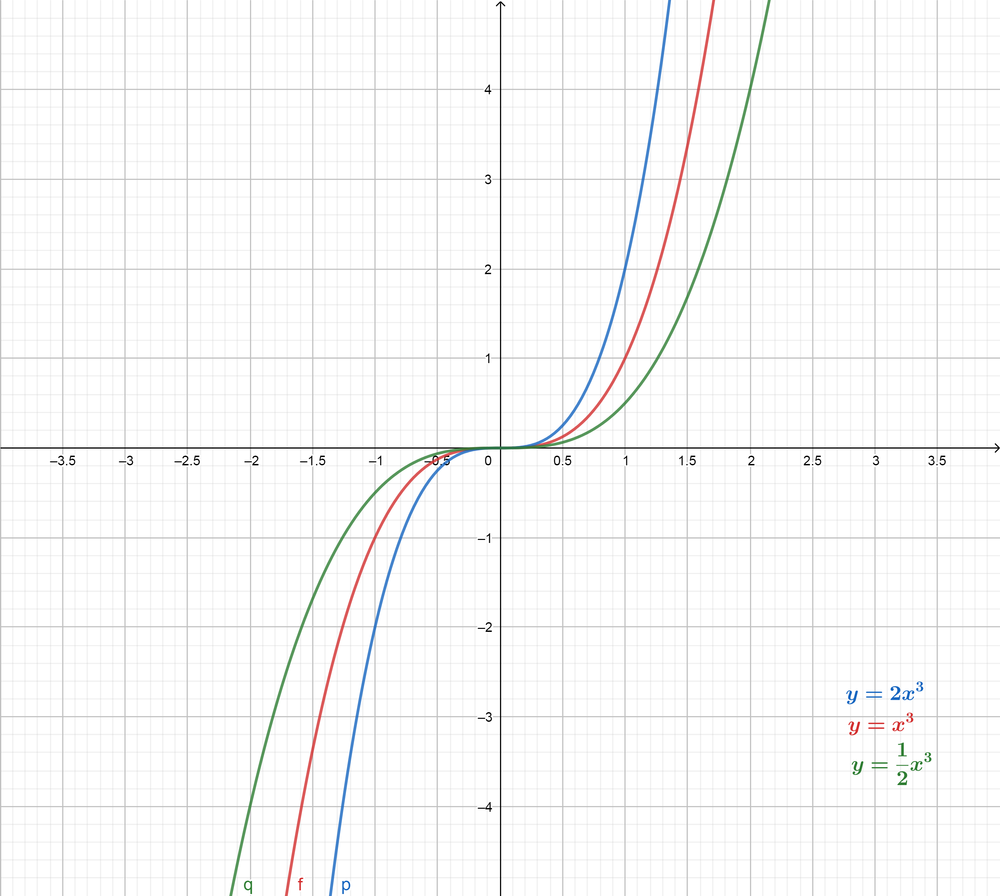
$y’=ax^3$
We can compress the graph vertically by a factor of $dfrac {1}{a}$ by multiplying the term $x^3$ by $dfrac {1}{a}$.
$y’=dfrac {1}{a}(x)^3$
The domain of both original and image graphs is: $(-infty leq x leq infty)$
The range of both original and image graphs is: $(-infty leq y leq infty)$
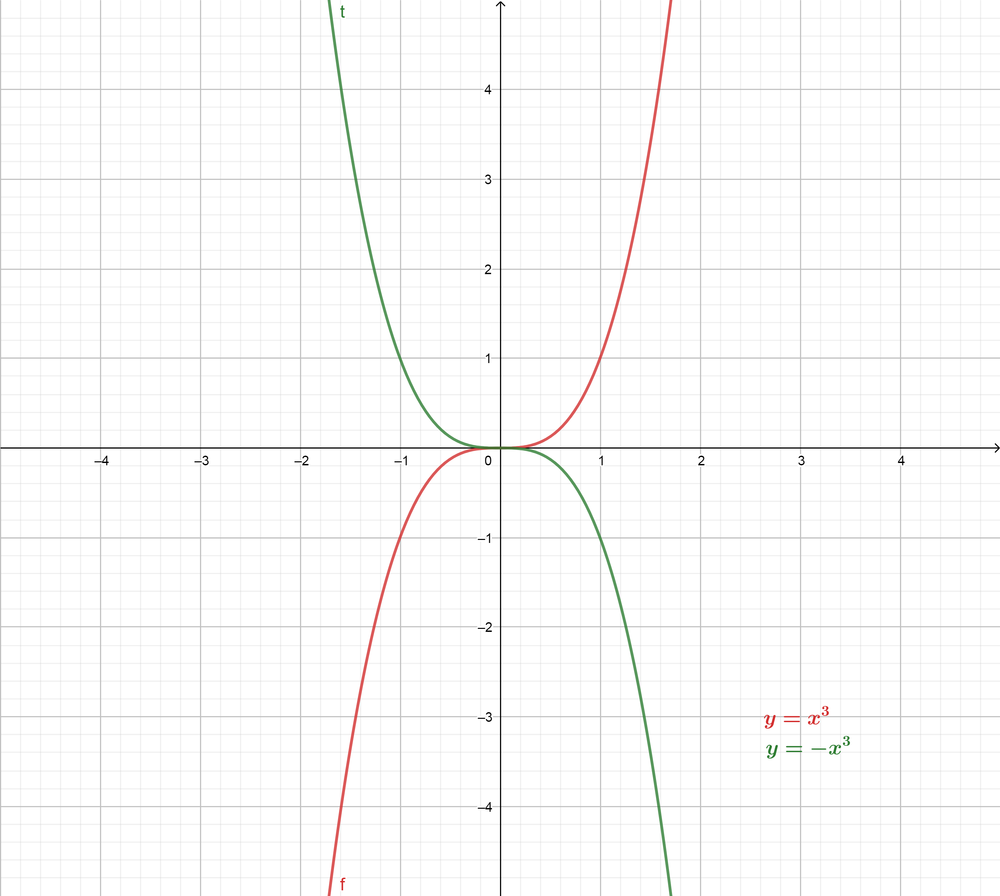
$y’=-x^3$
The domain of both original and image graphs is: $(-infty leq x leq infty)$
The range of both original and image graphs is: $(-infty leq y leq infty)$
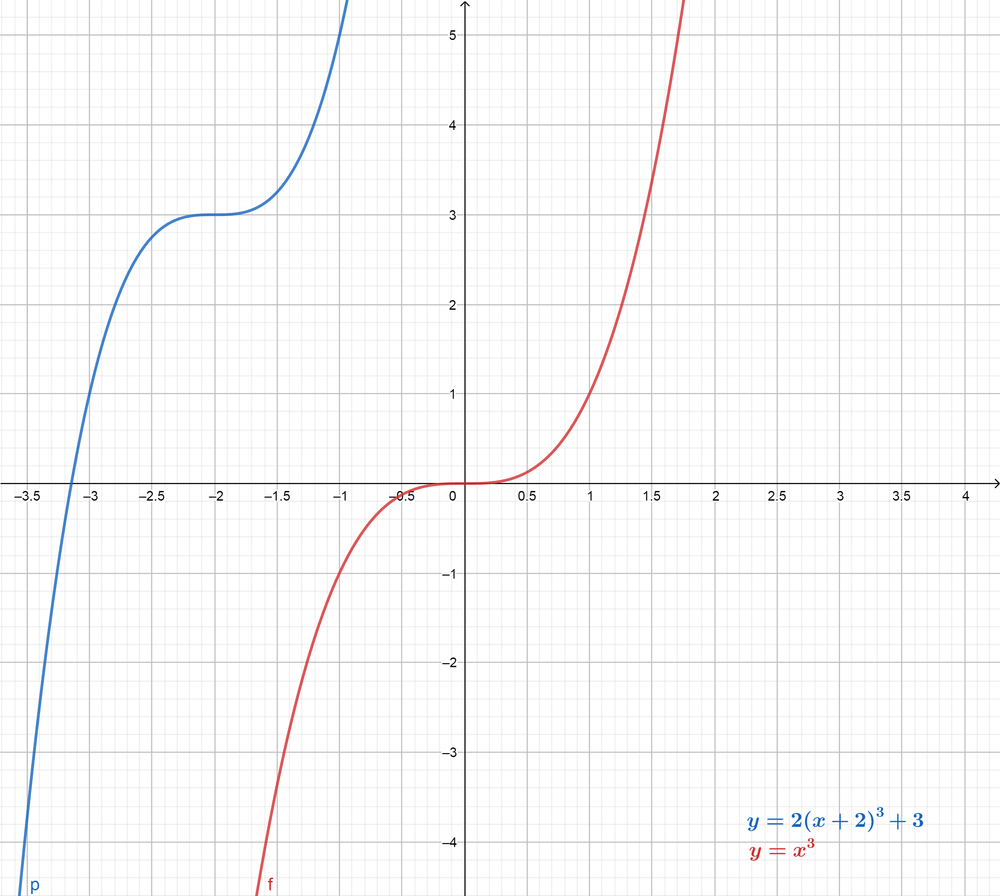
$y=x^3 rightarrow y’=2(x+2)^3+3$
Translating to the right: $y=x^3 rightarrow y’=(x-a)^3$
Translating upwards: $y=x^3 rightarrow y’=x^3+a$
Translating downwards: $y=x^3 rightarrow y’=x^3-a$
Stretching by the factor of $a$: $y=x^3 rightarrow y’=ax^3$
Compressing by the factor of $dfrac {1}{a}$: $y=x^3 rightarrow y’=dfrac {1}{a}x^3$
Flipping vertically: $y=x^3 rightarrow y’=-x^3$
The domain: $(-infty <x < infty)$
The range: $(-infty <x < infty)$
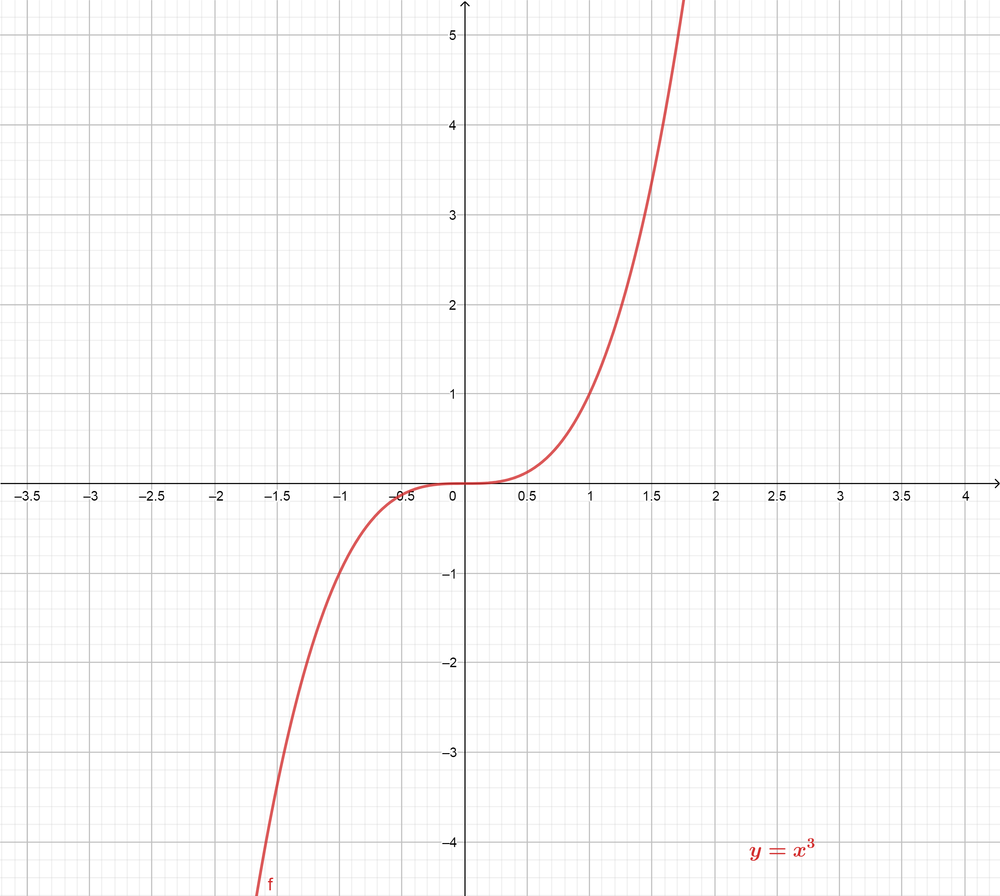
The domain: $(-infty <x < infty)$
The range: $(-infty <x < infty)$
My parent graph is: $y=x^3$.
Shifting the graph left: $y=x^3 rightarrow y’=(x+a)^3$
Shifting the graph right: $y=x^3 rightarrow y’=(x-a)^3$
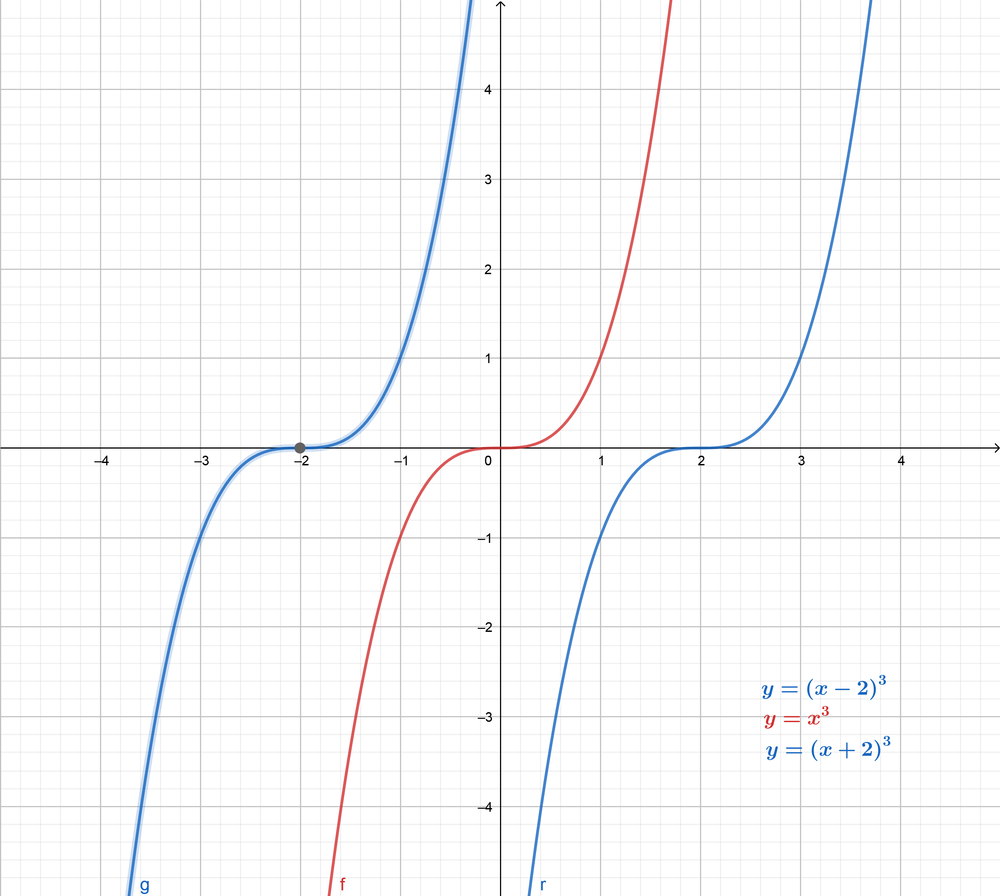
My parent graph is: $y=x^3$.
Shifting the graph up: $y=x^3 rightarrow y’=x^3+a$
Shifting the graph down: $y=x^3 rightarrow y’=x^3-a$
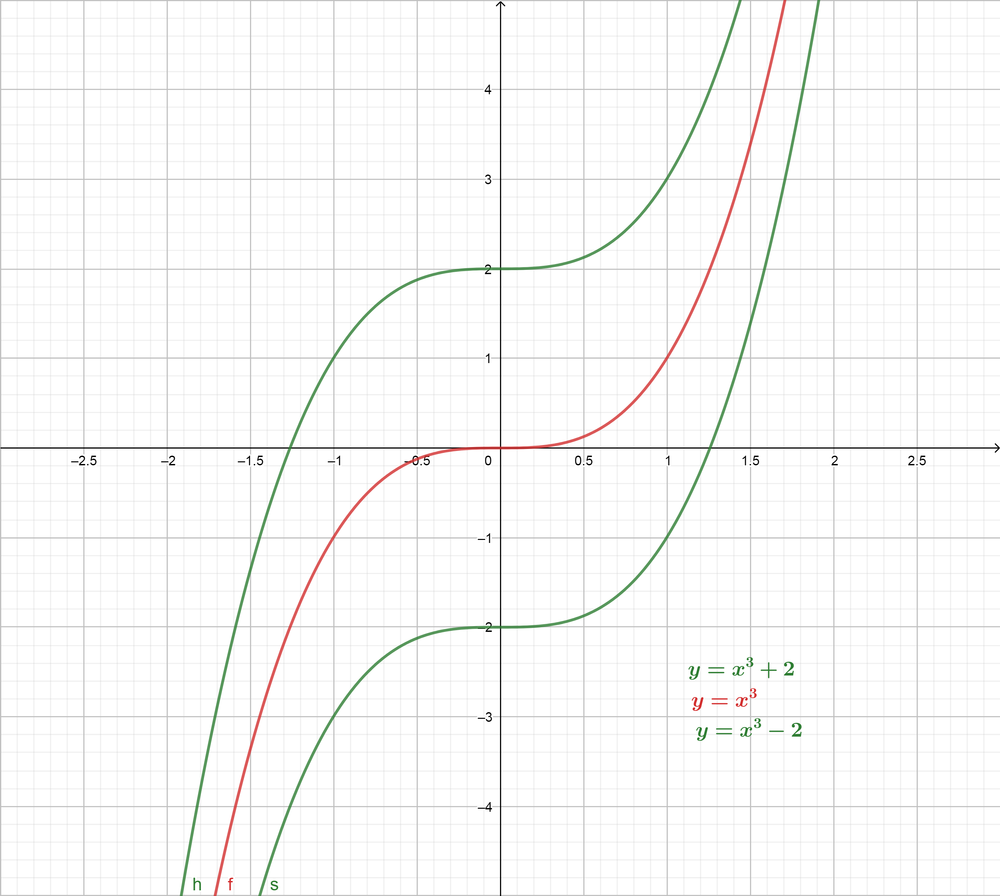
My parent graph is: $y=x^3$.
Stretching the graph : $y=x^3 rightarrow y’=ax^3$
Compressing the graph: $y=x^3 rightarrow y’=dfrac {1}{a}x^3$
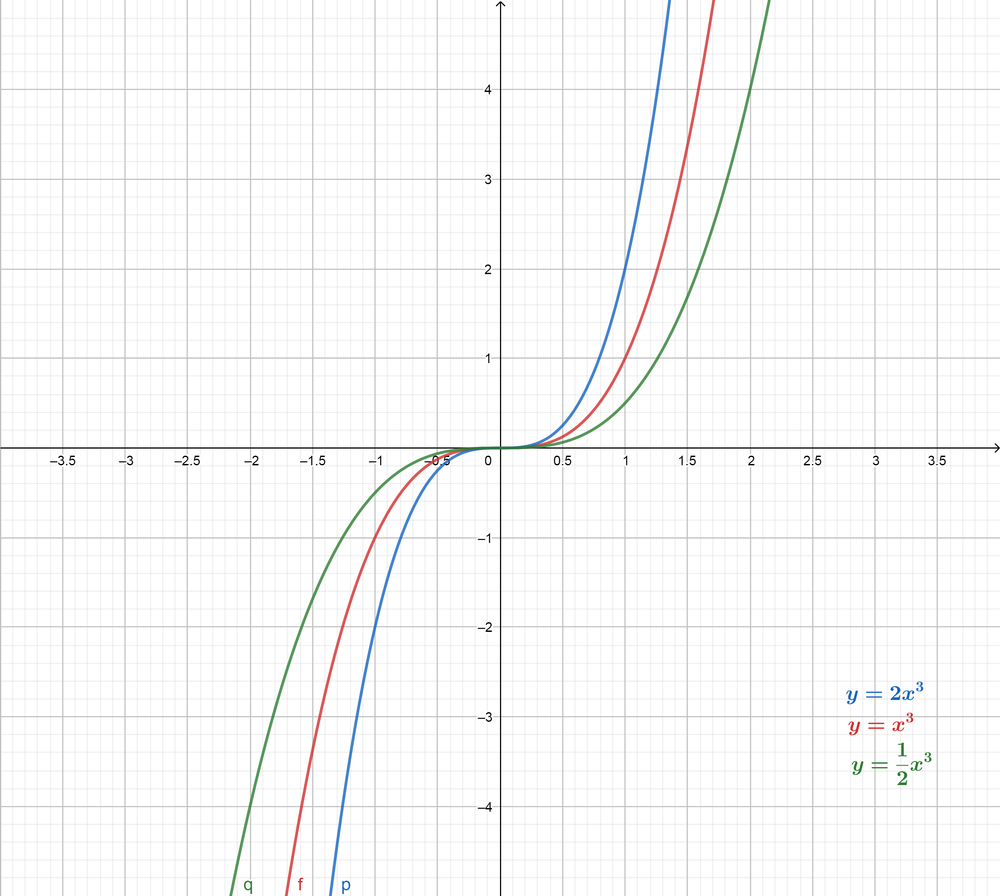
My parent graph is: $y=x^3$.
flipping the graph : $y=x^3 rightarrow y’=-x^3$
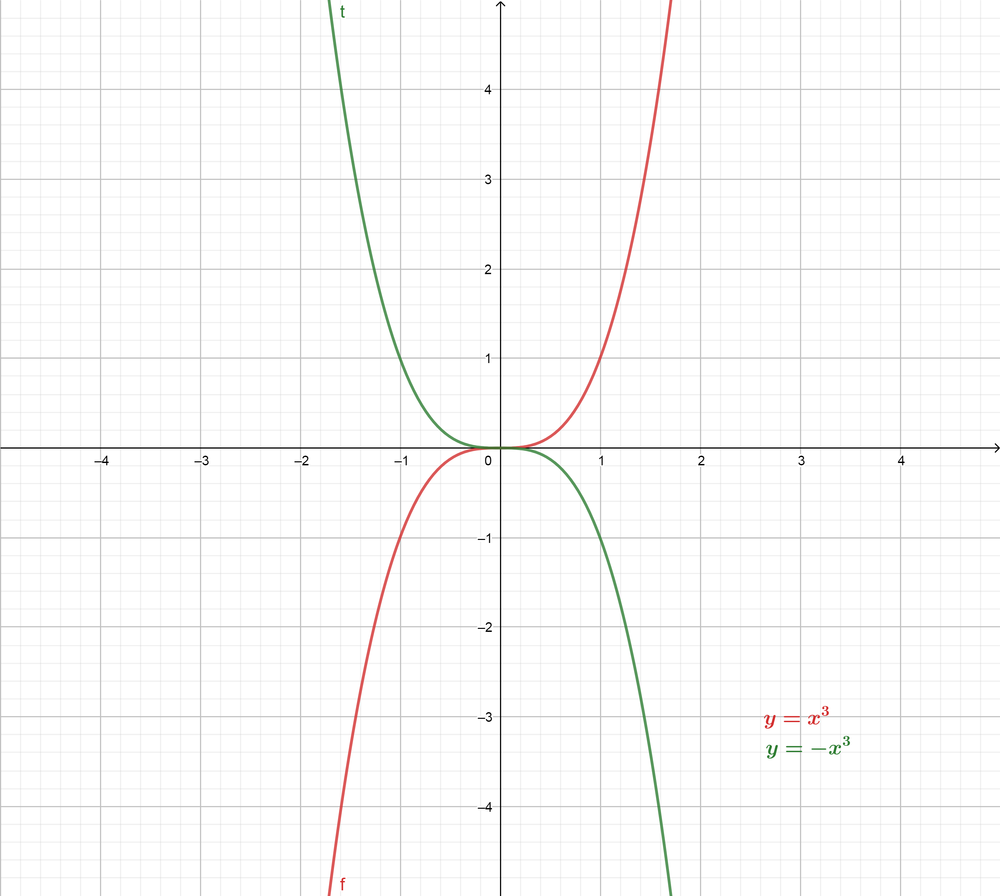
Translating to the right: $y=x^3 rightarrow y’=(x-a)^3$
Translating upwards: $y=x^3 rightarrow y’=x^3+a$
Translating downwards: $y=x^3 rightarrow y’=x^3-a$
Stretching by the factor of $a$: $y=x^3 rightarrow y’=ax^3$
Compressing by the factor of $dfrac {1}{a}$: $y=x^3 rightarrow y’=dfrac {1}{a}x^3$
Flipping vertically: $y=x^3 rightarrow y’=-x^3$
$y=a(x-h)^2+k$ qquad (Graphing form of the equation)\
\
Parameter $a$ represents:\
begin{enumerate}
item The opening direction of the parabola:\
begin{itemize}
item If $a>0$, The parabola opens upward.
item If $a1$, The parabola is stretching.\
item If $a<1$, The parabola is compressed.\
end{itemize}
end{enumerate}
Parameter $h$ represents the x-coordinate of the vertex:\
Parameter $k$ represents the y-coordinate of the vertex:\
$a$ represents the factor of stretch or compress and the opening direction.
$h$ is the horizontal shift.
$k$ is the vertical shift.
$y=x^3 rightarrow y’=a(x-h)^3+k$
$y=dfrac {1}{x} rightarrow y’=a times dfrac {1}{x-h}+k$
$y=sqrt {x} rightarrow y’=a cdot sqrt {x-h}+k$
$y=|x| rightarrow y’=a cdot |x-h|+k$
$y=b^x rightarrow y’=a cdot b^{x-h}+k$
Parameter $h$ represents the x-coordinate of the vertex:
Parameter $k$ represents the y-coordinate of the vertex:
$y=x^3 rightarrow y’=a(x-h)^3+k$
$y=dfrac {1}{x} rightarrow y’=a times dfrac {1}{x-h}+k$
$y=sqrt {x} rightarrow y’=a cdot sqrt {x-h}+k$
$y=|x| rightarrow y’=a cdot |x-h|+k$
$y=b^x rightarrow y’=a cdot b^{x-h}+k$
1. Invite your team.
2. Collect all parent graphs you and your team worked with.
3. Organize work into a large poster and use colors, arrows, and shading to show all of the connections you discover.
The highest point the water reached from the top of the flower is: $8-4=4$ feet.
The point $(5, 4)$ represents the vertex of the graph.
The graphing from of the equation is: $y=a(x-h)^2+k$ where $(h, k)$ is the vertex of the parabola
Substituting for the vertex and the point $(0, 0)$
$0=a(0-5)^2+4$
$25a=-4$
$$
a=-dfrac {4}{25}
$$
The equation is:
$$
y=-dfrac {4}{25}(x-5)^2+4
$$
The domain is: $(0 leq x leq 10)$
The domain is: $(0 leq y leq 4)$
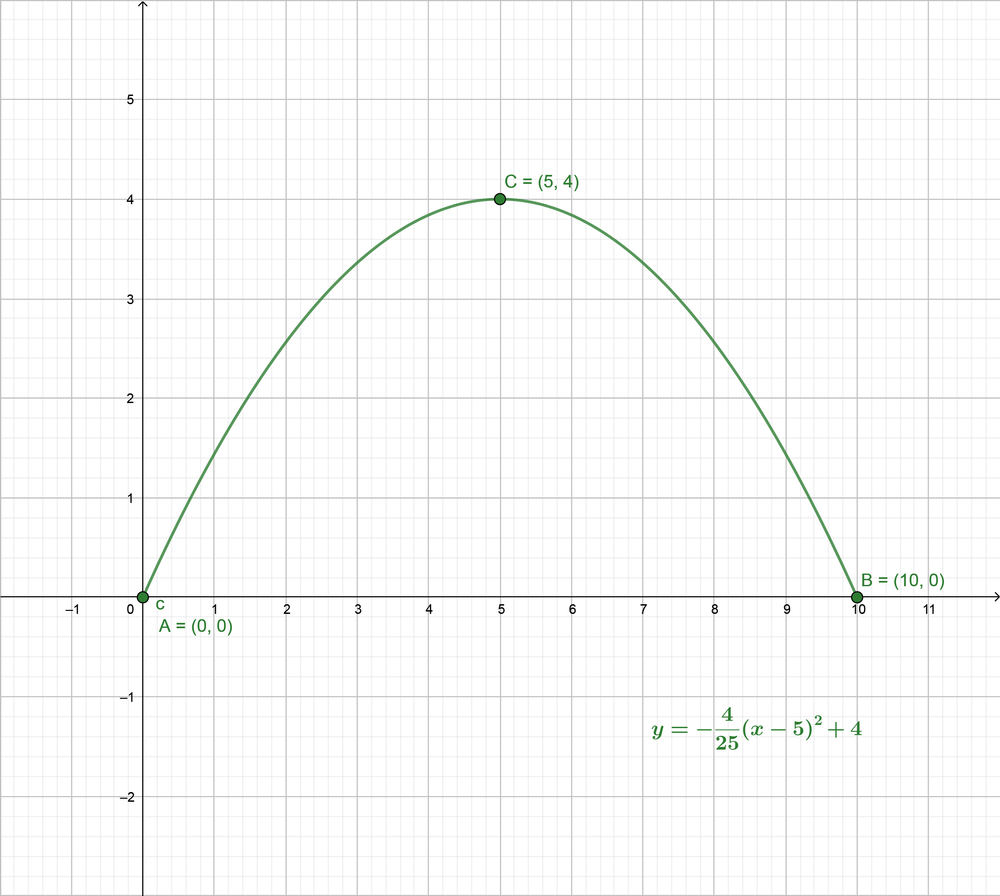
The domain is: $(0 leq x leq 10)$
The domain is: $(0 leq y leq 4)$
$color{#c34632} text{$y=2x^2+3x+1$}$
$$
a)
$$
$bullet,,$For the $x$-intercept(s), set $color{#c34632} text{$,,y=0,,$}$ and solve the resulting equation for $color{#c34632} text{$,,”x”,$}$:
$y=0$
$Rightarrow 2x^2+3x+1=0qquadqquadqquadqquadqquad$ $color{#c34632} text{[$a=2$ , $b=3$ , $c=1$]}$
$color{#c34632} text{Apply the quadratic formula:}$
$color{#c34632} text{$x_{1,2}=dfrac{-b pm sqrt{b^2-4ac}}{2a}$}$
$Rightarrow x_{1,2}=dfrac{-3pm sqrt{3^2-4(2)(1)}}{2(2)}$
$Rightarrow x_{1,2}=dfrac{-3pm sqrt{9-8}}{4}$
$Rightarrow x_{1,2}=dfrac{-3pm sqrt{1}}{4}$
$Rightarrow x_{1,2}=dfrac{-3pm 1}{4}$
$Rightarrow color{#4257b2} text{$x=-1,,,,$}$ or $color{#4257b2} text{$,,,, x=-dfrac{1}{2}$}$
The $x$-intercepts of the graph of this quadratic equation are the points:
$color{#4257b2} text{$big(-1,0big),,$}$ and $color{#4257b2} text{$,,bigg(-dfrac{1}{2} , 0bigg)$}$.
$y=2x^2+3x+1qquadqquadqquadqquadqquadqquadqquad$ $color{#c34632} text{[set $x=0$]}$
$Rightarrow y=2(0)^2+3(0)+1$
$Rightarrow y=0+0+1$
$Rightarrow color{#4257b2} text{$y=1$}$
The $y$-intercept of the graph of this quadratic function is the point $color{#4257b2} text{$,,big(0,1big)$}$.
b)
$$
Given a quadratic equation written in the standard form $color{#c34632} text{$,,y=ax^2+bx+x,,$}$ with $x$-intercepts $color{#c34632} text{$,,(x_{1} , 0),,$}$ and $color{#c34632} text{$,,(x_{2} , 0),,$}$, the axis of symmetry of the graph of this equation is the vertical line:
$color{#c34632} text{$x=dfrac{x_{1}+x_{2}}{2}$}$
$bullet,,$In this case, the $x$-intercepts of the graph of the given equation are the points $color{#c34632} text{$,,big(-1,0big),,$}$ and $color{#c34632} text{$,,bigg(-dfrac{1}{2} ,,, 0bigg),,$}$ so the axis of symmetry of this parabola is the line:
$x=dfrac{-1+bigg(-dfrac{1}{2}bigg)}{2}$
$Rightarrow x=dfrac{-1-dfrac{1}{2}}{2}$
$Rightarrow x=dfrac{-3/2}{2}$
$Rightarrow x=-dfrac{3}{4}$
$Rightarrow color{#4257b2} text{$x=-0.75$}qquadqquadqquadqquadqquad$ $color{#4257b2} text{The axis of symmetry}$
c)
$$
$bullet,,$Given a quadratic function written in the standard form $color{#c34632}text{$,,f(x)=ax^2+bx+c,,$}$ the vertex of the graph of this function is the point:
$color{#c34632} text{$bigg(-dfrac{b}{2a} ,,, fbigg(-dfrac{b}{2a}bigg)bigg)$}$
$bullet,,$In this case for the given quadratic function we have, $color{#4257b2} text{$,,a=2$}$ , $color{#4257b2} text{$b=3$}$ ,$color{#4257b2} text{ $c=1$}$ so:
$bullet,,-dfrac{b}{2a}=-dfrac{3}{2(2)}=color{#4257b2}text{$-dfrac{3}{4}$}$
$bullet,, fbigg(-dfrac{3}{4}bigg)=2bigg(-dfrac{3}{4}bigg)^2+3bigg(-dfrac{3}{4}bigg)+1$
$Rightarrow fbigg(-dfrac{3}{4}bigg)=dfrac{18}{16}-dfrac{9}{4}+1$
$Rightarrow fbigg(-dfrac{3}{4}bigg)=dfrac{18-36+16}{16}$
$Rightarrow fbigg(-dfrac{3}{4}bigg)=-dfrac{2}{16}$
$Rightarrow color{#4257b2} text{$fbigg(-dfrac{3}{4}bigg)=-dfrac{1}{8}$}$
$bullet,,$Finally the vertex of the graph of this quadratic function is the point:
$color{#4257b2} text{$bigg(-dfrac{3}{4} ,,, -dfrac{1}{8}bigg)$}$
$bullet,,$The graph of this function is shown in the picture below:
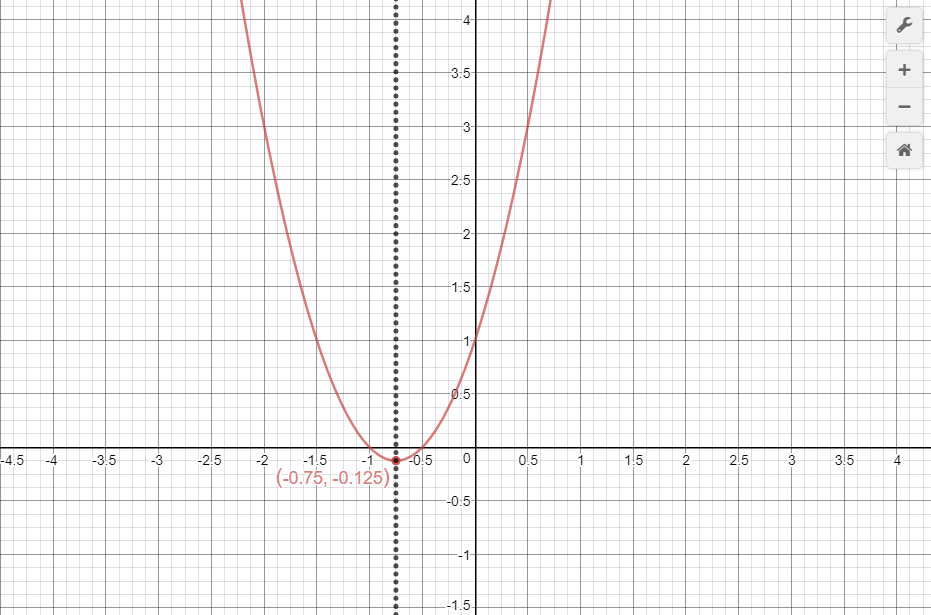
The vertex is $(-dfrac {3}{4}, qquad -dfrac {1}{8})$
To change the equation so that the parabola had only one x-intercept, we translate the equation upwards by the value of the y-coordinate of the vertex $dfrac {1}{8}$
$y’=y+dfrac {1}{8}$
$$
y’=2x^2+3x+1.125
$$
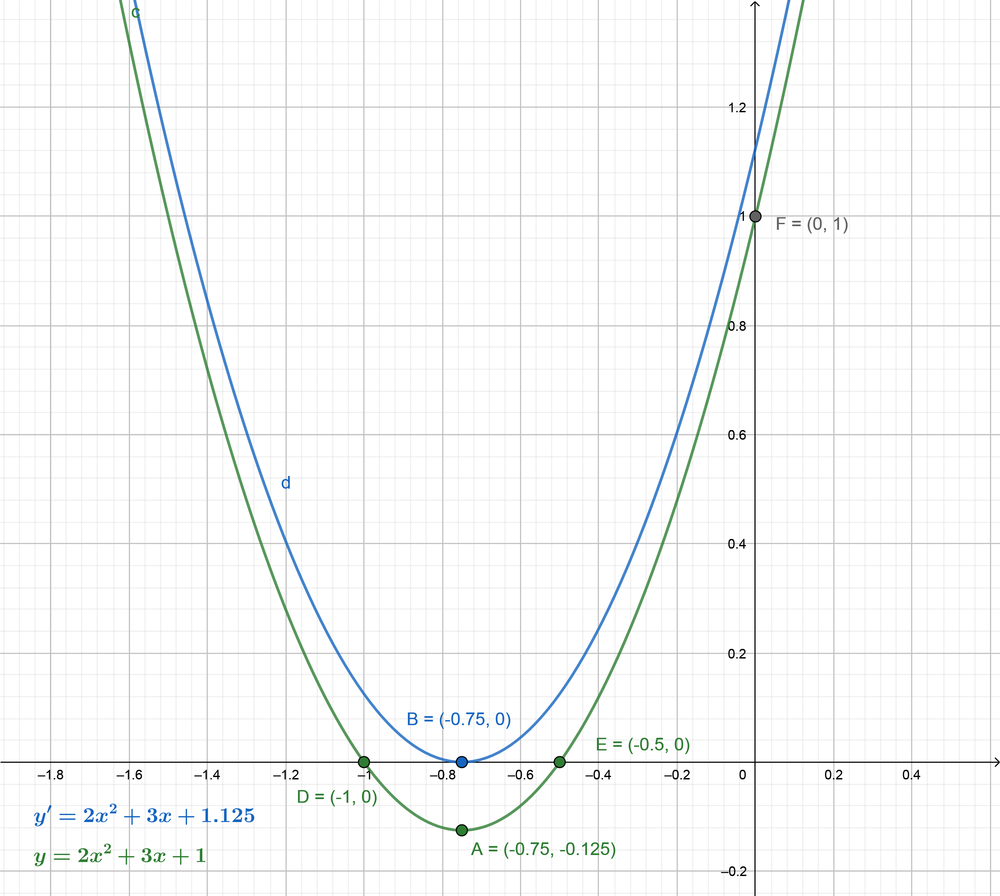
y’=2x^2+3x+1.125
$$
$$
begin{align*}
&text{a.} hspace{3mm} sqrt{50} = sqrt{25 cdot 2} =sqrt{25} cdot sqrt{2} = color{#c34632} 5sqrt{2}, \ \
&text{b.} hspace{3mm} sqrt{72} = sqrt{36 cdot 2} =sqrt{36} cdot sqrt{2} = color{#c34632} 6sqrt{2}, \ \
&text{c.} hspace{3mm} sqrt{45} = sqrt{9 cdot 5} =sqrt{9} cdot sqrt{5} = color{#c34632} 3sqrt{5}.
end{align*}
$$
text{a.} hspace{2mm} sqrt{50}=5sqrt{2} hspace{10mm} text{b.} hspace{2mm} sqrt{72}=6sqrt{2} hspace{10mm} text{c.} hspace{2mm} sqrt{45}=3sqrt{5}
$$
The appropriate unit of time is: Years.
The multiple that should be used is: $1-0.11=0.89$
The initial value is: $12,250
The equation is:
$$
f(x)=12,250 (0.89)^x
$$
The appropriate unit of time is: Years.
The multiple that should be used is: 1.06
The initial value is: $1000
The equation is:
$$
f(x)=1000 (1.06)^x
$$
b- $f(x)=1000 (1.06)^x$
The torn receipt shows that 18 pounds costs $92.07\
The price of the Colombian beans $4.89 per pound\
The price of the Mocha Java beans $5.43 per pound\
\
We can write the following linear system\$c+m=18 rightarrow c=18-m$\$4.89c+5.43m=92.07$\
\$4.89(18-m)+5.43m=92.07$\$88.02-4.89m+5.43m=92.07$\$0.54m=92.07-88.02$\$54m=405$\$ $m=7.5$ c+7.5=18$\$ $c=10.5$$
The domain is all real numbers
$$
color{#4257b2} D: -infty<x<infty.
$$
We match this domain with the graph number one $1)$ which is seen below.
The range of this function are all real number smaller than $3$
$$
color{#c34632} R: y leq 3 .
$$
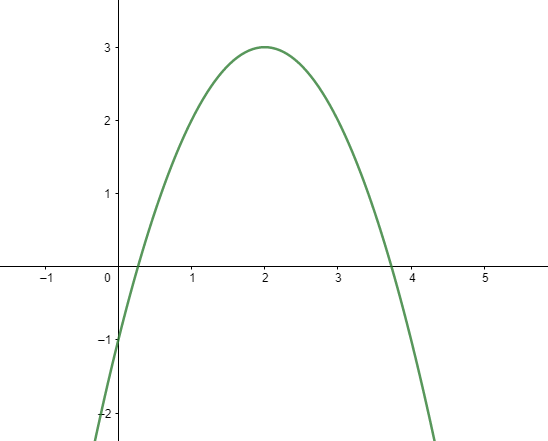
The domain is all real numbers bigger than $-2$
$$
color{#4257b2} D: x>-2.
$$
We match this domain with the graph number one $3)$ which is seen below.
The range of this function are all real number bigger than $0$
$$
color{#c34632} R: y > 0.
$$
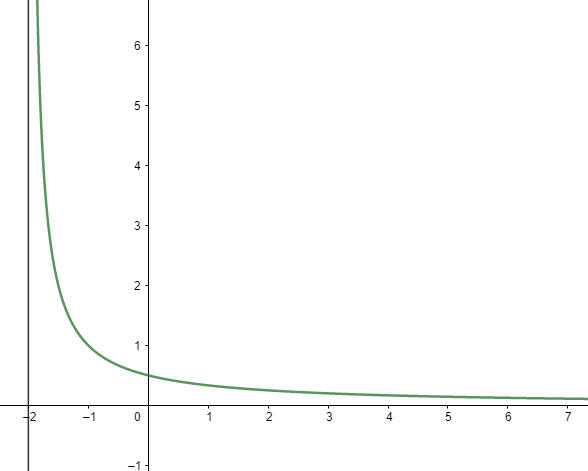
The domain is all real numbers smaller than $3$ including $3$
$$
color{#4257b2} D: xleq 3.
$$
We match this domain with the graph number one $2)$ which is seen below.
The range of this function are all real numbers than $0$
$$
color{#c34632} R: -infty <y<infty.
$$
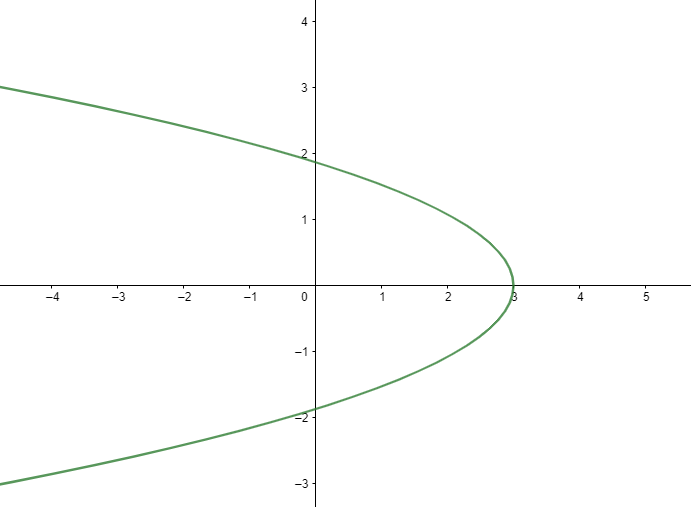
b. We match the domain with graph number 3) and the range is $y >0$.
c. We match the domain with graph number 2) and the range is $y in bold{R}$.
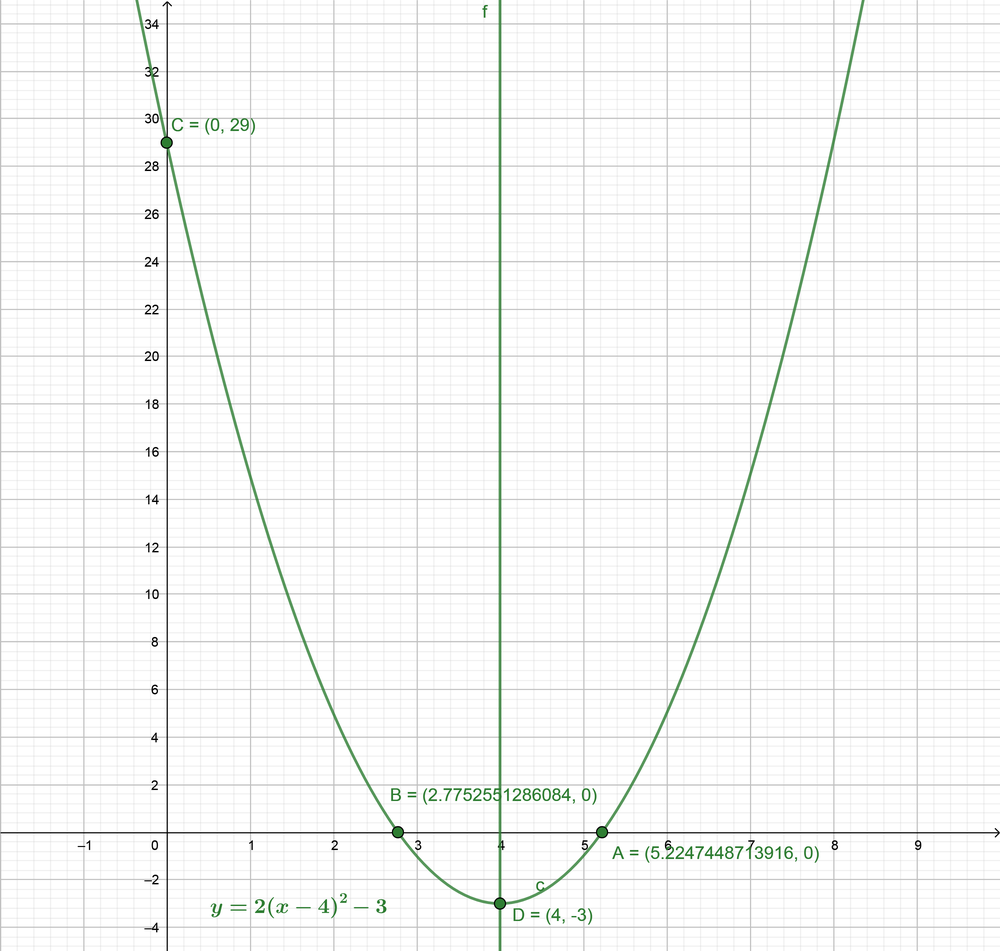
The equation is in the vertex form, the vertex is the point $(4, -3)$
The line of symmetry is the vertical line that passes the vertex. So, the equation of the line of symmetry is:
$$
x=4
$$
Initial valuein 1960: $a=1.665 cdot 10^{12}$
Annual growth rate: $r=%3.17$
Years form 1960 to 1989 $=29$ years.
$G(29)=1.665 cdot 10^{12} cdot (1.0317)^{29}$
$G(29)=4.1159 cdot 10^{12}$
Gross National Product in 1989: $=4.1159 cdot 10^{12}$
The equation that represents the GNP $t$ years after 1960
$$
G(t)=1.665 cdot 10^{12} cdot (1.0317)^t
$$
GNP depends on may factors that are not constants. So, it is not possible that the rate of growth remains constant.
b- The equation of the GNP $t$ years after 1960 is $G(t)=1.665 cdot 10^{12} cdot (1.0317)^t$
c- The rate of growth does not remain constant.
a) $sqrt{24}=$
$=sqrt{4cdot 6}=qquadqquadqquadqquadqquadquad$ $color{#c34632} text{[recall: $sqrt{acdot b}=sqrt{a}cdot sqrt{b}$]}$
$=sqrt{4}cdot sqrt{6}=$
$=color{#4257b2} text{$2sqrt{6}$}$
b) $sqrt{18}=$
$=sqrt{9cdot 2}=qquadqquadqquadqquadqquadquad$ $color{#c34632} text{[recall: $sqrt{acdot b}=sqrt{a}cdot sqrt{b}$]}$
$=sqrt{9}cdot sqrt{2}=$
$=color{#4257b2} text{$3sqrt{2}$}$
c) b) $sqrt{3}+sqrt{3}=$
$=color{#4257b2}text{$2sqrt{3}$}$
d) $sqrt{27}+sqrt{12}=$
$=sqrt{9cdot 3}+sqrt{4cdot 3}=qquadqquadqquadqquad$ $color{#c34632} text{[recall: $sqrt{acdot b}=sqrt{a}cdot sqrt{b}$]}$
$=sqrt{9}cdot sqrt{3}+sqrt{4}cdot sqrt{3}=$
$=3sqrt{3}+ 2sqrt{3}=$
$=color{#4257b2} text{$5sqrt{3}$}$
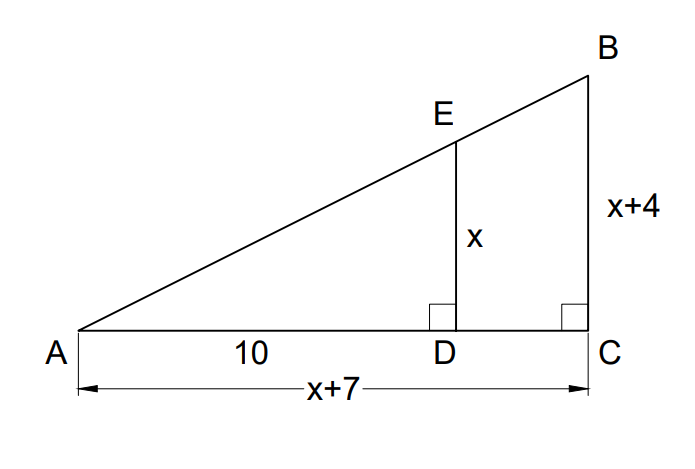
Let us calculate $x$. Since we know that in the diagram below
$$
triangle ABC sim triangle AED
$$
we conclude that the corresponding sides are in the same proportion. Therefore we write
$$
frac{AC}{AD} = frac{BC}{ED} = frac{AB}{AE} implies frac{x+7}{10} = frac{x+4}{x}.
$$
Now we solve for $x$. We have
$$
begin{align*}
frac{x+7}{10} = frac{x+4}{x} implies x cdot (x+7) &= 10 cdot (x+4) \ x^2 +7x &= 10x +40 \ x^2+7x-10x-40&=0 \
x^2-3x-40 &=0 \ x^2 -8x+5x-40 &=0 \ x cdot (x-8) +5 cdot (x-8) &= 0 \ (x+5)(x-8) &=0 \ x+5=0 vee x-8 &=0.
end{align*}
$$
This is a quadratic equation. We can use the quadratic formula to solve it or we can factorize the function on the left. Let us factorize it . We have
$$
begin{align*}
x^2-3x-40 &=0 \ x^2 -8x+5x-40 &=0 \ x cdot (x-8) +5 cdot (x-8) &= 0 \ (x+5)(x-8) &=0 \ x+5=0 vee x-8 &=0 \ x=-5vee x &=8.
end{align*}
$$
Since $x$ is the length of the triangle side the only solution is
$$
color{#c34632} x=8.
$$
Let us now calculate the perimeter of the $triangle AED$. We have
$$
AD= 10 hspace{5mm} text{and} hspace{5mm} ED = x= 8.
$$
We can use the Pythagorean theorem and calculate the length of $AE$. This yields
$$
begin{align*}
AE &= sqrt{AD^2 + ED^2} \ AE &= sqrt{10^2+8^2} \ AE &=sqrt{100+64} \text{AE} &=sqrt{164} approx 12,8.
end{align*}
$$
Now we calculate the perimeter of the triangle
$$
AD+ED+AE = 10+8+12,8=30,8.
$$
Therefore, the perimeter of the $triangle AED$ is
$$
color{#c34632} 30,8.
$$
b. The perimeter of $triangle AED$ is $30,8$.
$$
color{#4257b2} y=-frac{1}{3}x +5.
$$
First, let us write the equation of the perpendicular line to the given line. We need to find the equation
$$
y=k cdot x+n.
$$
We can find the coefficient $k$ using the fact that the two lines are perpendicular. We have
$$
k=-frac{1}{-frac{1}{3}} = 3.
$$
In order to find $n$ we use the fact that our wanted line passes through $(5,10)$. We substitute $k=3$, $x=5$ and $y=10$ and get
$$
10=3 cdot 5 +n implies 10=15+n implies n=10-15 = -5.
$$
Therefore, the equation of the perpendicular line to the line $y=-frac{1}{3}x +5$ which goes through $(5,10)$ is
$$
color{#c34632} y=3x -5.
$$
$$
y=-frac{1}{3}x +5 hspace{5mm} text{and} hspace{5mm} y=3x-5
$$
and on the graph given below see that the two lines intersect at point $(3, 4)$. The distance from the point $(5,10)$ to the line $y=-frac{1}{3}x +5$ is now the distance between the points $(3, 4)$ and $(5, 10)$. We use the formula
$$
d=sqrt{(x_2-x_1)^2+(y_2-y_1)^2}
$$
and get
$$
begin{align*}
d &=sqrt{(5-3)^2+(10-4)^2} = sqrt{2^2+6^2} =sqrt{4+36} \ &= sqrt{40}=sqrt{4 cdot 10} = 2sqrt{10} approx 6,3.
end{align*}
$$
Therefore, the distance from the point $(5,10)$ to the line $y=-frac{1}{3}x +5$ is $color{#c34632} 2sqrt{10} approx 6,3$.
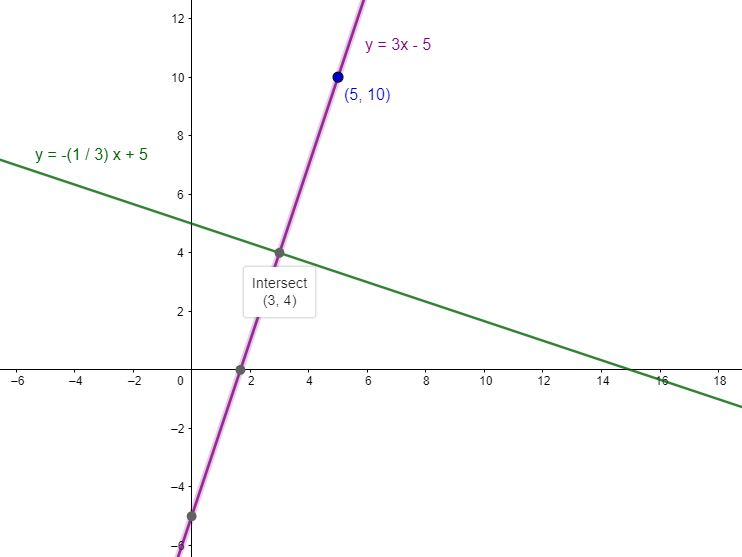
Consider the given equation
$$
color{#4257b2} 2^z=2^3.
$$
Since the base is the same, we can conclude that the exponents must be equal too. Hence, we have
$$
color{#c34632} z=3.
$$
Consider the given equation
$$
color{#4257b2} 4^z=8.
$$
Since the bases are not the same, we have to transform the equation so that they become the same. Since $4=2^2$ and $8=2^3$ we write
$$
(2^2)^z=2^3 implies 2^{2z}=2^3.
$$
Now we can conclude that the exponents must be equal. Hence, we have
$$
2z=3 implies color{#c34632} z=frac{3}{2}.
$$
Consider the given equation
$$
color{#4257b2} 3^z=81^2.
$$
Since the bases are not the same, we have to transform the equation so that they become the same. Since $81=3^4$ we write
$$
3^z = (3^4)^2 implies 3^z=3^8.
$$
Now we can conclude that the exponents must be equal. Hence, we have
$$
color{#c34632} z=8.
$$
Consider the given equation
$$
color{#4257b2} 5^{(z+1)/3}=25^{1/z}.
$$
Since the bases are not the same, we have to transform the equation so that they become the same. Since $25=5^2$ we write
$$
5^{(z+1)/3}=(5^2)^{1/z} implies 5^{(z+1)/3}=5^{2/z}.
$$
Now we can conclude that the exponents must be equal. Hence, we have
$$
begin{align*}
frac{z+1}{3} = frac{2}{z} implies z cdot (z+1) &= 2 cdot 3 \ z^2+z &=6 \ z^2+z-6 &=0.
end{align*}
$$
Since the expression of the left is a quadratic function we can use the quadratic formula
$$
z = frac{-b pm sqrt{b^2-4ac}}{2a}.
$$
We have
$$
a=1 hspace{12mm} b=1 hspace{12mm} c=-6.
$$
Hence, we have
$$
begin{align*}
z &= frac{-1 pm sqrt{1^2-4 cdot 1 cdot (-6)}}{2 cdot 1} \
z &= frac{-1 pm sqrt{1+24}}{2} \
z &= frac{-1 pm sqrt{25}}{2} \
z &= frac{-1 + sqrt{25}}{2} hspace{3mm} text{or} hspace{3mm} frac{1 – sqrt{25}}{2} \
z &= frac{-1 + 5}{2} hspace{3mm} text{or} hspace{3mm} frac{-1 – 5}{2} \
z &= frac{4}{2} hspace{3mm} text{or} hspace{3mm} frac{-6}{2} \
z &=2 hspace{3mm} text{or} hspace{3mm} -3
end{align*}
$$
Therefore, the solutions are
$$
color{#c34632} z=-3 hspace{3mm} text{color{default}or} hspace{3mm} z=2.
$$
begin{align*}
&text{a.} hspace{3mm} z=3 \
&text{b.} hspace{3mm} z=frac{3}{2} \
&text{c.} hspace{3mm} z=8 \
&text{d.} hspace{3mm} z=-3 hspace{3mm} text{color{default}or} hspace{3mm} z=2 \
end{align*}
$$
$y=3x^2+5$
The locator point is $(0, 5)$
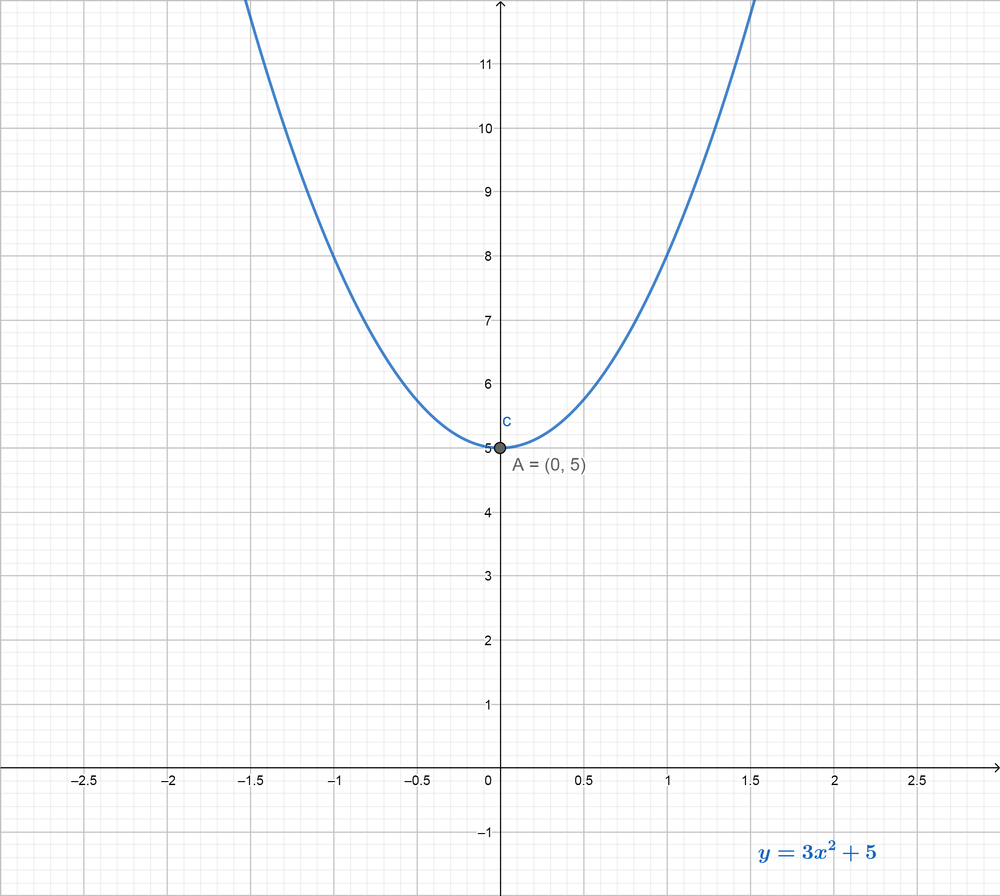
$y=-(x-3)^2-7$
The locator point is $(3, -7)$
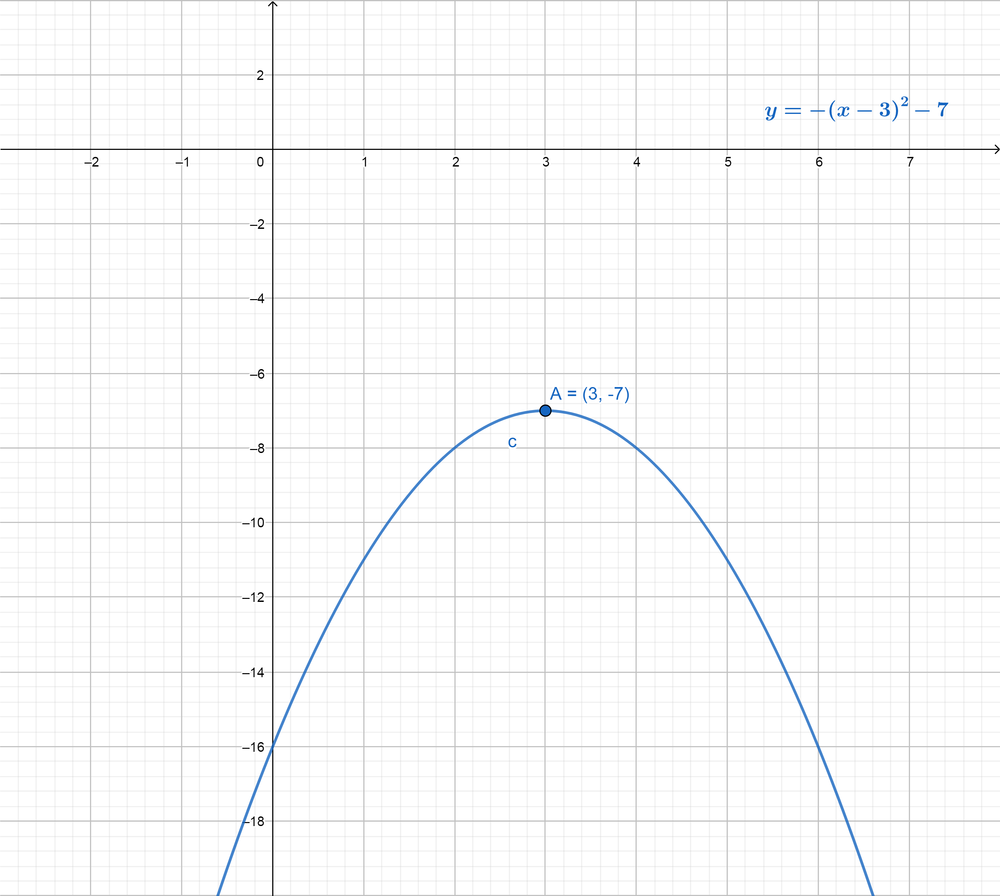
b- The locator point is $(3, -7)$
y=dfrac{1}{x+2}
$$
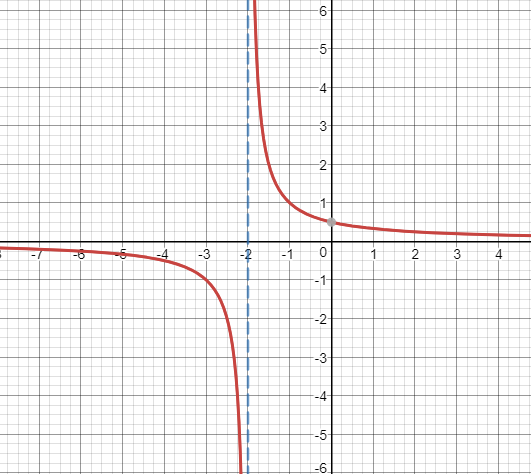
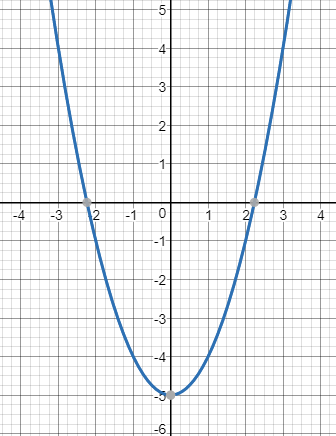
y=x^2-5
$$
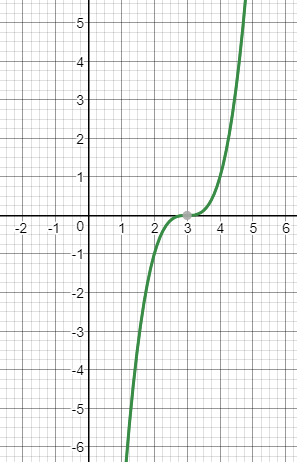
y=(x-3)^3
$$
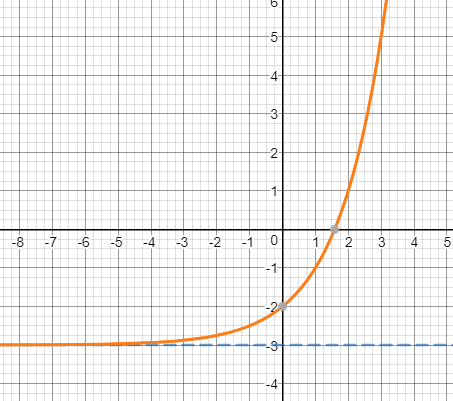
y=2^x-3
$$
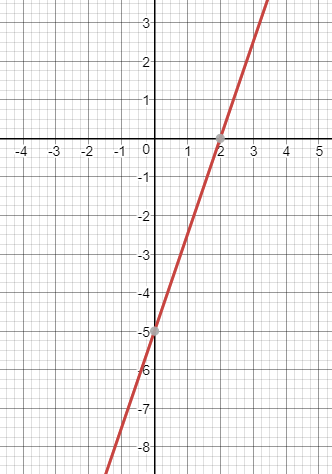
$dfrac{y}{-5}=dfrac{x-2}{-2}$
$-2y=-5(x-2)$
$$
y=dfrac{5(x-2)}{2}
$$
y=(x+2)^3+3
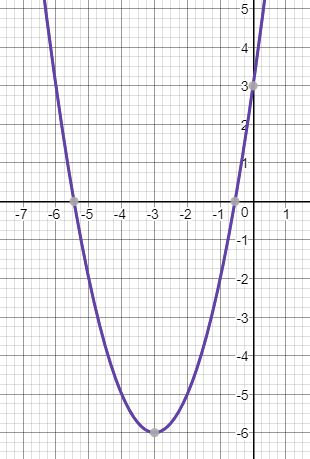
$$
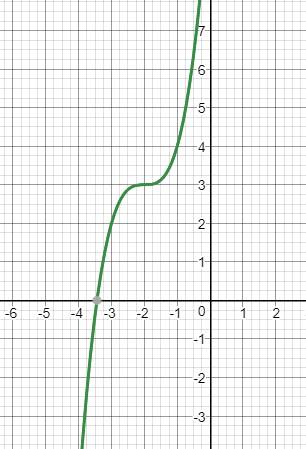
y=(x+3)^2-6
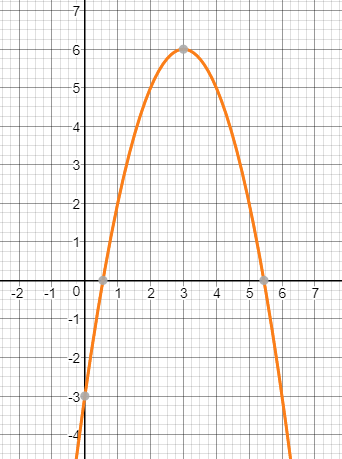
$$
y=-(x-3)^2+6
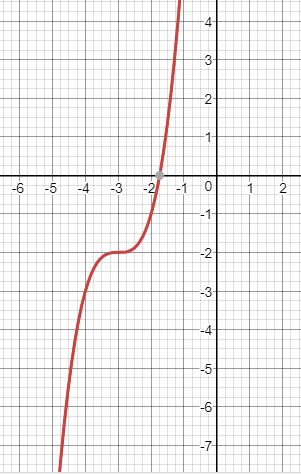
$$
y=(x+3)^3-2
$$
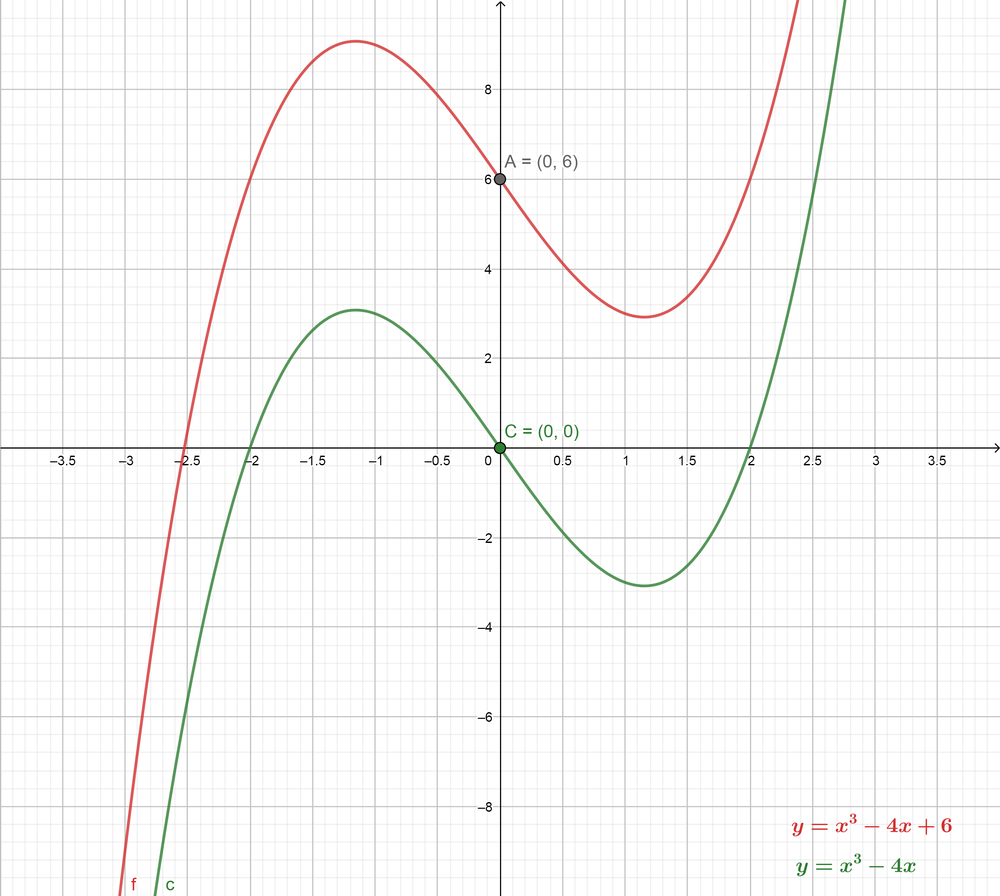
$$
a)
$$
$color{#c34632} text{[1]}$ $quad y=5x-2$
$color{#c34632} text{[2]}$ $quad y=3x+18$
$bullet,,$In the equation $color{#c34632} text{[2]}$ substitute $color{#c34632} text{$,,”y”,,$}$ by $color{#c34632} text{$,,5x-2,,$}$ and solve for $color{#c34632} text{$,,”x”,,$}$ as shown:
$y=3x+18qquadqquadqquadqquadqquadqquad$ $color{#c34632} text{[set $y=5x-2$]}$
$Rightarrow 5x-2=3x+18qquadqquadqquadqquadquad$ $color{#c34632} text{[match like terms]}$
$Rightarrow 5x-3x=18+2$
$Rightarrow 2x=20qquadqquadqquadqquadqquadqquad$ $color{#c34632} text{[divide both sides by $2$]}$
$Rightarrow color{#4257b2} text{$x=10$}$
$bullet,,$In the equation $color{#c34632} text{[1]}$ set $color{#c34632} text{$,,x=10,,$}$ and solve for $color{#c34632} text{$,,”y”,,$}$ as shown below:
$y=5x-2qquadqquadqquadqquadqquadqquad$ $color{#c34632} text{[set $x=10$]}$
$Rightarrow y=5(10)-2$
$Rightarrow y=50-2$
$Rightarrow color{#4257b2} text{$y=48$}$
$bullet,,$As we can see the solution of this linear system is the ordered pair $color{#4257b2} text{$,,(10, 48),,$}$ so these two lines intersect at the point $color{#4257b2} text{$,,(10 , 48)$}$.
b)
$$
$color{#c34632} text{[1]}$ $quad y=x-4$
$color{#c34632} text{[2]}$ $quad 2x+3y=17$
$bullet,,$In the equation $color{#c34632} text{[2]}$ substitute $color{#c34632} text{$,,”y”,,$}$ by $color{#c34632} text{$,,x-4,,$}$ and solve for $color{#c34632} text{$,,”x”,,$}$ as shown:
$2x+3y=17qquadqquadqquadqquadqquadqquadquad$ $color{#c34632} text{[set $y=x-2$]}$
$Rightarrow 2x+3(x-4)=17qquadqquadqquadqquadquad$
$Rightarrow 2x+3x-12=17qquadqquadqquadqquadqquad$ $color{#c34632} text{[add $12$ in both sides]}$
$Rightarrow 5x=29qquadqquadqquadqquadqquadqquadqquad$ $color{#c34632} text{[divide both sides by $5$]}$
$Rightarrow color{#4257b2} text{$x=dfrac{29}{5}$}$
$bullet,,$In the equation $color{#c34632} text{[1]}$ set $color{#c34632} text{$,,x=dfrac{29}{5},,$}$ and solve for $color{#c34632} text{$,,”y”,,$}$ as shown below:
$y=x-4qquadqquadqquadqquadqquadqquadqquad$ $color{#c34632} text{[set $x=frac{29}{5}$]}$
$Rightarrow y=dfrac{29}{5}-4$
$Rightarrow y=dfrac{29}{5}-dfrac{20}{5}$
$Rightarrow y=dfrac{29-20}{5}$
$Rightarrow color{#4257b2} text{$y=dfrac{9}{5}$}$
$bullet,,$As we can see the solution of this linear system is the ordered pair $color{#4257b2} text{$,,bigg(dfrac{29}{5} ,,, dfrac{9}{5}bigg),,$}$ so these two lines intersect at the point $color{#4257b2} text{$,,bigg(dfrac{29}{5} ,,, dfrac{9}{5}bigg)=big(5.8,,,1.8big),,$}$.
$$
60 = frac{BC cdot AC}{2} implies frac{12 AC}{2} = 60 implies 6AC=60 implies AC=10.
$$
Therefore, the length of the side $AC$ is $10$cm. Let us now calculate the hypotenuse of the $triangle ABC$. We have
$$
BC= 12 hspace{5mm} text{and} hspace{5mm} AC = 10.
$$
We can use the Pythagorean theorem and calculate the length of $AB$. This yields
$$
begin{align*}
AB &= sqrt{AC^2 + BC^2} \ AB &= sqrt{10^2+12^2} \ AB &=sqrt{100+144} \ AB &=sqrt{244} approx 15,62.
end{align*}
$$
Therefore, the length of the hypotenuse is
$$
color{#c34632} AB=15,62 text{cm}.
$$
Let us calculate $measuredangle B$. We use trigonometric rations and get
$$
tan measuredangle B = frac{text{opposite leg}}{text{adjacent leg}} = frac{AC}{BC} = frac{10}{12}=0,833.
$$
Therefore,
$$
measuredangle B = arctan {0,83} = 39,8^{circ}.
$$
We can conclude
$$
color{#c34632} measuredangle B=39,8^{circ}.
$$
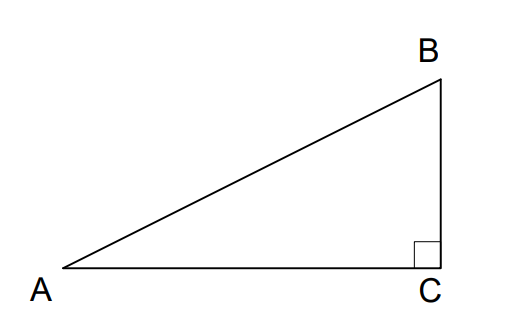
measuredangle B=39,8^{circ} hspace{5mm} text{and} hspace{5mm} AB=15,62text{cm}
$$
$(dfrac {1}{81})^{dfrac {-1}{4}}$ (Write the equation)
$=left((dfrac {1}{3})^4right)^{dfrac {-1}{4}}$ (Quotient of power property)
$=left(dfrac {1}{3}right)^{-1}$ (Product of power property)
$left(dfrac {1}{3}right)^{-1}=3$
$x^{-2}y^{-4}$ (Write the equation)
$=x^{-2} times y^{-4}$
$dfrac {1}{x^2} times dfrac {1}{y^4}$ (Negative power property)
$(2x)^{-2}(16x^2y)^{dfrac {1}{2}}$ (Write the equation)
$=2^{-2} cdot x^{-2} cdot 2^{dfrac {4}{2}} cdot x^{dfrac {2}{2}} cdot y^{dfrac {1}{2}}$ (Product of power property)
$=2^{(2-2)} cdot x^{(1-2)} cdot y^{dfrac {1}{2}}$ (Grouping similar terms)
$=1 cdot x^{-1} cdot y^{dfrac {1}{2}}$
$$
=dfrac {sqrt y}{x}
$$
b- $x^{-2}y^{-4}=dfrac {1}{x^2} times dfrac {1}{y^4}$
c- $(2x)^{-2}(16x^2y)^{dfrac {1}{2}}=dfrac {sqrt y}{x}$
n^{2}+4n+4=0
$$
left( n+2right)^{2}-4+4=0
$$
n=-2
$$
x^{2}+3x-4=0
$$
(b)
$$
left( x+4right)left(x-1 right)=0
$$
x=(-4,1)
$$
Consider the given equation
$$
color{#4257b2} y=(x-2)^2.
$$
Since
$$
(x-2)^2 geq 0 implies ygeq 0
$$
the smallest output is $y=0$. Let us find the input for output $0$. We substitute $y=0$ in the given equation and solve for $x$. We have
$$
begin{align*}
0 =(x-2)^2 implies x-2 = 0 implies x=2.
end{align*}
$$
Therefore, the input that will produce the smallest possible output is
$$
color{#c34632} x=2.
$$
Since, the highest point on the graph does not exist, the largest possible output does not exist as well.
Consider the given equation
$$
color{#4257b2} y=x^2+2.
$$
Since
$$
x^2 geq 0 implies x^2+2 geq 2 implies ygeq 2
$$
the smallest output is $y=2$. Let us find the input for output $2$. We substitute $y=2$ in the given equation and solve for $x$. We have
$$
begin{align*}
2 =x^2+2 implies x^2 = 0 implies x=0.
end{align*}
$$
Therefore, the input that will produce the smallest possible output is
$$
color{#c34632} x=0.
$$
Since, the highest point on the graph does not exist, the largest possible output does not exist as well.
Consider the given equation
$$
color{#4257b2} y=(x+3)^2.
$$
Since
$$
(x+3)^2 geq 0 implies ygeq 0
$$
the smallest output is $y=0$. Let us find the input for output $0$. We substitute $y=0$ in the given equation and solve for $x$. We have
$$
begin{align*}
0 =(x+3)^2 implies x+3= 0 implies x=-3.
end{align*}
$$
Therefore, the input that will produce the smallest possible output is
$$
color{#c34632} x=-3.
$$
Since, the highest point on the graph does not exist, the largest possible output does not exist as well.
Consider the given equation
$$
color{#4257b2} y=-x^2+5.
$$
Since
$$
x^2 geq 0 implies -x^2 leq 0 implies -x^2+5 leq 5 implies y leq 5
$$
the largest possible output is $y=5$. Let us find the input for output $5$. We substitute $y=5$ in the given equation and solve for $x$. We have
$$
begin{align*}
5 =-x^2+5 implies x^2 = 0 implies x=0.
end{align*}
$$
Therefore, the input that will produce the largest possible output is
$$
color{#c34632} x=0.
$$
Since, the lowest point on the graph does not exist, the smallest possible output does not exist as well.
a. The input that will produce the smallest output is $x=0$. The largest output does not exist.
a. The input that will produce the smallest output is $x=-3$. The largest output does not exist.
a. The input that will produce the largest output is $x=0$. The smallest output does not exist.
$y=x^2 qquad rightarrow qquad y=(x-4)^2$ (Shifting 4 units right)
Yes the strategy works for other parent graphs.
To shift a graph $k$ units right for $k>0$, we replace $x$ with $x-k$
For example, to shift the parent graph $y=x^3$ 4 units right $y=(x-4)^3$
Replacing $x^2$ with $(x-h)^2$ moves the graph to the right because this replacement moves the corresponding values of the function $y(x)$ to $y(x-h)$. Hence it moves all the graph to the right $h$ units.
b- Yes the strategy works for other parent graphs.
begin{enumerate}
item Linear function: qquad $y=mx+b$.
item Quadratic function: qquad $y=ax^2+bx+c$.
item Cubic function: qquad $y=ax^3+bx^2+cx+d$.
item Exponential function: qquad $y=a^x$
item Logarithmic function: qquad $y=log x$
end{enumerate}
Quadratic function: $y=ax^2+bx+c$.
Cubic function: $y=ax^3+bx^2+cx+d$
Exponential function: $y=a^x$
Logarithmic function: $y=log x$
1. Invite your team.
2. Collect Different graphs of family functions.
3. Write in your Learning Log all of the parent functions you have studied.
The general equation is: $y=mx+b$
$9=dfrac {4}{5} times 3+b$ (Substitute for $m=dfrac {4}{5}$ and the point $(3, 9)$ fro $(x, y)$
$b=9-dfrac {12}{5}$
$b=dfrac {33}{5}$
The general equation is:
$$
y=dfrac {4}{5}x+dfrac {33}{5}
$$
–
$5=m(-1)+b$ (Substitute for the point $(-1, 5)$ in the general equation)
$b=5+m$ (Add $m$ to each side)
$-2=m(8)+b$ (Substitute for the point $(8, -2)$ in the general equation)
$-2=8m+5+m$ (Substitute for $b$ from the first equation)
$-2=9m+5$
$9m=-7$
$$
m=dfrac {-7}{9}
$$
This is not the way we found the slope in the past.
We were calculating the slope from the formula $m=dfrac {y_{2}-y_{1}}{x_{2}-x_{1}}$
$m=dfrac {-2–(-5)}{8-(-1)}=-dfrac {7}{9}$
$y=mx+b$
$5=-dfrac {7}{9}(-1)+b$
$5=dfrac {7}{9}+b$
$b=dfrac {45}{9}-dfrac {7}{9}$
$b=dfrac {38}{9}$
The equation is:
$$
y=-dfrac {7}{9} x+dfrac {38}{9}
$$
b- $m=-dfrac {7}{9}$ and the equation is: $y=-dfrac {7}{9}x+dfrac {38}{9}$
y=a(x-h)^2+k
$$
$P(-1,3)$ is a point on the parabola’s graph
Given:
y=a(x-1)^2+2
$$
$3=4a+2$
$4a=3-2$
$4a=1$
$$
a=dfrac{1}{4}
$$
y=dfrac{1}{4}(x-1)^2+2
$$
$y=a(x-h)^2+k$ (General form of the quadratic equation)
The point $(2, 3)$ represents $(h, k)$
The graph passes the point $(3,4)$
$4=a(3-2)^2+3$ (Substituting in the general form of the equation)
$4=a+3$
$a=1$
The general equation is:
$$
y=(x-2)^2+3
$$
$y=a(x-h)^3+k$ (General form of the quadratic equation)
The point $(2, 3)$ represents $(h, k)$
The graph passes the point $(1, 2)$
$2=a(1-2)^3+3$ (Substituting in the general form of the equation)
$2=-a+3$
$a=3-2$
$$
a=1
$$
The general equation is:
$$
y=(x-2)^3+3
$$
$y=a(x-h)^2+k$ (General form of the quadratic equation)
The point $(-6, 0)$ represents $(h, k)$
The graph passes the point $(-5, -2)$
$-2=a(-5+6)^2+0$ (Substituting in the general form of the equation)
$a=-2$
The general equation is:
$$
y=-2(x+6)^2
$$
b- $y=(x-2)^3+3$
c- $y=-2(x+6)^2$
Domain: $(0 leq x leq infty)$ Range $(y geq 3)$
b- $y=(x-2)^3+3$
Domain: $(0 leq x leq infty)$ Range $(0 leq y leq infty)$
b- $y=-2(x+6)^2$
Domain: $(0 leq x leq infty)$ Range $(y leq 0)$
b- Domain: $(0 leq x leq infty)$ Range $(0 leq y leq infty)$
b- Domain: $(0 leq x leq infty)$ Range $(y leq 0)$
Now if we take the initial value of the bond as x.
We will have,
$$xleft(1+dfrac{4}{100}right)^5 = $146$$
Because after one year the value of the bond would have been
$x + x(4%)$ or $x(1+0.04)$
And after two years the value of the bond would have been
$x(1+0.04) (1+0.04)$ or $x(1+0.04)^2$ and so on…
$$begin{aligned}
xleft(1+dfrac{4}{100}right)^5 &= 146 \\
x(1+0.04)^5 &= 146 \
x(1.04)^5 &= 146 \
x(1.2167) &= 146 \\
x&=dfrac{146}{1.2167} \\
x&approx 120
end{aligned}$$
Therefore, the value of the bond worth $120 will be $146 five years from now appreciating at 4% per year.
Now if we take the initial value of the car as y.
We will have,
$$yleft(1-dfrac{20}{100}right)^{17} = $500$$
Because after one year the value of the car would have been
$y – y(20%)$ or $y(1-0.2)$
And after two years the value of the car would have been
$y(1-0.2) (1-0.2)$ or $y(1+0.2)^2$ and so on…
$$begin{aligned}
yleft(1-dfrac{20}{100}right)^{17} &= 500 \\
y(1-0.2)^{17} &= 500 \
y(0.8)^{17} &= 500 \
y(0.0225) &= 500 \\
y&=dfrac{500}{0.0225} \\
y&approx 22,222
end{aligned}$$
Therefore, the value of Ms. Speedi’s car worth $22,222 will be $500 seventeen years from now depreciating at 20% per year.
b. $22,222
$2=a cdot b^0 qquad rightarrow qquad a=dfrac {2}{b^0}$ (Solving for $a$)
$dfrac {1}{2}=a cdot b^2$
$dfrac {1}{2}=dfrac {2}{b^0} cdot b^2$
$dfrac {1}{2}=2 cdot b^{2-0}$
$b^2=dfrac {1}{4}$
$b=pm sqrt {dfrac {1}{4}}$
$b=pm dfrac {1}{2}$
For $b=dfrac {1}{2}$
$dfrac {1}{2}=a cdot left(dfrac {1}{2} right)^2$
$dfrac {1}{2}=dfrac {1}{4} cdot a$
$a=2$
For $b=-dfrac {1}{2}$
$dfrac {1}{2}=a cdot left(-dfrac {1}{2} right)^2$
$dfrac {1}{2}=dfrac {1}{4} cdot a$
$$
a=2
$$
$dfrac {1}{2}=a cdot b^0$
$2=a cdot b^2 qquad rightarrow qquad a=dfrac {2}{b^2}$ (Solving for $a$)
$dfrac {1}{2}=dfrac {2}{b^2} cdot b^0$
$dfrac {1}{2}=2 cdot b^{0-2}$
$b^-2=dfrac {1}{4}$
$dfrac {1}{b^2}=dfrac {1}{2^2}$
$b=pm 2$
For $b=2$
$2=a cdot 2^2$
$a=dfrac {1}{2}$
For $b=-2$
$2=a cdot (-2)^2$
$$
a=dfrac {1}{2}
$$
b- $b=pm 2$ $a=dfrac {1}{2}$
$$
sqrt{4x^2y^4}=sqrt{4}cdotsqrt{x^2}cdotsqrt{y^4}= 2 cdot x cdot y^2 = 2xy^2
$$
$$
(a) sqrt{4x^2y^4} = 2xy^2 (3)
$$
$$
sqrt{8x^2y} = sqrt{8} cdot sqrt{x^2} cdot sqrt{y} = sqrt{2^3} cdot x cdot sqrt{y} = sqrt{2^2cdot2} cdot x cdot sqrt{y}
$$
$$
sqrt{2^2} cdot sqrt{2} cdot x cdot sqrt{y} = 2 cdot sqrt{2} cdot x cdot sqrt{y} = 2xsqrt{2y}
$$
$$
(b)sqrt{8x^2y} =2xsqrt{2y}(4)
$$
$$
sqrt{4x^2y} = sqrt{4} cdot sqrt{x^2} cdot sqrt{y} = 2 cdot x cdot sqrt{y} = 2xsqrt{y}
$$
$$
(c)sqrt{4x^2y} = 2xsqrt{y}(1)
$$
$$
sqrt{16xy^2} = sqrt{16} cdot sqrt{x} cdot sqrt{y^2} = 4 cdot sqrt{x} cdot y = 4ysqrt{x}
$$
$$
(d)sqrt{16xy^2} =4ysqrt{x}(5)
$$
$$
sqrt{8xy^2} =sqrt{8} cdot sqrt{x} cdot sqrt{y^2} = sqrt{2^3} cdot sqrt{x}cdot y= sqrt{2^2 cdot 2} cdot sqrt{x}cdot y
$$
$$
sqrt{2^2} cdot sqrt{2} cdot sqrt{x} cdot y = 2cdot sqrt{2} cdot sqrt{x} cdot y = 2ysqrt{2x}
$$
$$
(e)sqrt{8xy^2} = 2ysqrt{2x}(2)
$$
a – 3
$$
$$
b – 4
$$
$$
c – 1
$$
$$
d – 5
$$
$$
e – 2
$$
Let us rewrite the following expression by using the definition of $i$.
$$
sqrt{-25} = sqrt{25 cdot (-1)} = sqrt{25i^2} = sqrt{(5i)^2} = 5i.
$$
Therefore, we conclude
$$
color{#c34632} sqrt{-25} = 5i.
$$
b.
Let us rewrite the following expression by using the definition of $i$.
$$
begin{align*}
sqrt{-32} &= sqrt{32 cdot (-1)} = sqrt{32i^2} = sqrt{2 cdot 16i^2} \ &=sqrt{2 cdot (4i)^2} = sqrt{2} cdot 4i = 4sqrt{2}i. end{align*}
$$
Therefore, we conclude
$$
color{#c34632} sqrt{-32} = 4sqrt{2}i.
$$
Let us rewrite the following expression by using the definition of $i$. First we multiply
$$
begin{align*}
(3+2i)(5-3i) &= 3 cdot 5 +3 cdot (-3i) +2i cdot 5 +2i cdot (-3i) \
&=15-9i+10i-6i^2 \ &= 15+i -6 cdot (-1) \ &=15+i+6 \ &= 21+i. end{align*}
$$
Therefore, we conclude
$$
color{#c34632} (3+2i)(5-3i) = 21+i.
$$
d.
Let us sum the following expression.
$$
begin{align*}
(3+2i)+(5-3i) &= 3 +5 +2i -3i \
&= 8-i. end{align*}
$$
Therefore, we conclude
$$
color{#c34632} (3+2i)+(5-3i) = 8-i.
$$
b. $sqrt{-32} = 4sqrt{2}i$
c. $(3+2i)(5-3i) = 21+i$
d. $(3+2i)+(5-3i) = 8-i$
We can now make the table of the function.
begin{center}
begin{tabular}{ |c|c|c|c|c|c|c|c|c|c|c|c|c| }
hline
x & 0 & 1 & 2 & 3 \
hline
y & 0 & 3.14 & 12,56 & 28,26 \
hline
end{tabular}
end{center}
And now we can draw the graph.\
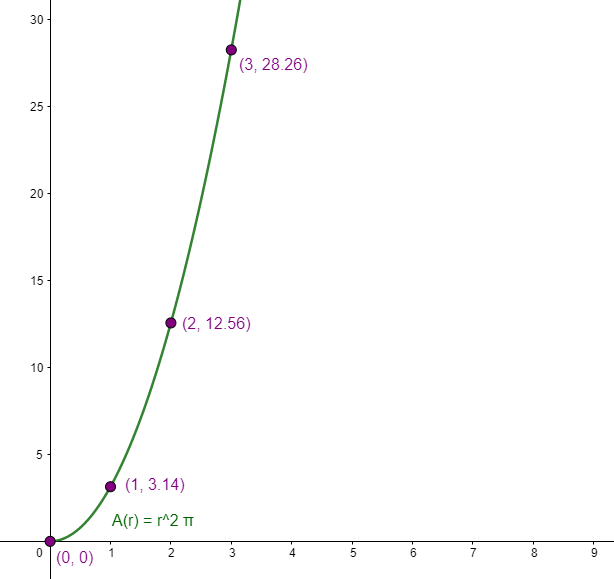
The domain of the function are all positive real numbers including $0$, we can write $x in [0, infty)$.
The range of the function are all positive real numbers, so we can write $y in [0, infty)$.
The $x$-intercept is the point $x=0$.
The $y$-intercept is the point $y=0$.
The function is not symmetric.
The function does not have asymptotes.
The function is increasing for $x in [0, infty).$
The function has a minimum point $(0, 0)$.
The function is continuous.
$$
A(r)=r^2 pi, hspace{4mm} r geq 0
$$
is graphed and described.
$A(r)=pi r^2$ ($r$ is the radius of the circle)
The reasonable domain of the equation is: $(r geq 0)$
The following is the graph of the function.
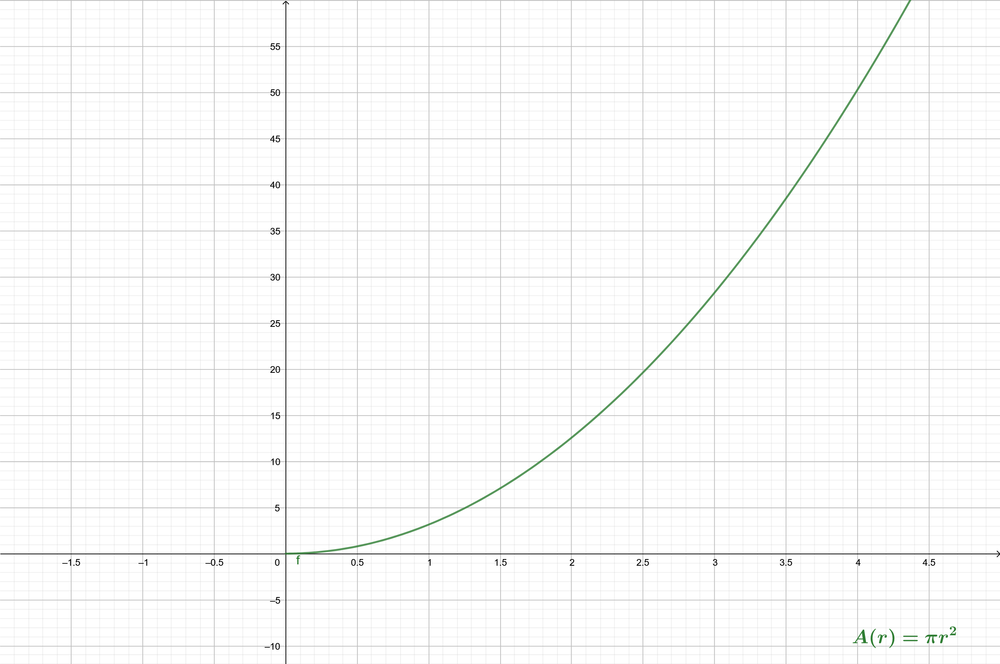
A(r)= pi r^2
$$
$$f(x)=a(x-h)^2+k$$
where the vertex is $(h,k)$
Therefore, the **vertex** is
$$(-3,-8)$$
$$begin{aligned}
because y&=2left(x+3right)^{2}-8\
therefore 0&=2left(x+3right)^{2}-8\
2left(x+3right)^{2}&=8\
left(x+3right)^{2}&=4\
x+3&=pm 2\
x+3&= 2hspace{1cm}textrm{Or}hspace{1cm}x+3=-2\
x&=-1hspace{1cm}textrm{Or}hspace{1cm}x=-5\
end{aligned}$$
$$begin{aligned}
because y&=2left(x+3right)^{2}-8\
therefore y&=2left(0+3right)^{2}-8\
y&=18-8\
y&=10\
end{aligned}$$
Let us solve the following equation
$$
color{#4257b2} 2x^2-6x=-5.
$$
First we transform the equation a little bit and get
$$
2x^2-6x+5=0.
$$
Since the expression of the left is a quadratic function we can use the quadratic formula
$$
x = frac{-b pm sqrt{b^2-4ac}}{2a}.
$$
We have
$$
a=2 hspace{12mm} b=-6 hspace{12mm} c=5.
$$
Hence, we have
$$
begin{align*}
x &= frac{-(-6) pm sqrt{(-6)^2-4 cdot 2 cdot 5}}{2 cdot 2} \
x &= frac{6 pm sqrt{36-40}}{4} \
x &= frac{6 pm sqrt{-4}}{4} \
x &= frac{6 pm sqrt{4i^2}}{4} \
x &= frac{6 pm 2sqrt{i^2}}{4} \
x &= frac{6 pm 2i}{4} \
x &= frac{6 + 2i}{4} hspace{3mm} text{or} hspace{3mm} frac{6 – 2i}{4} \
x &= frac{2(3 + i)}{4} hspace{3mm} text{or} hspace{3mm} frac{2(3 – i)}{4} \
x &= frac{3 + i}{2} hspace{3mm} text{or} hspace{3mm} frac{3 – i}{2}.
end{align*}
$$
Therefore, the solutions are
$$
color{#c34632} x=frac{3 +i}{2} hspace{3mm} text{color{default}or} hspace{3mm} x=frac{3 – i}{2}.
$$
$$
begin{align*}
2(frac{3 + i}{2})^2-6 cdot frac{3 + i}{2} &= 2 cdot frac{(3 + i)^2}{4}- frac{18 + 6i}{2} \ &= frac{3^2+2 cdot 3 cdot i +i^2}{2}- frac{18 + 6i}{2} \ &= frac{9+6i-1-18-6i}{2} = frac{-10}{2} = -5.
end{align*}
$$
$$
begin{align*}
2(frac{3 – i}{2})^2-6 cdot frac{3 – i}{2} &= 2 cdot frac{(3 – i)^2}{4}- frac{18 – 6i}{2} \ &= frac{3^2-2 cdot 3 cdot i +i^2}{2}- frac{18 – 6i}{2} \ &= frac{9-6i-1-18+6i}{2} = frac{-10}{2} = -5.
end{align*}
$$
Finally, we can conclude that both solutions are correct.
$$
color{#4257b2} frac{5}{9} – frac{x}{3} = frac{4}{9}.
$$
Now we solve for $x$.
$$
begin{align*}
frac{5}{9} – frac{x}{3} = frac{4}{9} implies frac{x}{3} &= frac{5}{9} – frac{4}{9} \ frac{x}{3} &= frac{1}{9} \
9 cdot x &=3 cdot 1 \ 9x&=3 \ x&=frac{3}{9} = frac{1}{3}.
end{align*}
$$
Therefore, the solution is
$$
color{#c34632} x=frac{1}{3}.
$$
$$
frac{5}{9} – frac{frac{1}{3}}{3} = frac{5}{9} – frac{1}{9} = frac{4}{9}.
$$
Hence, the solution is correct.
begin{align*}
&text{a.} hspace{3mm} x=frac{3 +i}{2} hspace{3mm} text{color{default}or} hspace{3mm} x=frac{3 – i}{2} \
&text{b.} hspace{3mm} x=frac{1}{3} \
end{align*}
$$
Let us find the possible exponential function in
$$
color{#4257b2} y=a cdot b^x
$$
form that has a $y$-intercept of $(0,3)$ and passes through the point $(2, 48)$. First, we will use the fact that the function has a $y$-intercept of $(0,3)$. We substitute $x=0$ and $y=3$ in the given exponential function form and get
$$
3=a cdot b^0 implies 3=a cdot 1 implies color{#4257b2} a=3.
$$
Now we will use the fact that the function passes through the point $(2, 48)$. We substitute $a=3$, $x=2$ and $y=48$ in the given exponential function form and get
$$
48=3 cdot b^2 implies b^2 = frac{48}{3} implies b^2=16 implies color{#4257b2} b=4.
$$
Therefore, the exponential function that has a $y$-intercept of $(0,3)$ and passes through the point $(2, 48)$ is
$$
color{#c34632} y=3cdot 4^x.
$$
Let us find the possible exponential function in
$$
color{#4257b2} y=a cdot b^x
$$
form that has a $y$-intercept of $(0,2)$ and passes through the point $(3, 0.25)$. First, we will use the fact that the function has a $y$-intercept of $(0,2)$. We substitute $x=0$ and $y=2$ in the given exponential function form and get
$$
2=a cdot b^0 implies 2=a cdot 1 implies color{#4257b2} a=2.
$$
Now we will use the fact that the function passes through the point $(3, 0.25)$. We substitute $a=2$, $x=3$ and $y=0.25$ in the given exponential function form and get
$$
0.25=2 cdot b^3 implies b^3 = frac{0.25}{2} implies b^2=0.125 implies color{#4257b2} b=0.5.
$$
Therefore, the exponential function that has a $y$-intercept of $(0,2)$ and passes through the point $(3, 0.25)$ is
$$
color{#c34632} y=2 cdot 0.5^x.
$$
b. $y=2 cdot 0.5^x$
$2x^2(3x+4x^2y)$
$=2x^2 cdot 3x+2x^2 cdot 4x^2y$ (Distributive property)
$=6x^3+8x^4y$ (Power of product property)
b-
$(x^3y^2)^4(x^2y)$
$=(x^{12}y^8)(x^2y)$ (Power of power property)
$=x^{14}y^9$ (Power of product property)
b- $(x^3y^2)^4(x^2y)=x^{14}y^9$
b- A parabola does not have asymptotes.
$$
color{#4257b2} (-2,5) hspace{3mm} text{color{default} and} hspace{3mm} (5, 2).
$$
a.
Let us calculate the distance between the points $(-2,5)$ and $(5, 2)$. Let
$$
(-2,5)=(x_1, y_1) hspace{3mm} text{color{default} and} hspace{3mm} (5, 2)=(x_2, y_2).
$$
Now we calculate the length
$$
begin{align*}
d &=sqrt{(x_2-x_1)^2+(y_2-y_1)^2}= sqrt{(5-(-2))^2+(2-5)^2} \
&= sqrt{(7)^2+(-3)^2} = sqrt{49+9} = sqrt{56} = sqrt{4 cdot 14} = 2sqrt{14} approx 7,5. end{align*}
$$
Therefore, the distance between the points $(-2,5)$ and $(5, 2)$ is
$$
color{#c34632} d= 2sqrt{14} approx 7,5.
$$
Let us calculate the slope of the line that goes through the two points. Let
$$
(-2, 5)=(x_1, y_1) hspace{3mm} text{color{default} and} hspace{3mm} (5,2)=(x_2, y_2).
$$
Now we calculate the slope
$$
m=frac{y_2-y_1}{x_2-x_1} = frac{2-5}{5-(-2)} = frac{-3}{7} = -frac{3}{7}.
$$
Therefore, the slope of the line that goes through the two points is
$$
color{#c34632} m= -frac{3}{7}.
$$
$$
d= 2sqrt{14} approx 7,5.
$$
b. the slope of the line that goes through the two points is
$$
m= -frac{3}{7}.
$$
$$x^2, x^3, dfrac{1}{x}, 2^x$$
We have to find the $f(-x)$ equivalent functions of the above parent functions.
Thus for $f(x) = x^2$ we have $f(-x) = (-x)^2 = x^2$
And for $f(x) = x^3$ we have $f(-x) = (-x)^3 = -x^3$
Similarly for $f(x) = dfrac{1}{x}$ we have $f(-x) = dfrac{1}{-x} = -dfrac{1}{x}$
Finally for $f(x) = 2^x$ we have $f(-x) = 2^{-x} = dfrac{1}{2^x}$
Firstly for $f(x) = x^2$ and $f(-x) = x^2$

$f(x) = x^3$ (Green Color) and
$f(-x) = -x^3$ (Blue Color)

$f(x) = dfrac{1}{x}$ (Blue Color) and
$f(-x) = -dfrac{1}{x}$ (Green Color)

$f(x) =2^x$ (Blue Color) and
$f(-x) = dfrac{1}{2^x}$ (Green Color)

$$x^2, x^3, dfrac{1}{x}, 2^x$$
We have to find the $f(-x)$ and $-f(x)$ equivalent functions of the above parent functions.
Thus for $f(x) = x^2$ we have
$f(-x) = (-x)^2 = x^2$ and
$-f(x) = -x^2$
And for $f(x) = x^3$ we have
$f(-x) = (-x)^3 = -x^3$ and
$-f(x) = -x^3$
Similarly for $f(x) = dfrac{1}{x}$ we have
$f(-x) = dfrac{1}{-x} = -dfrac{1}{x}$ and
$-f(x) = -dfrac{1}{x}$
Finally for $f(x) = 2^x$ we have
$f(-x) = 2^{-x} = dfrac{1}{2^x}$ and
$-f(x) = -2^{x}$
From above we can clearly make out that $f(x) = x^2$ and
$f(-x) = x^2$ i.e. $f(-x) = f(x)$. Therefore, $f(x) = x^2$ is an even function.
Further, for $f(x) = x^3$ we have $f(-x) = -x^3$ and
$-f(x) = -x^3$ i.e. $f(-x) =- f(x)$. Therefore, $f(x) = x^3$ is an odd function.
Similarly for $f(x) = dfrac{1}{x}$ we have $f(-x)= -dfrac{1}{x}$ and
$-f(x) = -dfrac{1}{x}$ i.e. $f(-x) =- f(x)$. Therefore, $f(x) = dfrac{1}{x}$ is an odd function.
In case of an odd function the graph will be symmetrical about the origin. This implies even if you put a positive integer, say, 2 or its negative counterpart i.e. $-2$ in an odd function, say, $f(x) = x^3$ the output will be 8 and $-8$ respectively. Thus, the line above the origin and below the origin will be opposite to each other.
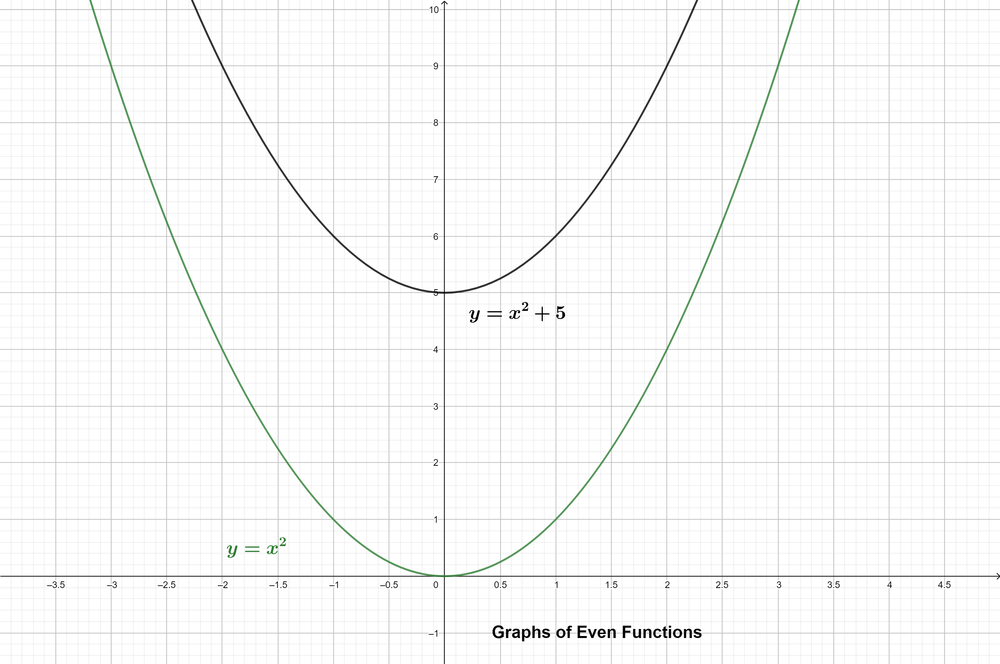
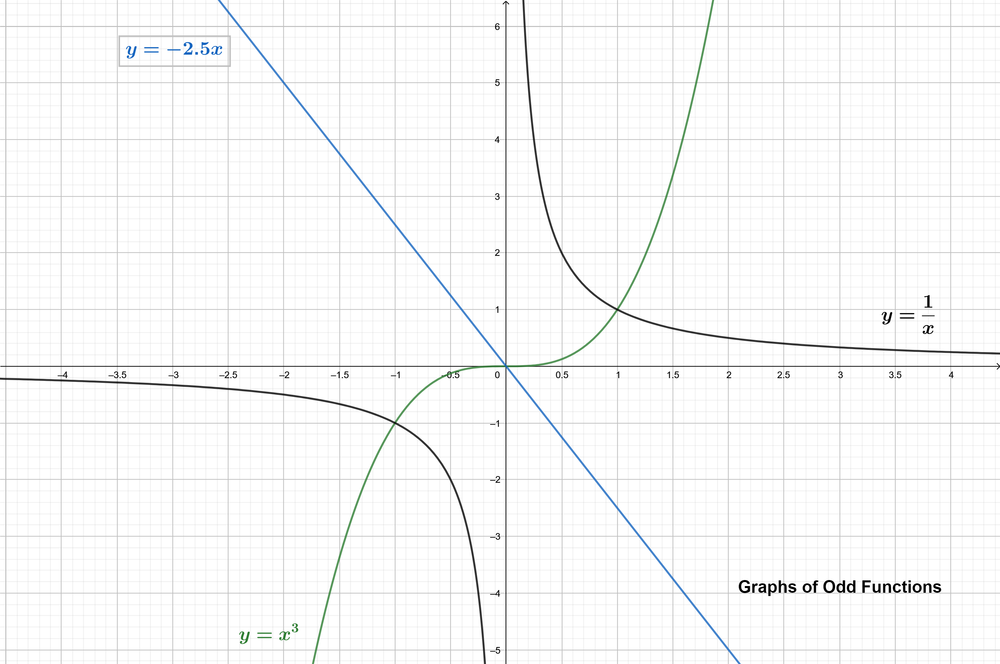
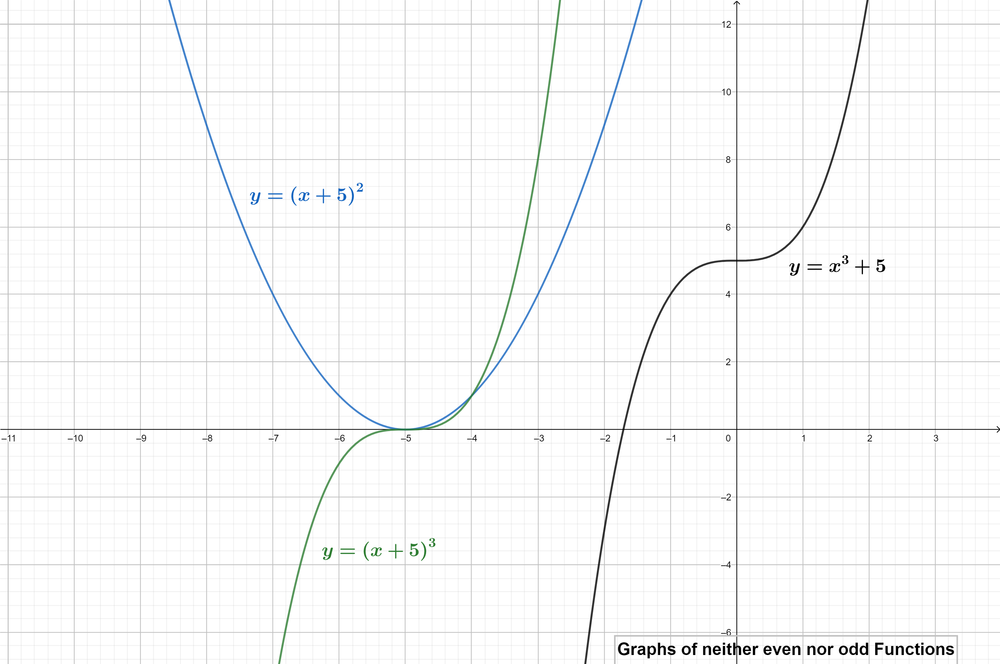
The even functions are: $f(x)=x^2$ and $f(x)=x^2+5$
The odd functions are: $f(x)=x^3$, $f(x)=dfrac {1}{x}$ and $f(x)=-2.5x$
The neither even nor odd functions are: $f(x)=(x+5)^2$, $f(x)=(x+5)^3$ and $f(x)=x^3+5$
From the graphing calculator,
The even functions are the functions that y-axis is the line of symmetry for their graphs.
The odd function are the functions that can rotate around the origin 180$text{textdegree}$ and keep their shape.
The other functions are neither even nor odd.
By looking at the graph, If the graph has the y-axis a line of symmetry, then the function is even. If the graph can rotate around the origin without changing its shape, then the function is odd, otherwise the function is neither even nor odd.
The graph of the function can rotate 180$text{textdegree}$ around the origin without changing its shape. So, the function is odd.
Let’s consider a function $f(x) = x^4 – x^2 +23$
Now, we will determine the function $f(-x)$
$$begin{aligned}
f(-x) &= (-x)^4 – (-x)^2 +23 \
&=x^4 – x^2 +23 \
&=f(x)
end{aligned}$$
Since, $f(-x)=f(x)$, $f(x) = x^4 – x^2 +23$ is an even function.
Let’s consider a function $f(x) = 2x^5 – x^3 +7x$
Now, we will determine the function $f(-x)$
$$begin{aligned}
f(-x) &= 2(-x)^5 – (-x)^3 +7(-x) \
&=-2x^5 + x^3 -7x \
&=-(2x^5 – x^3 +7x) \
&=-f(x)
end{aligned}$$
Since, $f(-x)=-f(x)$, $f(x) = 2x^5 – x^3 +7x$ is an odd function.
Now, we will determine the function $f(-x)$
$$begin{aligned}
f(-x) &= 2(-x)^3 – (-x)^2 +8 \
&=-2x^3 – x^2 +8 \
end{aligned}$$
Since, neither $f(-x)=f(x)$ nor $f(-x)=-f(x)$,
$f(x) = 2x^3 – x^2 +8$ is neither even function nor an odd function.
begin{center}
renewcommand{arraystretch}{2}
begin{tabular}{|l|l|l|l|}
hline
$y(x)$ & Graphs & Function $f(-x)$ & Type \
hline
$y=x^2$ & Coincident & $f(-x)=y$ & Even \
hline
$y=x^3$ & Reflection & $f(-x)=-y$ & Odd \
hline
$y=dfrac {1}{x}$ & Reflection & $f(-x)=-y$ & Odd \
hline
$y=a^x$ & Reflection over y-axis & $f(-x)$ & Neither \
hline
end{tabular}
end{center}
renewcommand{arraystretch}{2}
begin{tabular}{|l|l|l|l|}
hline
$y(x)$ & Graphs & Function $f(-x)$ & Type \
hline
$y=x^2$ & Coincident & $f(-x)=y$ & Even \
hline
$y=x^3$ & Reflection & $f(-x)=-y$ & Odd \
hline
$y=dfrac {1}{x}$ & Reflection & $f(-x)=-y$ & Odd \
hline
$y=a^x$ & Reflection over y-axis & $f(-x)$ & Neither \
hline
end{tabular}
end{center}
The line with a slope $5$ passes through the point $(3, -2)$. Let us write its equation in point-slope form. We use the given formula
$$
color{#4257b2} y-k=a(x-h).
$$
We have
$$
a=5, hspace{5mm} h=3 hspace{5mm} text{and} hspace{5mm} k=-2.
$$
Now we substitute all this in the given formula and get
$$
y-(-2)=5(x-3) implies y+2=5(x-3).
$$
Therefore, the equation of the line with a slope $5$ that passes through the point $(3, -2)$ in point-slope form is
$$
color{#c34632} y+2=5(x-3).
$$
Let us find the intercepts of the line from part (a)
$$
y+2=5(x-3).
$$
In order to find $x$-intercept, we substitute $y=0$ in the given equation. This yields
$$
begin{align*}
0+2=5(x-3) implies 2&=5x-15 \ 5x &= 15+2 \ 5x&=17 \ x&= frac{17}{5}.
end{align*}
$$
Therefore, the $x$-intercept point is
$$
color{#c34632} x= frac{17}{5}.
$$
In order to find $y$-intercept, we substitute $x=0$ in the given equation. This yields
$$
begin{align*}
y+2=5(0-3) implies y+2 &=-15 \ y &= -15-2 \ 5x&=17 \ y&= -17.
end{align*}
$$
Therefore, the $y$-intercept point is
$$
color{#c34632} y=-17.
$$
$$
y+2=5(x-3).
$$
b. The $x$-intercept point is $x= frac{17}{5}$ and the $y$-intercept point is $y=-17$.
$$
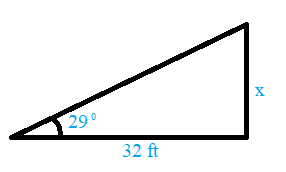
begin{align*}
tan 29 text{textdegree}&=dfrac{x}{32}\
x&=32 cdot tan 29 text{textdegree}\
x&= 32 cdot 0.5543\
x&=17.7376\
x&approx 17.7 textrm{ft}\
end{align*}
$$
$=sqrt {5^2 times 3}+sqrt {3^2 times 3}$
$=5 sqrt {3}+3 sqrt {3}$
$$
=8sqrt {3}
$$
$$
3 sqrt x
$$
$$
=12
$$
$=3^2 times (sqrt {12})^2$
$=9 times 12$
$$
=108
$$
b- $sqrt x+2 sqrt x=3 sqrt x$
c- $(sqrt {12})^2=12$
d- $(3 sqrt {12})^2=108$
$7x+3y=1$ (2)
Solving equation (1):
$3x=2-8$
$3x=-6$
$$
x=-2
$$
Substituting in equation (2)
$7(-2)+3y=1$
$3y=15$
$$
y=5
$$
$$
A_n = A_1 cdot r^n
$$
$$
1500 cdot 1.047^{3} = 1722
$$
Now there are 1722 students in the school.
$$
1500 = A_1 cdot 1.047^2
$$
$$
1500 div 1.047^2= A_1 cdot 1.047^2div 1.047^2
$$
$$
A_1 = 1500 div 1.047^2
$$
$$
A_1 = 1368
$$
Five years ago there were 1368 students in the school.
The start with the default formula:
$$
A_n = A_1 cdot r^n
$$
We input the values we know.
$$
A_n = 1722 cdot 1.047^n
$$
And we have the answer.
Domain $rightarrow (-infty, 10]$.
Range $rightarrow [-4, 6]$.
$$begin{aligned}
f(x) &= dfrac{4x-1}{-x + 11}, x < 0\\
&= x – 4, 0 leq x leq 10\
end{aligned}$$

**Histogram** of the calorie data

The inspector tested 30 wings even it would have been much easier and less expensive to test just one, because as the number of wings in the sample increases the accuracy of result will increase.
Mean and median values set of measures best describes the calories in a typical Pollo Genio batter-fried chicken wing, because it gives us a approximate indicate about the number of calories.
$f(x)=dfrac {2}{3}x+1$
$-f(x)=-dfrac {2}{3}-1$
$f(-x)=dfrac {2}{3}(-x)+1 neq f(x)$ and $f(-x) neq -f(x)$ (Neither even nor odd)
b-
$f(x)=(x+2)^2=x^2+4x+4$
$-f(x)=-x^2-4x-4$
$f(-x)=x^2-4x+4 neq f(x)$ and $f(-x) neq -f(x)$ (Neither even nor odd)
c-
$f(x)=|x|-x^2$
$-f(x)=|-x|+x^2$
$f(-x)=|-x|-(-x)^2=|-x|-x^2=f(x)$ (Even Function)
b- (Neither even nor odd)
c- (Even Function)
$$begin{aligned}
y &= x^{2} + 6 text{x}\\
end{aligned}$$
Expand the equation by using the completing the square.
text {y} &= (x^{2} + 6text{x} + left(dfrac{6}{2}right)^{2}) – left(dfrac{6}{2}right)^{2}\\
text {y} &= (x^{2} + 6text{x} + (3)^{2}) – (3)^{2}\\
text {y} &= (x^{2} + 6text{x} + 9) -9\\
end{aligned}$$
Using,
$$begin{aligned}
(a+b)^{2} &= a^{2}+2ab+b^{2}\
end{aligned}$$
text {y} &= (x+3)^{2} – 9\\
end{aligned}$$
We graph the parent function $text {y} = x^{2}$,
then we shifts it $6 text {units}$ to the left to get $text {y} = (x + 3)^{2}$ and
finally $9 text {units}$ down to get $text {y} = (x + 3)^{2} -9$.

Put $text {y} = 0$
$$begin{aligned}
text {y} &= text {x}^{2} + 6 text{x}\
0 &= text {x}(text {x}+ 6)\\
&boxed {text{x}_{1} = 0 text{ and } text{x}_{2} = -6}\
end{aligned}$$
Put $x = 0$
$$begin{aligned}
y &= 0^{2} + 6 cdot 0\\
&boxed {text{y}= 0}\
end{aligned}$$
$$begin{aligned}
text {y} &= text{a}(text {x} – text {h})^{2} + text {k}\
text {h} &= -3\
text {k} &= -9\
end{aligned}$$
$$V(h, k) = (-3, -9)$$
a) $5^{-2}cdot 4^{1/2}$
$color{#c34632} text{$bigg[$apply the negative exponents property: $,,,a^{-b}=dfrac{1}{a^b}bigg]$}$
$=dfrac{1}{5^2}cdot 4^{1/2}=$
$color{#c34632} text{$bigg[$rewrite $4^{1/2}$ as $sqrt{4}bigg]$ }$
$=dfrac{1}{25}cdot sqrt{4}=$
$=color{#4257b2} text{$dfrac{2}{25}$}$
b) $dfrac{3xy^2z^{-2}}{(xy)^{-1}z^2}=$
$color{#c34632} text{$bigg[$apply the negative exponents property: $,,,a^{-b}=dfrac{1}{a^b},,,,,,,,,dfrac{1}{a^{-b}}=a^bbigg]$}$
$=dfrac{3xy^2(xy)}{z^2z^2}=$
$color{#c34632} text{$bigg[$apply the product of powers property: $,,,a^bcdot a^c=a^{b+c}bigg]$}$
$=dfrac{3x^{(1+1)}y^{(2+1)}}{z^{(2+2)}}=$
$$
=color{#4257b2} text{$dfrac{3x^2y^3}{z^4}$}
$$
$color{#c34632} text{$bigg[$apply the power of a product property: $,,,(ab)^c=a^bcdot b^cbigg]$}$
$=3^3cdot (m^2)^3 cdot (2mn)^{-1}cdot 8^{2/3}(n^3)^{2/3}=$
$color{#c34632} text{$bigg[$apply the power of a power property: $,,,(a^b)^c=a^{bc}bigg]$}$
$=27cdot m^{(2cdot 3)}cdot (2mn)^{-1}cdot (2^3)^{2/3}cdot n^{3(2/3)}=$
$=27m^6cdot (2mn)^{-1}cdot 2^{6/3}cdot n^{6/3}=$
$=27m^6cdot (2mn)^{-1}cdot 2^2cdot n^2=$
$=27m^6cdot(2mn)^{-1}cdot 4n^2=$
$color{#c34632} text{$bigg[$apply the negative exponents property: $,,,a^{-b}=dfrac{1}{a^b}bigg]$}$
$=dfrac{108m^6n^2}{2mn}=$
$color{#c34632} text{$bigg[$apply the quotient of powers property: $,,,dfrac{a^b}{a^c}=a^{b-c}bigg]$}$
$=54m^{(6-1)}n^{(2-1)}=$
$$
=color{#4257b2} text{$54m^5n$}
$$
$color{#c34632} text{$bigg[$apply the power of a product property: $,,,(ab)^c=a^bcdot b^cbigg]$}$
$=5^{1/3}cdot (x^2)^{1/3}cdot (y^3)^{1/3}cdot z^{1/3}=$
$color{#c34632} text{$bigg[$apply the power of a power property: $,,,(a^b)^c=a^{bc}bigg]$}$
$=5^{1/3}cdot x^{2/3}cdot y^{3/3}cdot z^{1/3}=$
$color{#c34632} text{$bigg[$recall: $,,,x^{m/n}=sqrt[n]{x^m}bigg]$}$
$=sqrt[3]{5}cdot sqrt[3]{x^2}cdot ycdot sqrt[3]{z}=$
$color{#c34632} text{$bigg[$recall: $,,, sqrt[n]{a}cdot sqrt[n]{b}=sqrt[n]{ab}bigg]$}$
$$
=color{#4257b2} text{$ysqrt[3]{5x^2z}$}
$$
$$begin{aligned}
text{Height of a “fire safe zone”}, h &= 100 text{ metres}\
h&= dfrac{100}{2}\\
&boxed{h=50 text{ metres}}\\
text{ Expected height of the firework}, k&= 30 text{ metres}\
end{aligned}$$
Vertex of the parabola $rightarrow(50, 30)$.
$$begin{aligned}
y&= a (x – h)^2 + k \
end{aligned}$$
Substituting the values,
$$begin{aligned}
0&=a(0-50)^2 + 30\
&= 2500a + 30\
-30&= 2500a\
dfrac{-30}{2500}&= a\\
&boxed{-0.012=a}
end{aligned}$$
Substituting the value of $a$,
$$begin{aligned}
&boxed{y=-0.012(x-50)^2 + 30}\
end{aligned}$$
$(sqrt {x+2})^2=8^2$ (Square each side)
$x+2=64$ (Simplify)
$x=62$ (Solve for $x$)
Checking solution:
$sqrt {62+2}=sqrt {64}=8 qquad checkmark$
$$
x^2 = -16.
$$
Let us determine the solutions. We solve for $x$ and get
$$
x^2 = -16 implies x = pm sqrt{-16} =pm sqrt{16i^2} =pm sqrt{(4i)^2} = pm 4i.
$$
Therefore, the solutions are
$$
color{#c34632} x=4i hspace{3mm} text{color{default} and} hspace{3mm} x=-4i.
$$
x=4i hspace{3mm} text{color{default} and} hspace{3mm} x=-4i
$$
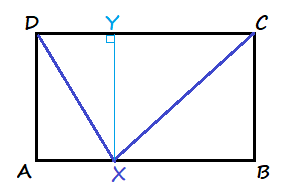
$=dfrac{dfrac{CDcdot XY}{2}}{CDcdot AD}$
$$
=dfrac{XY}{2AD}
$$
P(triangle XCD)=dfrac{1}{2}
$$
P(triangle XCD)=dfrac{1}{2}
$$
$$begin{aligned}
text {x} &= text{y}^{2} rightarrow(1)\\
text {x}^{2} + text{y}^{2} &= 25 rightarrow(2)\\
end{aligned}$$


| y | $x = y^{2}$ |
|:–:| :–: |
|-3 |9|
|-2 |4|
|-1 |1|
|0 |0|
|1 |1|
|2 |4|
|3 |9|
The graph $x = y^{2}$ is symmetrical with respect to the $x$- axis.
The domain is $(0, infty)$, the range is the set of all real numbers. It is not a function as it doesn’t as the Vertical Line Test.
The graph $x^{2}+y^{2} = 25$ is symmetrical with respect to both $x$- axis and $y$-axis..
The domain and range are $(-5, 5)$. It is not a function as it doesn’t as the Vertical Line Test.
$$begin{aligned}
x^2+y^2&=25hspace{2cm}textrm{Given}\
(x-3)^2+y^2&=25hspace{2cm}textrm{If translate the graph of the function horizontally}\
x^2+(y+1)^2&=25hspace{2cm}textrm{If translate the graph of the function vertically}\
(x-h)^2+(y-k)^2&=r^2hspace{2cm}textrm{We write the equation in graphing form for the family of circles}\
end{aligned}$$
The radius of the circle $r$. To make the circle larger we increase the radius
$$x^2+y^2=36$$
Write the equation of the circle with center $(5,-7)$ and radius $10$
$$(x-5)^2+(y-(-7))^2=10^2$$
$$Rightarrow (x-5)^2+(y+7)^2=100$$
Write the equation of the circle with center $(5,-7)$ and radius $12$
$$(x-5)^2+(y-(-7))^2=12^2$$
$$Rightarrow (x-5)^2+(y+7)^2=144$$
Given equation ,
$$begin{aligned}
x^2 + y^2&= 25rightarrow(1)
end{aligned}$$
|$x_!$ |$y_1$ |
|–|–|
| 0|0 |
|-5 |0 |
| 5|0 |
| 5|0 |
| 0|-5 |


We can make the circle larger by increasing the radius and smaller by decreasing the radius.
The radius of the given equation is 5 units.
The radius is a parameter of the circle, it connects the variable of the equation.
Given,
$$begin{aligned}
text{Centre}, (h,k)&= (5, -7)\
text{Radius}, r &= 10 text{units}\
end{aligned}$$
$$begin{aligned}
(x-h)^2 + (y-k)^2&= r^2\
end{aligned}$$
Substituting the values.
$$begin{aligned}
(x-5)^2 + (y-(-7))^2&= 10^2\
&boxed{(x-5)^2 + (y+7)^2= 100}\
end{aligned}$$
$$begin{aligned}
(x-5)^2 + (y-(-7))^2&= 12^2\
&boxed{(x-5)^2 + (y+7)^2= 144}\
end{aligned}$$
Given the coordinates of the center $C(h,k)$ and the radius $r$ of a circle
$$(x-h)^2+(y-k)^2=r^2$$
Given that
$$(x-3)^2+(y+7)^2=169$$
Compare with the circle’s equation.
$$h=3,hspace{0.3cm}k=-7$$
$$r=sqrt{169}=13$$
$$begin{aligned}
x & = y^{2} rightarrow(1)\
x^{2} + y^{2} &= 25 rightarrow(2)\
end{aligned}$$
$$begin{aligned}
y & =sqrt {x^{2}}rightarrow(3)\
y &= sqrt{25-x^{2}}rightarrow(4)\
end{aligned}$$
There are two functions in each case. The graphing calculator can draw them both (which are half-circles) but one by one.


We have to take into consideration what type of function (Linear, Quadratic, Exponential, Piecewise-defined. etc) we transform.
The piecewise defined function is the hardest one to transform. because it has different parts for different intervals.
Consider the function
$$
color{#4257b2} y=3x^3.
$$
We rewrite it in the form
$$
f(x)=3x^3.
$$
Now we evaluate $f(-x)$. This gives
$$
f(-x) = 3(-x)^3 = 3cdot (-x^3) = -3x^3 = -f(x).
$$
Therefore,
$$
color{#c34632} f(-x) = -f(x)
$$
stands for every $x$. We can conclude that our given function is $text{color{#c34632} odd.}$
Consider the function
$$
color{#4257b2} y=x^2+16.
$$
We rewrite it in the form
$$
f(x)=x^2+16.
$$
Now we evaluate $f(-x)$. This gives
$$
f(-x) = (-x)^2+16 = x^2+16 = f(x).
$$
Therefore,
$$
color{#c34632} f(-x) = f(x)
$$
stands for every $x$. We can conclude that our given function is $text{color{#c34632} even.}$
Consider the function
$$
color{#4257b2} y=frac{x^4}{2}.
$$
We rewrite it in the form
$$
f(x)=frac{x^4}{2}.
$$
Now we evaluate $f(-x)$. This gives
$$
f(-x) = frac{(-x)^4}{2} = frac{x^4}{2} = f(x).
$$
Therefore,
$$
color{#c34632} f(-x) = f(x)
$$
stands for every $x$. We can conclude that our given function is $text{color{#c34632} even.}$
b. The given function is even.
c. The given function is even.
$$
color{#4257b2} y=2x +3.
$$
First, let us write the equation of the perpendicular line to the given line. We need to find the equation
$$
y=k cdot x+n.
$$
We can find the coefficient $k$ using the fact that the two lines are perpendicular. We have
$$
k=-frac{1}{2}.
$$
In order to find $n$ we use the fact that our wanted line passes through $(4, 5)$. We substitute $k=-1/2$, $x=4$ and $y=5$ and get
$$
5=-frac{1}{2} cdot 4 +n implies 5=-2+n implies n=5+2 = 7.
$$
Therefore, the equation of the perpendicular line to the line $y=2x +3$ which goes through $(4,5)$ is
$$
color{#c34632} y=-frac{1}{2}x +7.
$$
$$
y=2x +3 hspace{5mm} text{and} hspace{5mm} y=-frac{1}{2}x+7
$$
and on the graph given below see that the two lines intersect at point $(1.6, 6.2)$. The distance from the point $(4,5)$ to the line $y=2x+3$ is now the distance between the points $(1.6, 6.2)$ and $(4, 5)$. We use the formula
$$
d=sqrt{(x_2-x_1)^2+(y_2-y_1)^2}
$$
and get
$$
begin{align*}
d &=sqrt{(4-1,6)^2+(5-6,2)^2} = sqrt{2,4^2+(-1,2)^2} =sqrt{5,76+1,44} \ &= sqrt{7,2} approx 2,7.
end{align*}
$$
Therefore, the distance from the point $(4,5)$ to the line $y=2x+3$ is $color{#c34632} 2,7$.
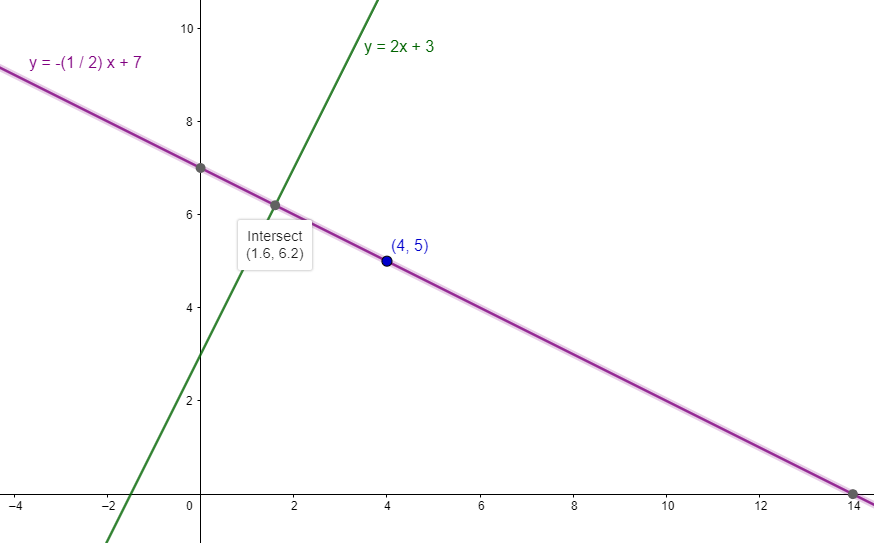
We can now make the table of the function.
begin{center}
begin{tabular}{ |c|c|c|c|c|c|c|c|c|c|c|c|c| }
hline
x & 3 & 4 & 7 & 12 & 19 & 28 & 39 \
hline
y & -5 & -4 & -3 & -2 & -1 & 0 & 1 \
hline
end{tabular}
end{center}
And now we can draw the graph.\
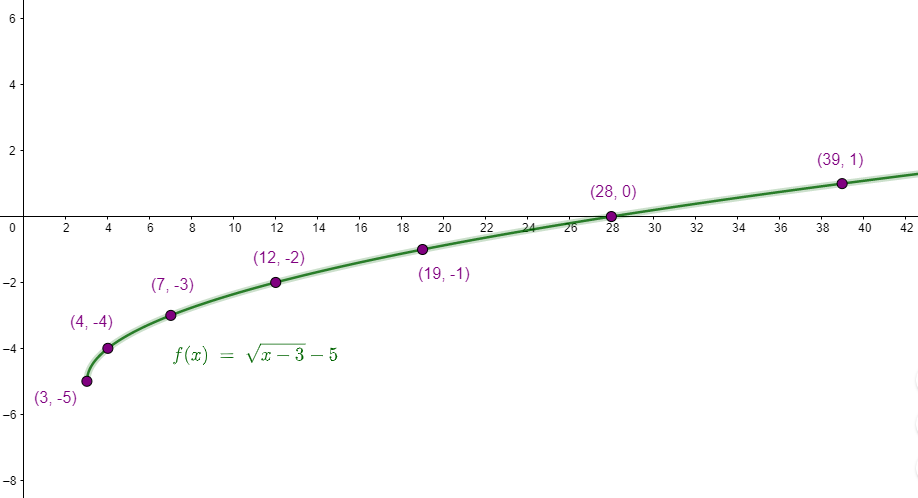
The domain of the function are all real numbers larger than $3$ including $3$, we can write $x in [3, infty)$.
The range of the function are all real numbers larger than $-5$ including $-5$, so we can write $y in [-5, infty)$.
The $y$-intercept does not exist.
The $x$-intercept is the point $x=28$.
The function is not symmetric.
The function does not have asymptotes.
The function is increasing for $x in [3, infty).$
The function has a minimum point $(3, -5)$.
The function is continuous.
\
begin{center}
begin{tabular}{|r|r|r|r|r|}
hline
x & 2 & 3 & 5 & 10 \
hline
F(x) & 5 & 10 & 26 & 101 \
hline
end{tabular}
end{center}
Firs we check if it is a linear equation,\
The slope is calculated by the equation $m=dfrac {y2-y1}{x2-x1}$\
$dfrac {101-26}{10-5}=dfrac {75}{5}=5$\
$dfrac {26-10}{5-3}=dfrac {16}{2}=8$\
So, there is no a constant slope and the function is not linear.\
\
Checking if it is a quadratic:\
$y=ax^2+bx+c$\
$101=a(10)^2+b(10)+c qquad rightarrow qquad 100a+10b+c=101$ qquad (1)\
$26=a(5)^2+b(5)+c qquad rightarrow qquad 25a+5b+c=26$ qquad (2)\
$10=a(3)^2+b(3)+c qquad rightarrow qquad 9a+3b+c=10$ qquad (3)\
\
$25 times dfrac {101-10b-c}{100}+5b+c=26$ (Substituting for $a$ in equation (2))
$dfrac {101-10b-c}{4}+5b+c=26$
$101-10b-c+20b+4c=104$
$10b+3c=3$ (4)
$9 times dfrac {101-10b-c}{100}+3b+c=10$ (Substituting for $a$ in equation (3))
$909-90b-9c+300b+100c=1000$ (Multiply each side by 100)
$210b+91c=91$ (5)
$b=dfrac {3-3c}{10}$ (Solving equation (4) for $b$)
$210 times dfrac {3-3c}{10}+91c=91$ (Substituting for $b$ in equation (5)
$21(3-3c)+91c=91$
$63-63c+91c=91$
$91c-63c=91-63$
$28c=28$
$$
c=1
$$
Substituting for $c$ in equation (4)
$10b+3 (1)=3$
$10b=3-3$
$10b=0$
$$
b=0
$$
$100a+10(0)+1=101$
$100a=100$
$$
a=1
$$
The function of the machine is:
$$
y=x^2+1
$$
Checking for the function:
$f(2)=2^2+1=5$ checkmark
$f(3)=3^2+1=10$ checkmark
$f(5)=5^2+1=26$ checkmark
$f(2)=(10)^2+1=101$ checkmark
Consider the given equation
$$
color{#4257b2} x-3(y+2) = 6.
$$
We solve for $y$ and get
$$
begin{align*}
x-3(y+2) &= 6 \ x-3y-6 &=6 \ -3y &= 6+6-x \ -3y &= 12-x \ y&=frac{12-x}{-3} = frac{-(12-x)}{3} = frac{x-12}{3}.
end{align*}
$$
Therefore, the solution is
$$
color{#c34632} y=frac{x-12}{3}.
$$
Consider the given equation
$$
color{#4257b2} frac{6x-1}{y}-3=2.
$$
We solve for $y$ and get
$$
begin{align*}
frac{6x-1}{y}-3 &=2 \ frac{6x-1}{y} &=2+3 \ frac{6x-1}{y} &= 5 \ frac{6x-1}{y} &= frac{5}{1} \
5 cdot y &=(6x-1) cdot 1 \ 5y &= 6x-1 \ y &= frac{6x-1}{5}.
end{align*}
$$
Therefore, the solution is
$$
color{#c34632} y=frac{6x-1}{5}.
$$
Consider the given equation
$$
color{#4257b2} sqrt{y-4} = x+1.
$$
First we square both sides of the equation. Thus yields
$$
(sqrt{y-4})^2 = (x+1)^2 implies y-4 = (x+1)^2.
$$
We solve for $y$ and get
$$
begin{align*}
y-4 &= (x+1)^2 \ y-4 &= x^2+2cdot x cdot 1 +1^2 \ y-4 &= x^2+2x +1 \ y &= x^2+2x +1+4 \
y &= x^2+2x +5.
end{align*}
$$
Therefore, the solution is
$$
color{#c34632} y=x^2+2x +5.
$$
Consider the given equation
$$
color{#4257b2} sqrt{y+4} = x+2.
$$
First we square both sides of the equation. Thus yields
$$
(sqrt{y+4})^2 = (x+2)^2 implies y-4 = (x+2)^2.
$$
We solve for $y$ and get
$$
begin{align*}
y+4 &= (x+2)^2 \ y+4 &= x^2+2cdot x cdot 2 +2^2 \ y+4 &= x^2+4x +4 \ y &= x^2+4x +4-4 \
y &= x^2+4x.
end{align*}
$$
Therefore, the solution is
$$
color{#c34632} y=x^2+4x.
$$
begin{align*}
&text{a.} hspace{5mm} y=frac{x-12}{3} \
&text{b.} hspace{5mm} y=frac{6x-1}{5} \
&text{c.} hspace{5mm} y=x^2+2x+5 \
&text{d.} hspace{5mm} y=x^2+4x \
end{align*}
$$
Therefore, $(a+b)^2=a^2+2ab+b^2$
Hence, Paul is missing $2ab$.
Also using diagram below it can be observed Paul is missing $2ab$:
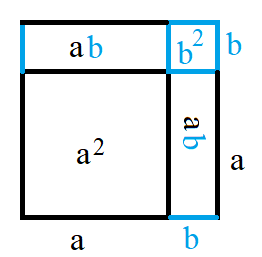
a. $-18-sqrt{-25}=-18-5sqrt{-1}=-18-5i$
b. $dfrac{2pm sqrt{-16}}{2}=dfrac{2pm 4sqrt{-1}}{2}=1pm 2sqrt{-1}=1pm 2i$
c. $5+sqrt{-6}=5+sqrt{6}sqrt{-1}=5+sqrt{6}i$
b. $1pm 2i$
c. $5+sqrt{6}i$
The graph of the equation $(x-4)^2+(y+1)^2=16$ is a circle with the center $(4,-1)$ and the radius $r=sqrt {16}=4$
The general form of the radius equation is $r=sqrt {(x-h)^2+(y-k)^2}$
$r=sqrt {(x-4)^2+(y+1)^2}=sqrt {16}=4$
The information that we learn about the graph just by looking at the equation are the center $(h, k)$ and the radius $r$ of the circle.
The graph of the function $(x-4)^2+(y+1)^2=16$
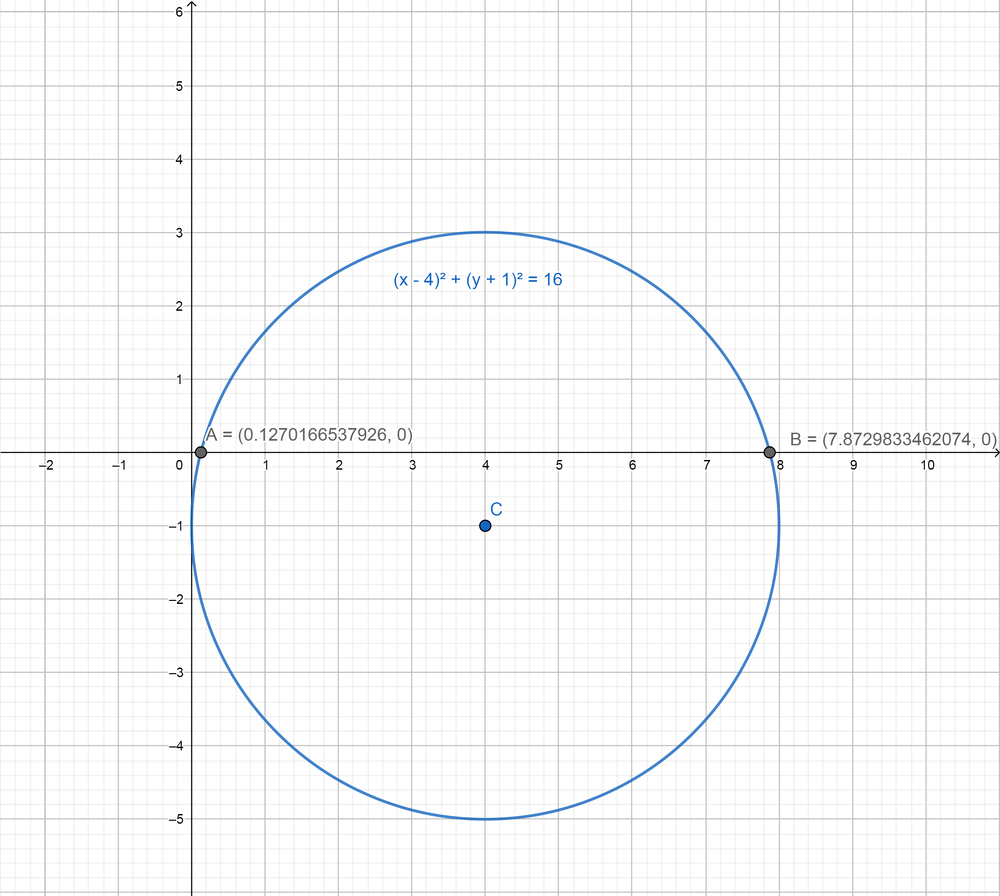
b- The information that we learn about the graph just by looking at the equation are the center $(h, k)$ and the radius $r$ of the circle.
If the parabola is a function, then the general equation is: $y=a(x-h)^3+k$
$0=a(0-3)^2+5$ (Substituting for the vertex and the point $(0, 0)$)
$0=9a+5$
$9a=-5$
$a=dfrac {-5}{9}$
The equation is:
$$
y=-dfrac {5}{9}(x-3)^2+5
$$
If the parabola is not a function “Sleeping ” parabola, then the general equation is: $x=dfrac {(y-k)^2}{a^2}+h$
$0=dfrac {(0-5)^2}{a^2}+3$ (Substituting for the vertex and the point $(0, 0)$)
$0=dfrac {25}{a^2}+3$
$pm dfrac {5}{a}=3$
$a=pm dfrac {5}{3}$
The equation is:
$$
x=dfrac {9(y-5)^2}{25}+3
$$
b- Parabola is not a function, The equation is: $x=dfrac {9(y-5)^2}{25}+3$
The function that represents this relation is the rectangular hyperbola
Assuming the distance is $x$ and loudness is $y$, the function that represents this relation is:
$y=dfrac {1}{x}$
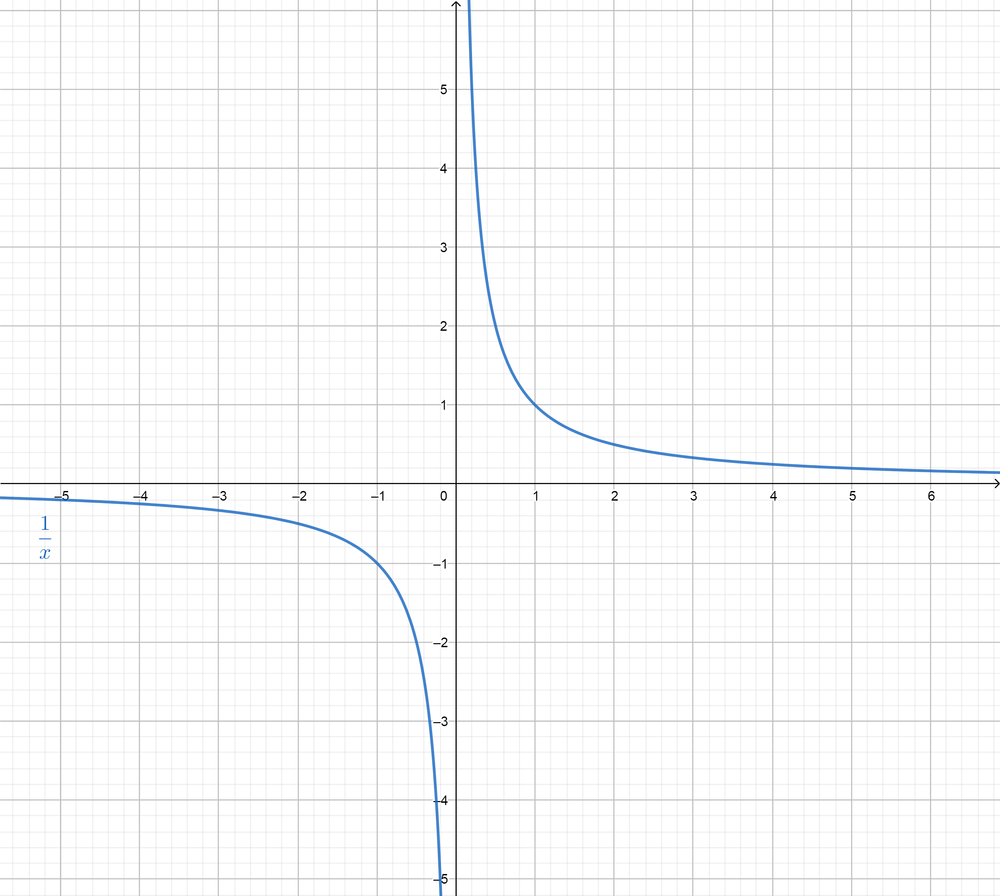
The dependent variable is the loudness of the music $y$,
The independent variable is the distance $x$,
b- The dependent variable is the loudness of the music $y$,
The independent variable is the distance $x$,
Let us solve the following equation
$$
color{#4257b2} -5x^-2x-6=-2.
$$
First we transform the equation a little bit and get
$$
5x^2+2x+6-2=0 implies 5x^2+2x+4=0.
$$
Since the expression of the left is a quadratic function we can use the quadratic formula
$$
x = frac{-b pm sqrt{b^2-4ac}}{2a}.
$$
We have
$$
a=5 hspace{12mm} b=2 hspace{12mm} c=4.
$$
Hence, we have
$$
begin{align*}
x &= frac{-2 pm sqrt{(2^2-4 cdot 5 cdot 4}}{2 cdot 5} \
x &= frac{-2 pm sqrt{4-80}}{10} \
x &= frac{-2 pm sqrt{-76}}{10} \
x &= frac{-2 pm sqrt{76i^2}}{10} \
x &= frac{-2 pm sqrt{19 cdot 4i^2}}{10} \
x &= frac{-2 pm 2sqrt{19}i}{10} \
x &= frac{-2 + 2sqrt{19}i}{10} hspace{3mm} text{or} hspace{3mm} frac{-2 – 2sqrt{19}i}{10} \
x &= frac{2(-1 + sqrt{19}i)}{10} hspace{3mm} text{or} hspace{3mm} frac{2(-1 – sqrt{19}i)}{5} \
x &= frac{-1 + sqrt{19}i}{5} hspace{3mm} text{or} hspace{3mm} frac{-1 – sqrt{19}i}{5}.
end{align*}
$$
Therefore, the solutions are
$$
color{#c34632} x=frac{-1 + sqrt{19}i}{5} hspace{3mm} text{color{default}or} hspace{3mm} x=frac{-1 – sqrt{19}i}{5}.
$$
Let us solve the following equation
$$
color{#4257b2} -2x^2=-x-9.
$$
First we transform the equation a little bit and get
$$
2x^2-x-9=0.
$$
Since the expression of the left is a quadratic function we can use the quadratic formula
$$
x = frac{-b pm sqrt{b^2-4ac}}{2a}.
$$
We have
$$
a=2 hspace{12mm} b=-1 hspace{12mm} c=-9.
$$
Hence, we have
$$
begin{align*}
x &= frac{-(-1) pm sqrt{(-1)^2-4 cdot 2 cdot (-9)}}{2 cdot 2} \
x &= frac{1 pm sqrt{1+72}}{4} \
x &= frac{1 pm sqrt{73}}{4} \
x &= frac{1 + sqrt{73}}{4} approx 2,39 hspace{3mm} text{or} hspace{3mm} frac{1 – sqrt{73}}{4} approx -1,89.
end{align*}
$$
Therefore, the solutions are
$$
color{#c34632} x=frac{1 + sqrt{73}}{4} approx 2,39 hspace{3mm} text{color{default}or} hspace{3mm} x=frac{1 – sqrt{73}}{4} approx -1,89.
$$
begin{align*}
&text{a.} hspace{3mm} x=frac{-1 + sqrt{19}i}{5} hspace{3mm} text{color{default}or} hspace{3mm} x=frac{-1 – sqrt{19}i}{5} \
&text{b.} hspace{3mm} x=frac{1 + sqrt{73}}{4} approx 2,39 hspace{3mm} text{color{default}or} hspace{3mm} x=frac{1 – sqrt{73}}{4} approx -1,89 \
end{align*}
$$
$25x^2-1$ (Given)
$=(5x+1)(5x-1)$ (Difference of two squares property)
$5x^3-125x$ (Given)
$5x(x^2-25)$ (Factor out 5x)
$=5x(x+5)(x-5)$ (Difference of two squares property)
$x^2+x-72$ (Given)
$x^2+9x-8x-72$ ($9x-8x=x$ and $9 cdot 8=72$)
$(x+9)(x-8)$ (Factoring)
$x^3-3x^2-18x$ (Given)
$x(x^2-3x-18)$ (Factor out $x$)
$x(x^2+3x-6x-18$ ($3x-6x=-3x$ and $3 cdot -6=-18$)
$x(x+3)(x-6)$ (Factoring)
b- $5x^3-125x=5x(x+5)(x-5)$
c- $x^2+x-72=(x+9)(x-8)$
d- $x^3-3x^2-18x=x(x+3)(x-6)$
As seen on the picture below angles $70^{circ}$ and $x$ are interior angles and as such they are congruent. Therefore, we conclude
$$
color{#c34632} x=70^{circ}.
$$
Similarly, angles $50^{circ}$ and $y$ are corresponding angles and as such they are congruent. Therefore, we conclude
$$
color{#c34632}y=50^{circ}.
$$
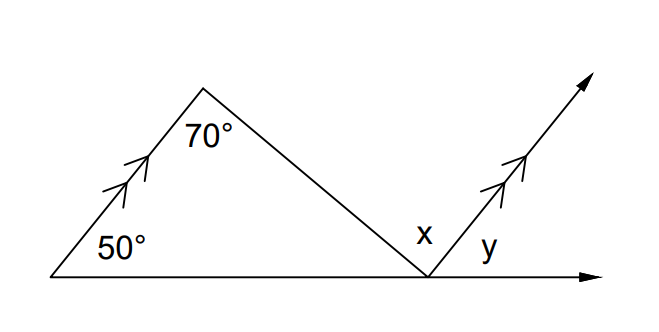
The angles in a triangle sum up to $180^{circ}$. Therefore the missing interior angle is
$$
180^{circ} – (80^{circ}+25^{circ}) = 180^{circ}-105^{circ} = 75^{circ}.
$$
And now since angles $75^{circ}$ and $x$ sum up to a straight angle we have
$$
x+75^{circ} = 180^{circ} implies x= 180^{circ}-75^{circ} = 105^{circ}.
$$
Therefore we finally conclude that
$$
color{#c34632} x=105^{circ}.
$$
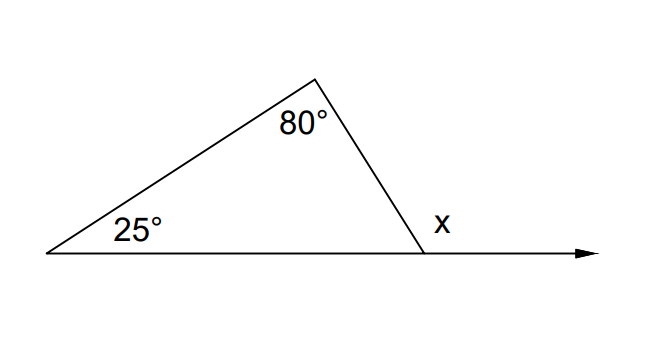
b. $x=105^{circ}$
$39^2=15^2+x^2$ (Pythagorean theorem)
$x^2=1521-225=1269$
$$
x=36
$$
$30^2=10^2+x^2$ (Pythagorean theorem)
$x^2=900-100=800$
$$
x=20 sqrt 2
$$
b- $x=20 sqrt 2$
Let $x$ be the number of days. Thus the total cost of renting a car i.e. $f(x)$ can be mathematically with the help of a table given below:
|No, of days, $x$ |$f(x)$ |
|–|–|
| 1|39 |
| 2|39+23= 62 |
| 3|62+ 23= 85 |
| 4|85+ 23= 108 |
| 5|131+ 23= 131 |

The graph of this function is a step-function/ integer- function.
Domain $rightarrow [0, n]$, where $n$ is an integer number of days.
Range $rightarrow (39, 39+23, 39+ 2(23)+…..)$
Equation to model the relationship is as follows:
Let $y$ be the total cost then mathematically it is given as follows:
$$begin{aligned}
&boxed{y= 39 + 23(x)}
end{aligned}$$
where $x$ is the number of days.
In order to describe the transformation in the graph we will first make a new table.
|No, of days, $x$ |$f(x)$ |
|–|–|
| 1|50 |
| 2|50+23= 73 |
| 3|73+ 23= 96 |
| 4|96+ 23= 119 |
| 5|119+ 23= 142 |
Sketching the graph using the information described above.

Graph of downloads of free apps.


Average rate of change for each type of app from 2010 to 2015.
$$begin{aligned}
text{Average rate}&= dfrac{text{Highest frequency}- text{Lowest frequency}}{text{Highest frequency}- text{Lowest frequency}}\
end{aligned}$$
Thus,
$$begin{aligned}
text{Average rate of free apps}&=dfrac{288-22}{5-0}\\
&= dfrac{266}{5}\\
&= 53.2\\
end{aligned}$$
And,
$$begin{aligned}
text{Average rate of paid apps}&=dfrac{22-3}{5-0}\\
&= dfrac{19}{5}\\
&= 3.8\\
end{aligned}$$
$$begin{aligned}
y- y_1&= m (x – x_1)\
end{aligned}$$
where, $y_1 = 288$, $m (text{average} = 53.2)$, and $x_1 = 5$.
Substituting the values:
$$begin{aligned}
y – 288&= 53.2 (x- 5)\
y&=53.2 (x- 5)+ 288\
end{aligned}$$
At $x = 10$.
$$begin{aligned}
y&= 53.2(5)+ 288\
y&= 266 + 288\
y&= 544\
end{aligned}
$y_1 = 22$, $m (text{average} = 3.8)$, and $x_1 = 5$.
Substituting the values:
$$begin{aligned}
y – 22&= 3.8 (x- 5)\
y&=3.8 (x- 5)+ 22\
end{aligned}$$
At $x = 10$.
$$begin{aligned}
y&= 3.8(5)+ 22\
y&= 19 + 22\
y&= 41\
end{aligned}
The function to model the number of free apps downloaded based on the year
$$y-y_1=m(x-x_1)$$
Graph of downloads of free apps.

The function to model the number of paid apps downloaded based on the year
$$y-y_1=m(x-x_1)$$
Graph of downloads of paid apps.

The average rate of free app $=53.2$
The average rate of paid app $=2.8$
The number of free apps will be downloaded in 2020
$$y =53.2(2020-2010)=532$$
The number of paid apps will be downloaded in 2020
$$y =2.8(2020-2010)=28$$
No, this predictions are not reasonable.
Ms. LaCarre needs more information and data to get the correct function for making an informed decision.
A function to model the total number of apps downloaded based on the year.
$$y=(x-h)^2+k$$
A reasonable domain for the model of the total number of apps downloaded is
$$D=[2015,infty)$$
The percentage of the apps downloaded each year are free
| Year|Percentage |
|–|–|
|2010 |$3%$ |
|2011 | $5.53%$|
|2012 |$10%$ |
|2013 | $16.4%$|
|2014 |$25.8%$ |
|2015 |$39.3%$ |
The average rate of change in percentage of free apps downloaded from 2010 to 2015
$$Avg=dfrac{39.3-3%}{2015-2010}=7.26$$
The function for the percentage of free apps (out of all apps) that are downloaded each year.
$$p=dfrac{textrm{The number of apps downloaded each year are free}}{textrm{Total number of apps downloaded free}}times 100%$$
1. Study the case carefully.
2. Prepare a report for Ms. LaCarre detailing your findings and your recommendations.
3. Prediction for what app sales in 2020
1. Prepare your Learning Log.
2. Open a new page with title “Developing a Mathematical Model” .
3. Write an entry addressing the steps involved in creating a mathematical model, including examples for each step.
|Number of people |Number of Bus|
|–|–|
|45|1|
|90|2|
|135|3|

t(1)=10.25times1.03=10.5575=$10.56
$$
t(n)=t(1)r^{n-1}=10.5575(1.03)^{n-1}
$$
t(10)=10.5575(1.03)^{10-1}=$13.78
$$
The graph of the function: $(x-5)^2+(y-8)^2=49$
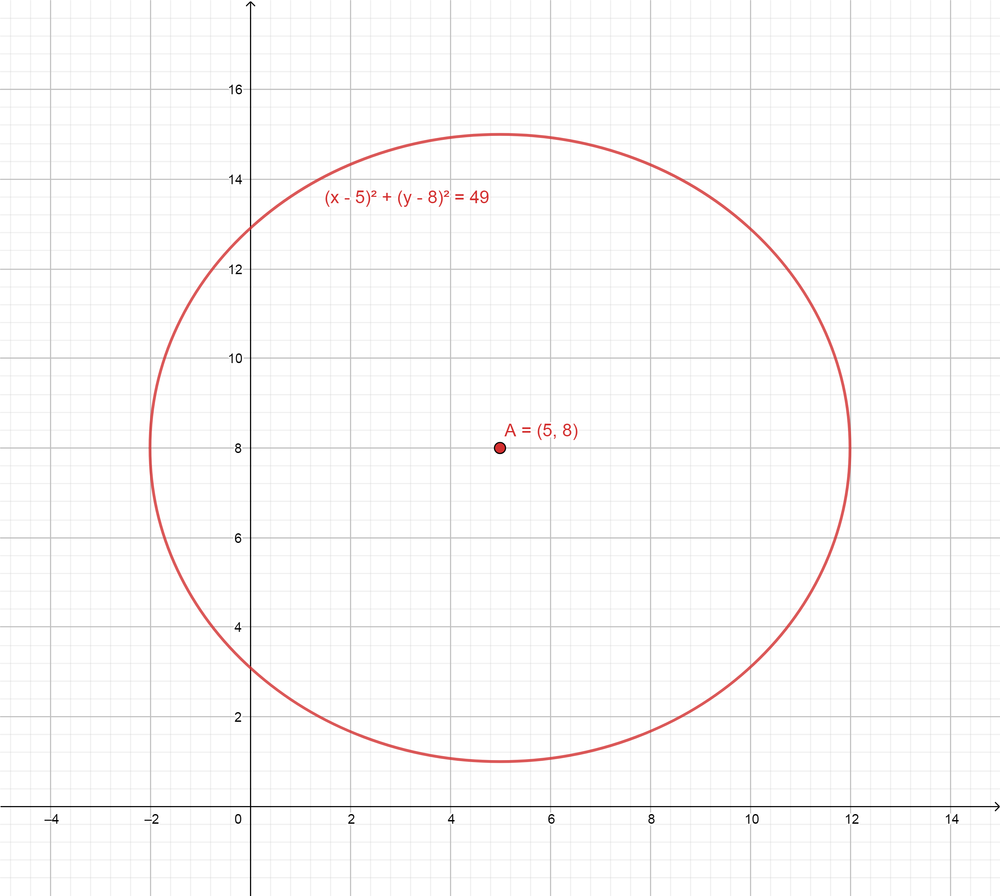
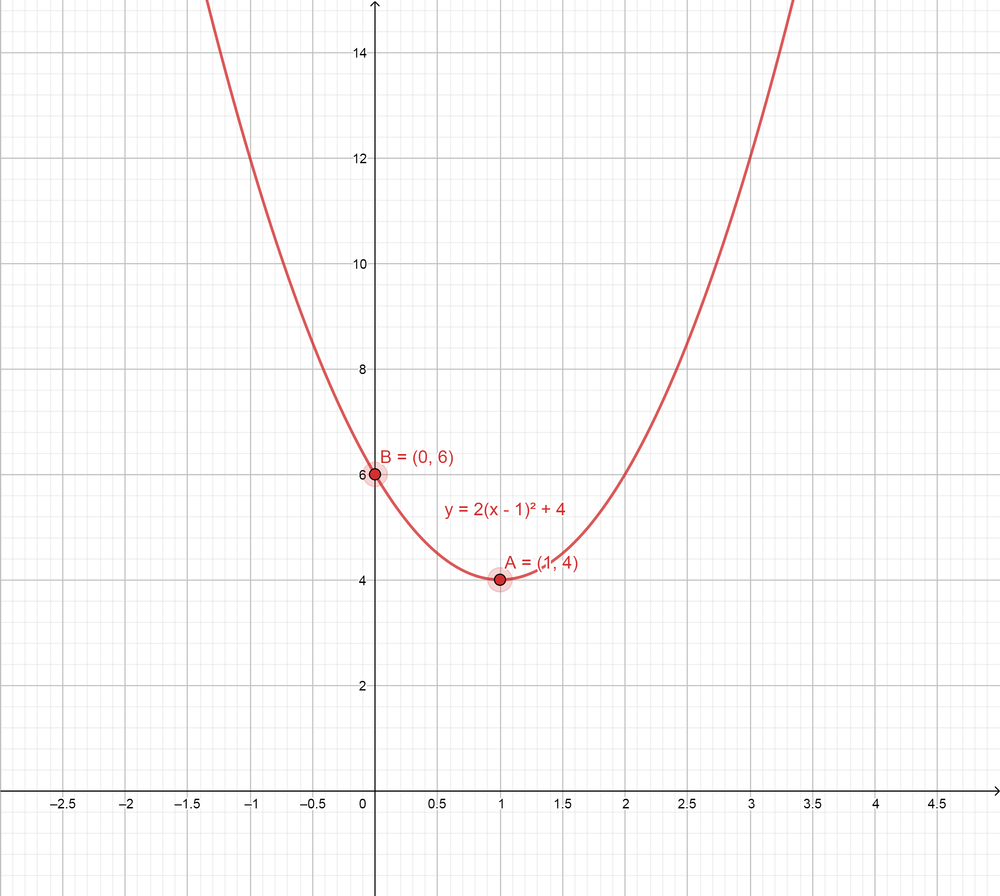
$y=2(x-1)^2+4$
$y=2(x^2-2x+1)+4$
$y=2x^2-4x+6$
There will never be any difference between the graph, they are coincident. Because it the same equation in a different form.
The parent function of $y=2(x-1)^2+4$ is $y=x^2$
The parent function of $y=2x^2-4x+6$ is $y=x^2$
b- There will never be any difference between the graphs
c- The parent function of $y=2(x-1)^2+4$ is $y=x^2$
d- The parent function of $y=2x^2-4x+6$ is $y=x^2$
$$
begin{align*}
tantheta &= mathrm{frac{opposite leg}{adjacent leg}} \
sintheta &= mathrm{frac{opposite leg}{hypotenuse}} \
costheta &= mathrm{frac{adjacent leg}{hypotenuse}}
end{align*}
$$
$$
{color{#c34632}cancel{color{Black}#1}color{Black}}
$$
#### (a)
Using this we can see that the cosine of $angle C$ is given by
$$
cos(mangle C) = frac{redcancel 8 sqrt{3}}{color{#c34632}_{2,,}redcancel{16}} = frac{sqrt{3}}{2}
$$
Putting $arccos(sqrt{3}/2)$ in a calculator, we then find that $mangle C = 30text{textdegree}$.
$$
{color{#c34632}cancel{color{Black}#1}color{Black}}
$$
#### (b)
Again, we are given the adjacent leg and hypotenuse, so we can use the cosine of $angle C$ and a calculator to find $mangle C$. This time
$$
cos(mangle C) = frac{12}{13}
$$
Putting $arccos(12/13)$ in a calculator, we then find that $mangle C approx 22.62text{textdegree}$.
(b) 22.62$text{textdegree}$
$cos C=dfrac {8 cdot sqrt {3}}{16}=dfrac {sqrt {3}}{2}$
$$
mangle C=30text{textdegree}
$$
$cos C=dfrac {12}{13}=0.9231$
$$
mangle C=22.62text{textdegree}
$$
b- $mangle C=22.62text{textdegree}$
By graphing $f(x)$ and $f(-x)$ it is noted that the graph of $f(-x)$ a reflection over the x-axis for the function $f(x)$
So. the function is odd.
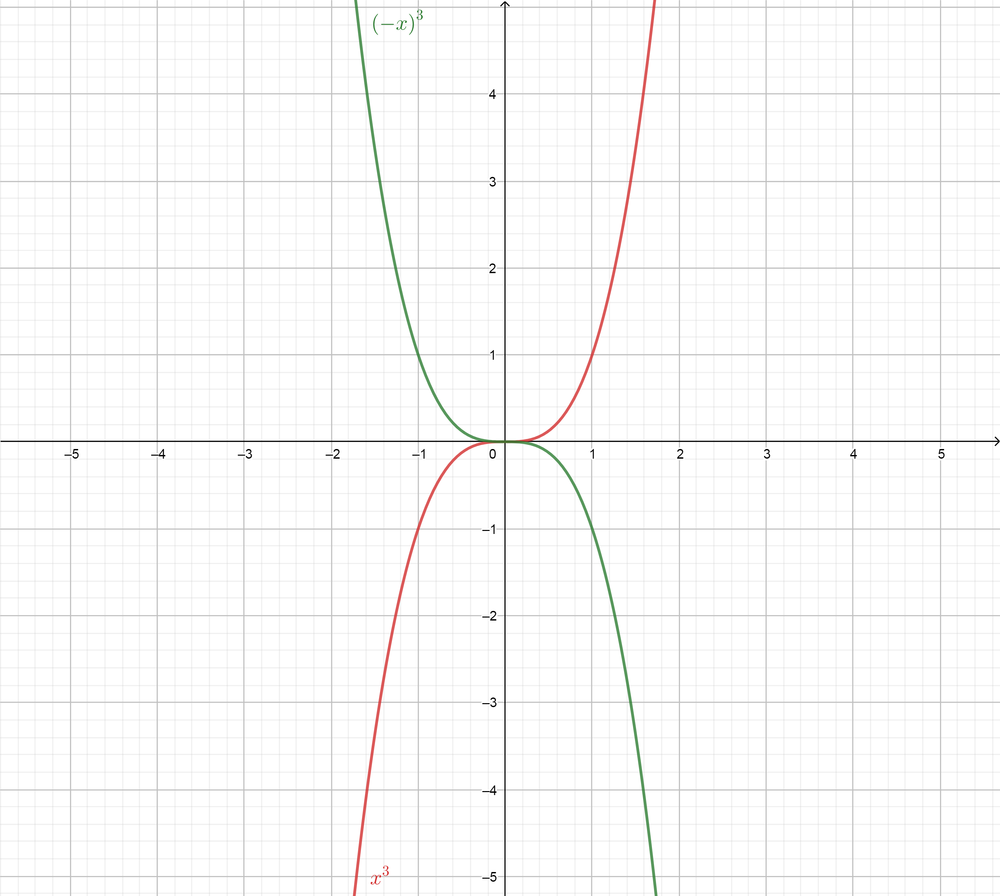
The table shows that for each value of $x$ and $-x$,\
$$f(-x)=-f(x)$$
So, the function is odd.\
begin{center}
renewcommand{arraystretch}{1.5}
begin{tabular}{|r|r|r|r|}
hline
x & $f(x)$ & $f(-x)$ & \
hline
-5 & -125 & 125 & \
hline
-4 & -64 & 64 & \
hline
-3 & -27 & 27 & \
hline
-2 & -8 & 8 & \
hline
-1 & -1 & 1 & \
hline
0 & 0 & 0 & \
hline
1 & 1 & -1 & \
hline
2 & 8 & -8 & \
hline
3 & 27 & -27 & \
hline
4 & 64 & -64 & \
hline
8 & 512 & -512 & \
hline
end{tabular}
end{center}
$f(-x)=(-x)^3=-x^3=-f(x)$
So, the function is odd.
From the table, we notice that $f(-x)=-f(x)$
Let us solve the following equation
$$
color{#4257b2} sqrt{3x-6}+6=12.
$$
First we subtract $6$ from both sides of the equation and get
$$
sqrt{3x-6}+6-6=12-6 implies sqrt{3x-6}=6.
$$
Now we square both sides of the equation. This yields
$$
begin{align*}
(sqrt{3x-6})^2 &=6^2 \
3x-6 &=36 \
3x &= 36+6 \
3x &=42 \
x&= frac{42}{3} = 14.
end{align*}
$$
Therefore, the solution of the given equation is
$$
color{#c34632} x=14.
$$
$$
sqrt{3 cdot 14 -6} +6 = sqrt{42-6}+6=sqrt{36}+6=6+6=12.
$$
Therefore, the solution is correct.
Let us solve the following equation
$$
color{#4257b2} 11x^2=-10x-11.
$$
First we transform the equation a little bit and get
$$
11x^2+10x+11=0.
$$
Since the expression of the left is a quadratic function we can use the quadratic formula
$$
x = frac{-b pm sqrt{b^2-4ac}}{2a}.
$$
We have
$$
a=11 hspace{12mm} b=10 hspace{12mm} c=11.
$$
Hence, we have
$$
begin{align*}
x &= frac{-10 pm sqrt{10^2-4 cdot 11 cdot 11}}{2 cdot 11} \
x &= frac{-10 pm sqrt{100-484}}{22} \
x &= frac{-10 pm sqrt{-384}}{22} \
x &= frac{-10 pm sqrt{384i^2}}{22} \
x &= frac{-10 pm sqrt{6 cdot 64i^2}}{22} \
x &= frac{-10pm 8sqrt{6}i}{22} \
x &= frac{-10 + 8sqrt{6}i}{22} hspace{3mm} text{or} hspace{3mm} frac{-10 – 8sqrt{6}i}{22}\
x &= frac{2(-5 + 4sqrt{6}i)}{22} hspace{3mm} text{or} hspace{3mm} frac{2(-5 – 4sqrt{6}i)}{22}\
x &= frac{-5 + 4sqrt{6}i}{11} hspace{3mm} text{or} hspace{3mm} frac{-5 – 4sqrt{6}i}{11}.
end{align*}
$$
Therefore, the solutions are
$$
color{#c34632} x=frac{-5 + 4sqrt{6}i}{11} hspace{3mm} text{color{default}or} hspace{3mm} x=frac{-5 – 4sqrt{6}i}{11}.
$$
$$
begin{align*}
11(frac{-5 + 4sqrt{6}i}{11})^2 &=-10 cdot frac{-5 + 4sqrt{6}i}{11} -11 \
11 cdot frac{(-5)^2+2 cdot (-5) cdot 4sqrt{6}i +16 cdot 6i^2}{121} &=frac{50 -40sqrt{6}i}{11} – frac{121}{11} \
frac{25-40sqrt{6}i -96}{11} &=frac{50 -40sqrt{6}i-121}{11} \
frac{-71-40sqrt{6}i }{11} &=frac{-71 -40sqrt{6}i}{11}
end{align*}
$$
Therefore, $x=frac{-5 + 4sqrt{6}i}{11}$ is a correct solution.
$$
begin{align*}
11(frac{-5 – 4sqrt{6}i}{11})^2 &=-10 cdot frac{-5 – 4sqrt{6}i}{11} -11 \
11 cdot frac{(-5)^2-2 cdot (-5) cdot 4sqrt{6}i +16 cdot 6i^2}{121} &=frac{50+40sqrt{6}i}{11} – frac{121}{11} \
frac{25+40sqrt{6}i -96}{11} &=frac{50 +40sqrt{6}i-121}{11} \
frac{-71+40sqrt{6}i }{11} &=frac{-71 +40sqrt{6}i}{11}
end{align*}
$$
Finally, we can conclude that both solutions are correct.
begin{align*}
&text{a.} hspace{2mm} x=6 \
&text{b.} hspace{2mm} x=frac{-5 + 4sqrt{6}i}{11} hspace{3mm} text{or} hspace{3mm} x=frac{-5 – 4sqrt{6}i}{11}
end{align*}
$$
By graphing both equations, we find that both graphs are coincident.
So, both equations are equivalent.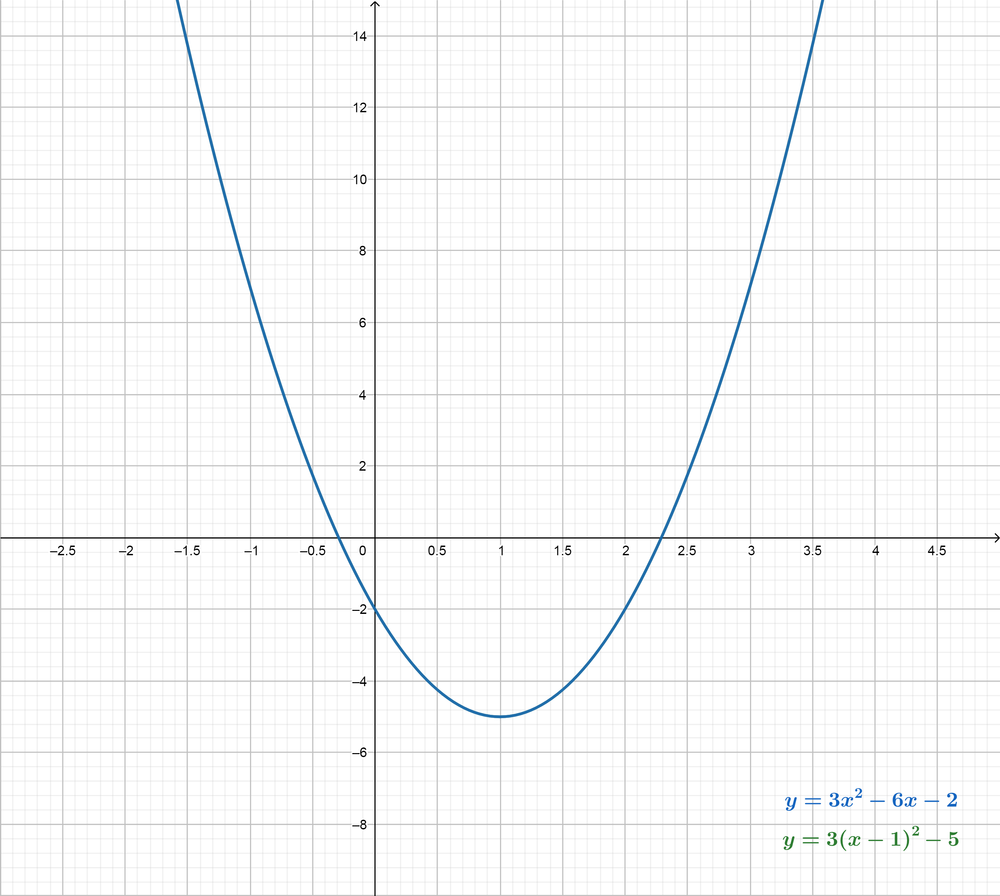
Starting with the first equation:
$y_{1}=3(x-1)^2-5$
$y_{1}=3(x^2-2x+1)-5$
$y_{1}=3x^2-6x+3-5$
$$
y_{1}=3x^2-6x-2=y_{2}
$$
The value for $a$ would be the same number on both forms of the equation because it is the factor of stretch or compress.
If $|a|>1$ the graph is stretching.
If $|a|0$ the parabola opens up.
If $a<0$ the parabola opens down.
b- Starting with the first equation: $y_{1}=3x^2-6x-2=y_{2}$
c- The value for $a$ would be the same number on both forms of the equation because it is the factor of stretch or compress. and the sign of the factor $a$ determines the open direction of the parabola.
a) $sqrt{x}+sqrt{y}+5sqrt{x}+2sqrt{y}=qquadqquadqquad$ $color{#c34632} text{[combine like terms]}$
$=big(sqrt{x}+5sqrt{x}big)+big(sqrt{y}+2sqrt{y}big)=$
$=color{#4257b2} text{$6sqrt{x}+3sqrt{y}$}$
b) $big(2sqrt{8}big)^2=qquadqquadqquadqquad$
$color{#c34632} text{[apply the power of a product property: $,,,(acdot b)^c=a^ccdot b^c$]}$
$=2^2cdot big(sqrt{8}big)^2=$
$=4cdot 8=$
$=color{#4257b2} text{$32$}$
c) $dfrac{sqrt{50}}{sqrt{2}}=qquadqquadqquadqquadqquad$ $color{#c34632} text{[rewrite $50$ as $2sqrt{25}$]}$
$=dfrac{sqrt{2cdot 25}}{sqrt{2}}=qquadqquadqquadqquad$ $color{#c34632} text{[recall: $,,,sqrt{acdot b}=sqrt{a}sqrt{b}$]}$
$=dfrac{cancel{sqrt{2}}sqrt{25}}{cancel{sqrt{2}}}=$
$=color{#4257b2} text{$5$}$
d) $sqrt{dfrac{3}{4}}=qquadqquadqquadqquadqquad$ $color{#c34632} text{$Bigg[$recall: $,,,sqrt{dfrac{a}{b}}=dfrac{sqrt{a}}{sqrt{b}}Bigg]$}$
$=dfrac{sqrt{3}}{sqrt{4}}=$
$$
=color{#4257b2} text{$dfrac{sqrt{3}}{2}$}
$$
The domain of the function is: $(0 leq x)$
The range of the function is: $(3 leq y)$
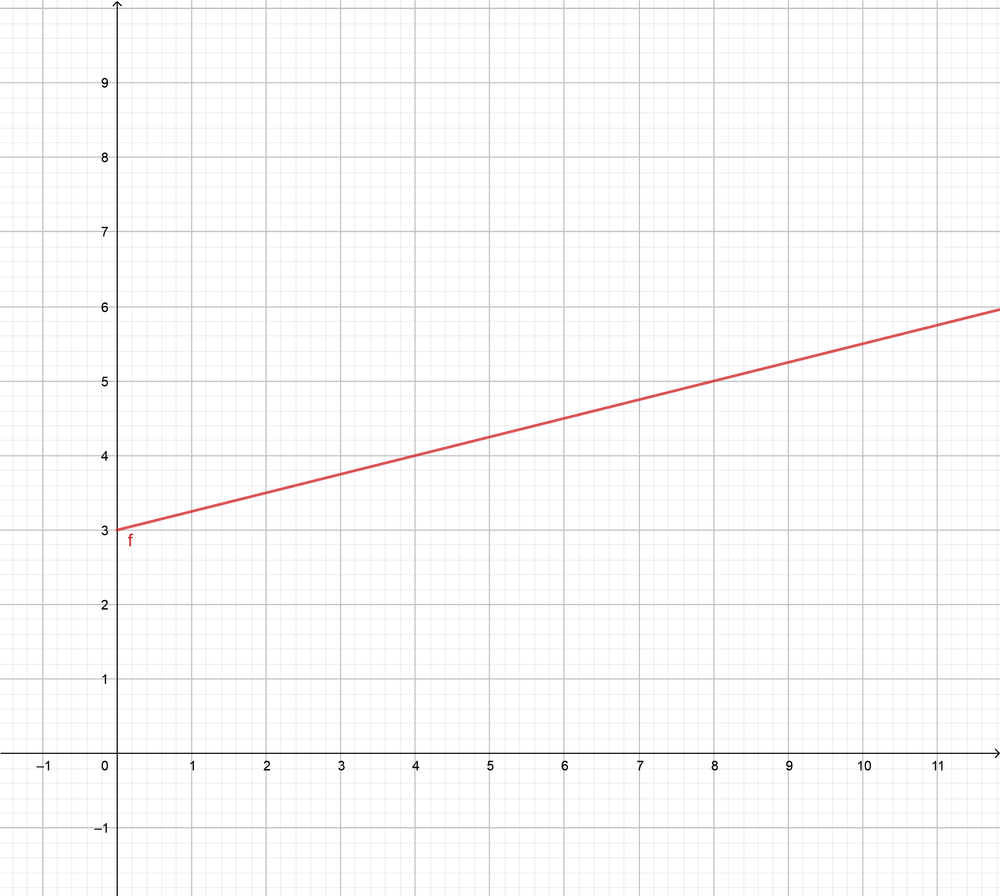
The range of the function is: $(3 leq y)$
Let us solve the following equation
$$
color{#4257b2} x^2-x-6=0.
$$
Since the expression of the left is a quadratic function we can use the quadratic formula
$$
x = frac{-b pm sqrt{b^2-4ac}}{2a}.
$$
We have
$$
a=1 hspace{12mm} b=-1 hspace{12mm} c=-6.
$$
Hence, we have
$$
begin{align*}
x &= frac{-(-1) pm sqrt{(-1)^2-4 cdot 1 cdot (-6)}}{2 cdot 1} \
x &= frac{1 pm sqrt{1+24}}{2} \
x &= frac{1 pm sqrt{25}}{2} \
x &= frac{1 pm 5}{2} \
x &= frac{1 + 5}{2} hspace{3mm} text{or} hspace{3mm} frac{1-5}{2} \
x &= frac{6}{2} hspace{3mm} text{or} hspace{3mm} frac{-4}{2} \
x &= 3 hspace{3mm} text{or} hspace{3mm} -2.
end{align*}
$$
Therefore, the solutions are
$$
color{#c34632} x=3 hspace{3mm} text{color{default}or} hspace{3mm} x=-2.
$$
Let us solve the following equation
$$
color{#4257b2} 5x^2-8=12x.
$$
First we transform the equation a little bit and get
$$
5x^2-12x-8=0.
$$
Since the expression of the left is a quadratic function we can use the quadratic formula
$$
x = frac{-b pm sqrt{b^2-4ac}}{2a}.
$$
We have
$$
a=5 hspace{12mm} b=-12 hspace{12mm} c=-8.
$$
Hence, we have
$$
begin{align*}
x &= frac{-(-12) pm sqrt{(-12)^2-4 cdot 5 cdot (-8)}}{2 cdot 5} \
x &= frac{12 pm sqrt{144+160}}{10} \
x &= frac{12 pm sqrt{304}}{10} \
x &= frac{12 pm sqrt{16 cdot 19}}{10} \
x &= frac{12 pm 4sqrt{19}}{10} \
x &= frac{12 + 4sqrt{19}}{10} hspace{3mm} text{or} hspace{3mm} frac{12 – 4sqrt{19}}{10} \
x &= frac{2(6 + 2sqrt{19})}{10} hspace{3mm} text{or} hspace{3mm} frac{2(6 – 2sqrt{19})}{10} \
x &= frac{6 + 2sqrt{19}}{5} hspace{3mm} text{or} hspace{3mm} frac{6 – 2sqrt{19}}{5}.
end{align*}
$$
Therefore, the solutions are
$$
color{#c34632} x=frac{6 + 2sqrt{19}}{5} hspace{3mm} text{color{default}or} hspace{3mm} x=frac{6 – 2sqrt{19}}{5}.
$$
Let us solve the following equation
$$
color{#4257b2} x^2+8x+20=0.
$$
Since the expression of the left is a quadratic function we can use the quadratic formula
$$
x = frac{-b pm sqrt{b^2-4ac}}{2a}.
$$
We have
$$
a=1 hspace{12mm} b=8 hspace{12mm} c=20.
$$
Hence, we have
$$
begin{align*}
x &= frac{-8 pm sqrt{8^2-4 cdot 1 cdot 20}}{2 cdot 1} \
x &= frac{-8 pm sqrt{16-80}}{2} \
x &= frac{-8 pm sqrt{-64}}{2} \
x &= frac{-8 pm sqrt{64i^2}}{2} \
x &= frac{-8 pm 8i}{2} \
x &= frac{-8+8i}{2} hspace{3mm} text{or} hspace{3mm} frac{-8-8i}{2} \
x &= frac{2(-4+4i)}{2} hspace{3mm} text{or} hspace{3mm} frac{2(-4-4i)}{2} \
x &= -4+4i hspace{3mm} text{or} hspace{3mm} -4-4i.
end{align*}
$$
Therefore, the solutions are
$$
color{#c34632} x=-4+4i hspace{3mm} text{color{default}or} hspace{3mm} x=-4-4i.
$$
Let us solve the following equation
$$
color{#4257b2} 2y^2-5y=12.
$$
First we transform the equation a little bit and get
$$
2y^2-5y-12=0.
$$
Since the expression of the left is a quadratic function we can use the quadratic formula
$$
y = frac{-b pm sqrt{b^2-4ac}}{2a}.
$$
We have
$$
a=2 hspace{12mm} b=-5 hspace{12mm} c=-12.
$$
Hence, we have
$$
begin{align*}
y &= frac{-(-5) pm sqrt{(-5)^2-4 cdot 2 cdot (-12)}}{2 cdot 2} \
y &= frac{5 pm sqrt{25+96}}{4} \
y &= frac{5 pm sqrt{121}}{4} \
y &= frac{5 pm 11}{4} \
y &= frac{5 + 11}{4} hspace{3mm} text{or} hspace{3mm} frac{5-11}{4} \
y &= frac{16}{4} hspace{3mm} text{or} hspace{3mm} frac{-6}{4} \
y &= 4 hspace{3mm} text{or} hspace{3mm} -frac{3}{2}.
end{align*}
$$
Therefore, the solutions are
$$
color{#c34632} y=4 hspace{3mm} text{color{default}or} hspace{3mm} y=-frac{3}{2}.
$$
begin{align*}
&text{a.} hspace{2mm} x=3 hspace{3mm} text{color{default}or} hspace{3mm} x=-2 \
&text{b.} hspace{2mm} x=frac{6 + 2sqrt{19}}{5} hspace{3mm} text{color{default}or} hspace{3mm} x=frac{6 – 2sqrt{19}}{5} \
&text{c.} hspace{2mm} x=-4+4i hspace{3mm} text{color{default}or} hspace{3mm} x=-4-4i \
&text{d.} hspace{2mm} y=4 hspace{3mm} text{color{default}or} hspace{3mm} y=-frac{3}{2}
end{align*}
$$
$y=-dfrac {1}{2}x+6$ (Given)
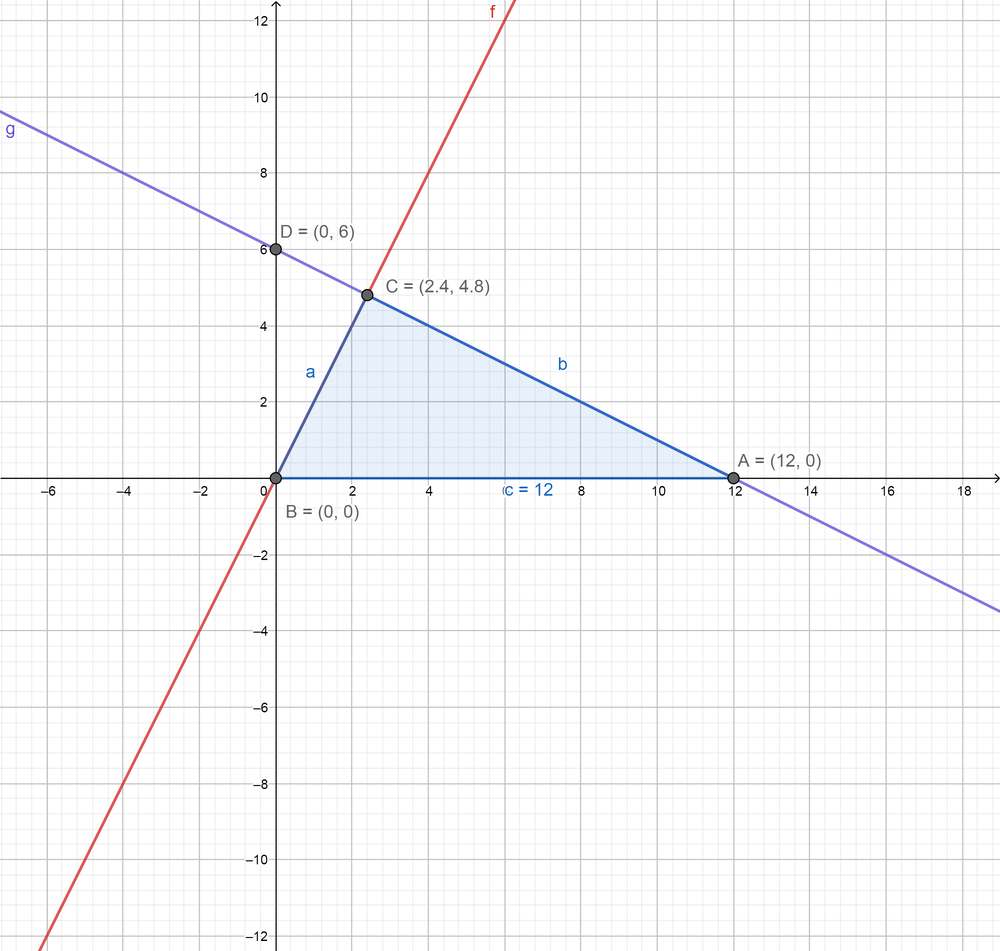
$y=2x$ (Given)
x-intercept is $(0, 0)$
y-intercept is $(0, 0)$
$y=-dfrac {1}{2}x+6$ (Given)
x-intercept is $(12, 0)$
y-intercept is $(0, 6)$
The domain of the shaded region is: $(0 leq x leq 12)$
The range of the shaded region is: $(0 leq y leq 4.8)$
The shaded area is a triangle.
The are of the triangle: $a=dfrac {1}{2}bh$
$b=moverline {AB}=12-0=12$
$h=4,8$ ($y$ coordinate of the point $C$)
$a=dfrac {1}{2} times 12 times 4.8$
$a=28.8$
$y=2x$
x-intercept and y-intercept is $(0, 0)$
$y=-dfrac {1}{2}x+6$
x-intercept is $(12, 0)$ y-intercept is $(0, 6)$
c- Shaded region domain: $(0 leq x leq 12)$ Range is: $(0 leq y leq 4.8)$
d- The are of the shaded region $=28.8$ Square units.
$$begin{aligned}
h(x) &= -3x^{2}-11x+4\
end{aligned}$$
(a) Put the value of $x=0$,
$$begin{aligned}
h(0) &= -3(0)^{2}-11(0)+4\
&boxed {h(0) = 4}\
end{aligned}$$
$$begin{aligned}
h(x) &= -3x^{2}-11x+4\
end{aligned}$$
(a) Put the value of $x=0$,
$$begin{aligned}
h(0) &= -3(0)^{2}-11(0)+4\
&boxed {h(0) = 4}\
end{aligned}$$
$$begin{aligned}
h(2) &= -3(2)^{2}-11(2)+4\
h(2) &= -12-22+4\
&boxed {h(2) = -30}\
end{aligned}$$
$$begin{aligned}
h(dfrac{1}{2}) &= -3(dfrac{1}{2})^{2}-11(dfrac{1}{2})+4\\
h(dfrac{1}{2}) &= -3(dfrac{1}{4})-11(dfrac{1}{2})+4\\
h(dfrac{1}{2}) &= -dfrac{3}{4} – dfrac{11}{2} + 4\\
&boxed {h(dfrac{1}{2}) = -2.25}\
end{aligned}$$
$$begin{aligned}
-3x^{2} – 11x + 4 &= 0\
3x^{2} + 11x – 4 &= 0\
end{aligned}$$
By using the splitting middle term, we get
$$begin{aligned}
3x^{2} + 12x – x- 4 &= 0\
3x(x + 4) – (x- 4) &= 0\
(3x-1) (x-4) &= 0\
rightarrow 3x-1 &= 0\
3x &= 1\
boxed {x = dfrac{1}{3}}\\
rightarrow x-4 &= 0\
boxed {x =4} \
end{aligned}$$
The value of $x$ for which $h(x)=0$ is $-4, -dfrac{1}{3}$.
$(b.)$ -30
$(c.)$ 12
$(d.)$ -2.25
$(e.)$ -4 ; $dfrac{1}{3}$
$$y = x^{2} – 2x – 15$$
Now, bring the equation of the parabola by using the Completing of the square.
y = x^{2} – 2x + left(dfrac {2}{2}right)^{2} – left(dfrac {2}{2}right)^{2} – 15\
y = x^{2} – 2x +(1)^{2} – (1)^{2} – 15\\
boxed {y = (x-1)^{2} – 16}\
end{aligned}$$
Thus, this is an equation of the parabola.
$$y = x^{2} + 8x +10$$
Now, bring the equation of the parabola by using the Completing of the square.
y = x^{2}+ 8x + left(dfrac {8}{2}right)^{2} – left(dfrac {8}{2}right)^{2} +10\
y = x^{2} +8x +(4)^{2} – (4)^{2} + 10\
y = x^{2} + 8x +(16) – (16) + 10\
boxed {y = (x+4)^{2} – 6}\
end{aligned}$$
Thus, this is an equation of the parabola.
$$y = (x+4)^{2} – 6$$
Now just looking at the expression $x^{2}+8x+10$.
We can say that $x^{2}+8x+10$ is the sum of the area of a square with side length $x$, area of eight rectangular tiles with dimension $x$ by 1, and area of ten square tiles with unit side length.

By using one square tile of side length $x$, all the right rectangular tiles, and four out of nine square tiles of unit length, we get a square of side length $x+4$ and $6$ square of unit side length will be left.
Thus, we can write
$$begin{aligned}
y &= x^{2}+8x+10\
y &= x^{2}+8x+left (dfrac{8}{2}right)^{2} – left (dfrac{8}{2}right)^{2} + 10\\
y &= x^{2}+8x+(4)^{2} – (4)^{2} + 10\
y &= x^{2}+8x+16 -16 + 10\
y &= (x+4)^{2} – 6\
end{aligned}$$

From the equation $y = (x+4)^{2} – 6$
On comparing the given equation to the standard form of a parabola.
$$begin{aligned}
(y-k) &= a(x-h)^{2}\
y &= a(x-h)^{2} + k\
end{aligned}$$
where, $(h,k)$ is the vertex of the parabola.
$$boxed {text{Vertex }(-4, -6)}$$
|$x_1$ |$y_1$ |
|–|–|
| -4| -6|
|-6.499 |0 |
|-1.551 |0 |

Now just looking at the expression $x^{2}+4x+9$, we can say that $x^{2}+4x+9$ is the sum of the area of a square with side length $x$, area of four rectangular tiles with dimension $x$ by 1 and area of nine square tiles with unit side length.

By using one square tile of side length $x$, all the four rectangular tiles and four out of nine square tiles of unit length, we get a square of side length $x+2$ and $5$ square of unit side length will be left.
Thus, we can write
$$begin{aligned}
y &= x^{2}+4x+9\
y &= x^{2}+4x+left (dfrac{4}{2}right)^{2} – left (dfrac{4}{2}right)^{2} + 9\\
y &= x^{2}+4x+(2)^{2} – (2)^{2} + 9\
y &= (x+2)^{2} – 4+ 9\
y &= (x+2)^{2} + 5\
end{aligned}$$

From the equation $y = (x+2)^{2} + 5$
On comparing the given equation to the standard form of a parabola.
$$begin{aligned}
(y-k) &= a(x-h)^{2}\
y &= a(x-h)^{2} + k\
end{aligned}$$
where, $(h,k)$ is the vertex of the parabola.
$$boxed {text{Vertex }(-2, 5)}$$

We have to simplify the given algebraic expression
$$begin{aligned}
x^2+y^2+4x-8y+11&=0\
(x^2+4x+4)+(y^2-8y+16)-9&=0
end{aligned}$$


To complete the two squares 20 unit tiles are needed.
(c)
We write the equation in graphing form:
$$(x^2+2)+(y^2-4)=9$$
The graph of the equation is

$text{ a)} y = x^{2}+6x+7$
$text{ b)} f(x) = 3x^{2}+12x+11$
$text{ c)} x^{2}+y^{2}+2x-4y=4$
$text{ d)} f(x)=x^{2}+7x+2$
$text{ e)} y=2x^{2}+16x$
$text{ f)} x^{2}+y^{2}+y+2=8$
$$
begin{align*}
y&=x^{2}+6x+7\
y&=(x^{2}+6x+9)-9+7\
y&=(x+3)^{2}-2\
end{align*}
$$
Thus, the vertex of the equation from the graph mentioned below is $(-3,-2)$.
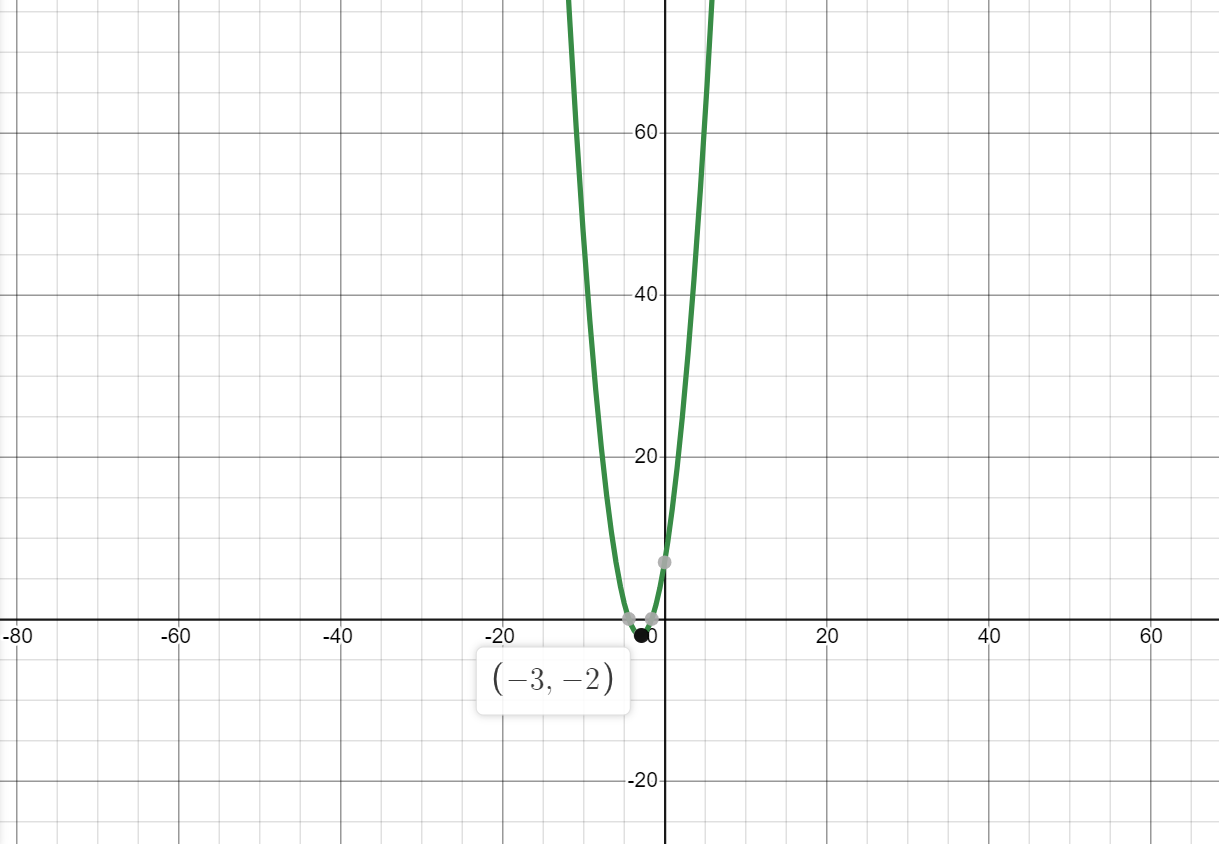
$$
begin{align*}
f(x)&=3x^{2}+12x+11\
f(x)&=3(x^{2}+4x+4)-12+11\
f(x)&=3(x+2)^{2}-1\
end{align*}
$$
Thus, the vertex of the equation from the graph mentioned below is $(-2,-1)$.
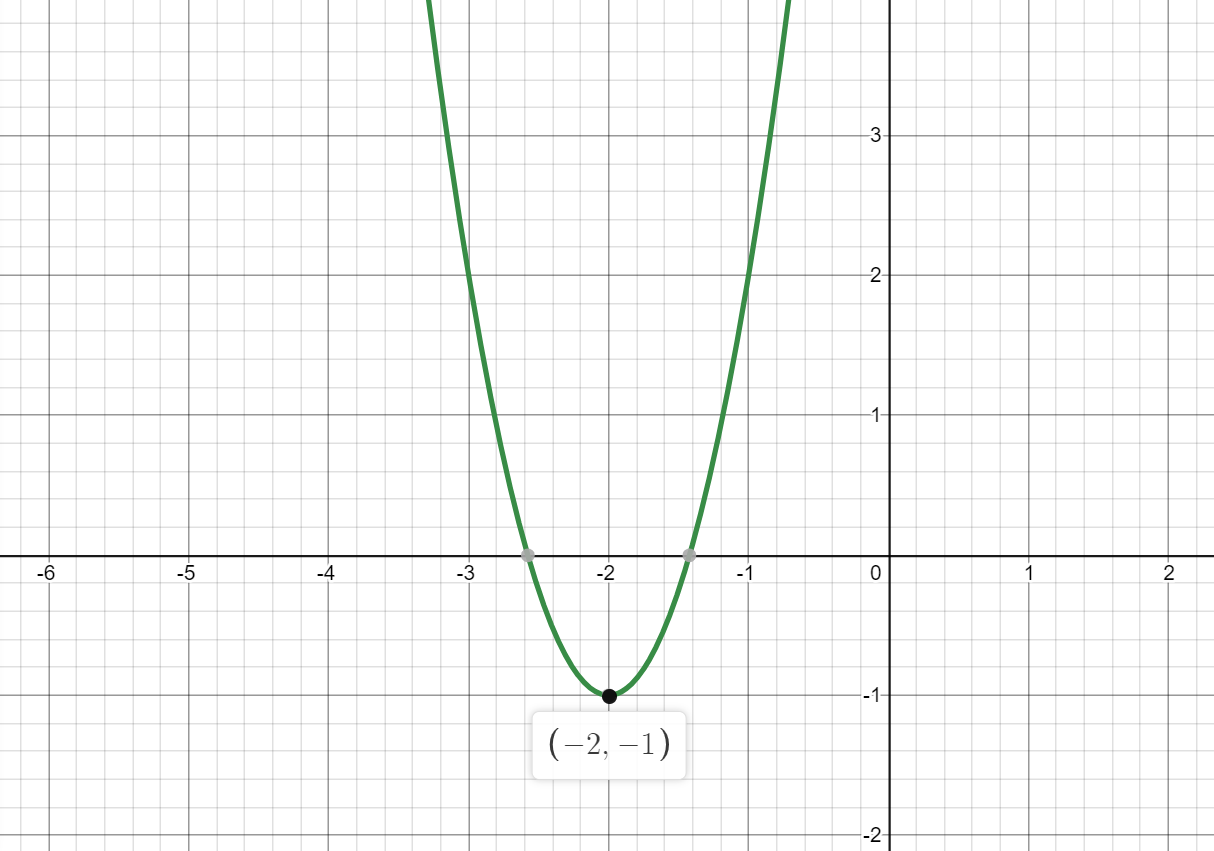
$$
begin{align*}
x^{2}+y^{2}-4y&=4 \
(x^{2}+2x+1)+(y^{2}-4y+4)-1-4&=4 \
(x+1)^{2}+(y+2)^{2}-5&=4 \
(x+1)^{2}+(y+2)^{2}&=4+5\
(x+1)^{2}+(y+2)^{2}&=9\
end{align*}
$$
Thus, the centre and the radius of the equation from the graph mentioned below is $(-1,2)$ and radius$= sqrt{9} = 3$ respectively.
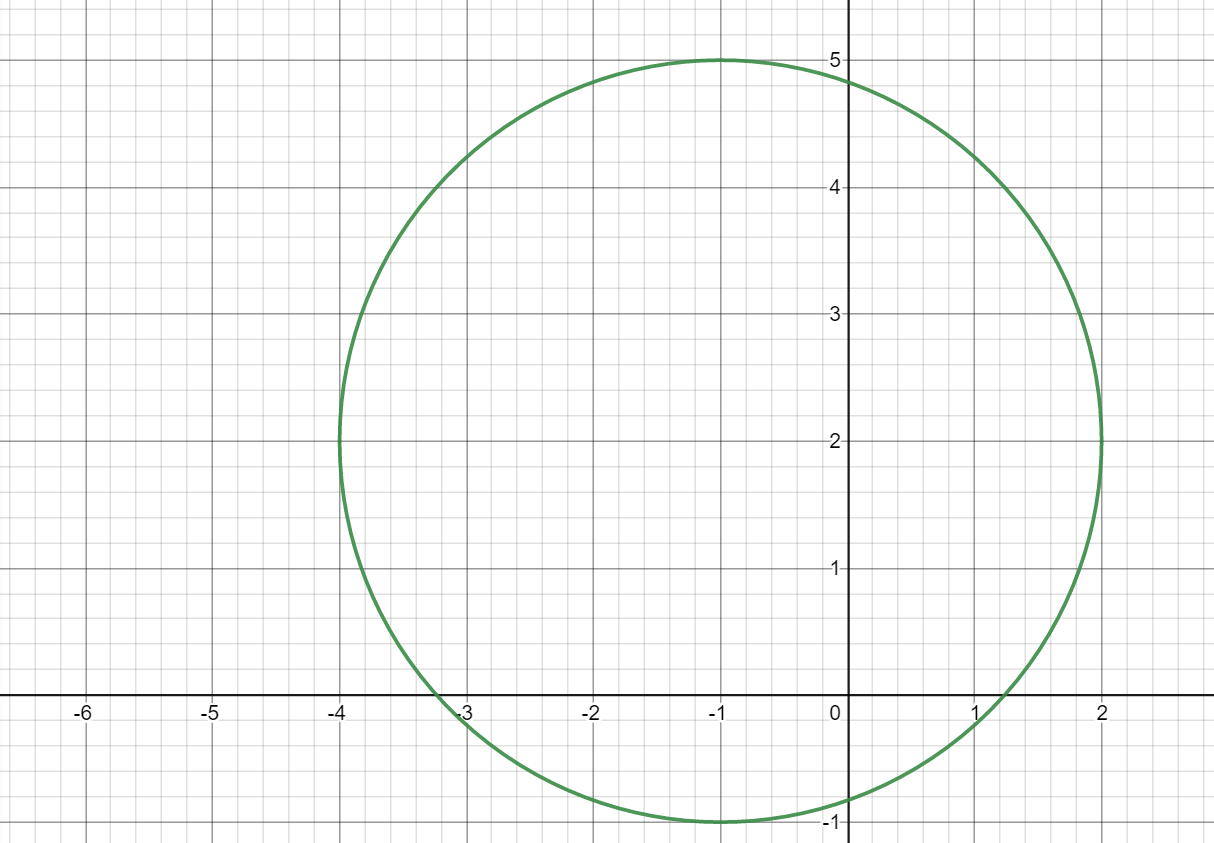
$$
begin{align*}
f(x)&=x^{2}+7x+2\
f(x)&=(x^{2}+2dfrac{7}{2}x+dfrac{49}{4})-dfrac{49}{4}+2 \
f(x)&=(x+dfrac{7}{2})^{2}-dfrac{41}{4} \
f(x)&=(x+3.5)^{2}-10.25 \
end{align*}
$$
Thus, the vertex of the equation from the graph mentioned below is $(-3.5,-10.25)$.
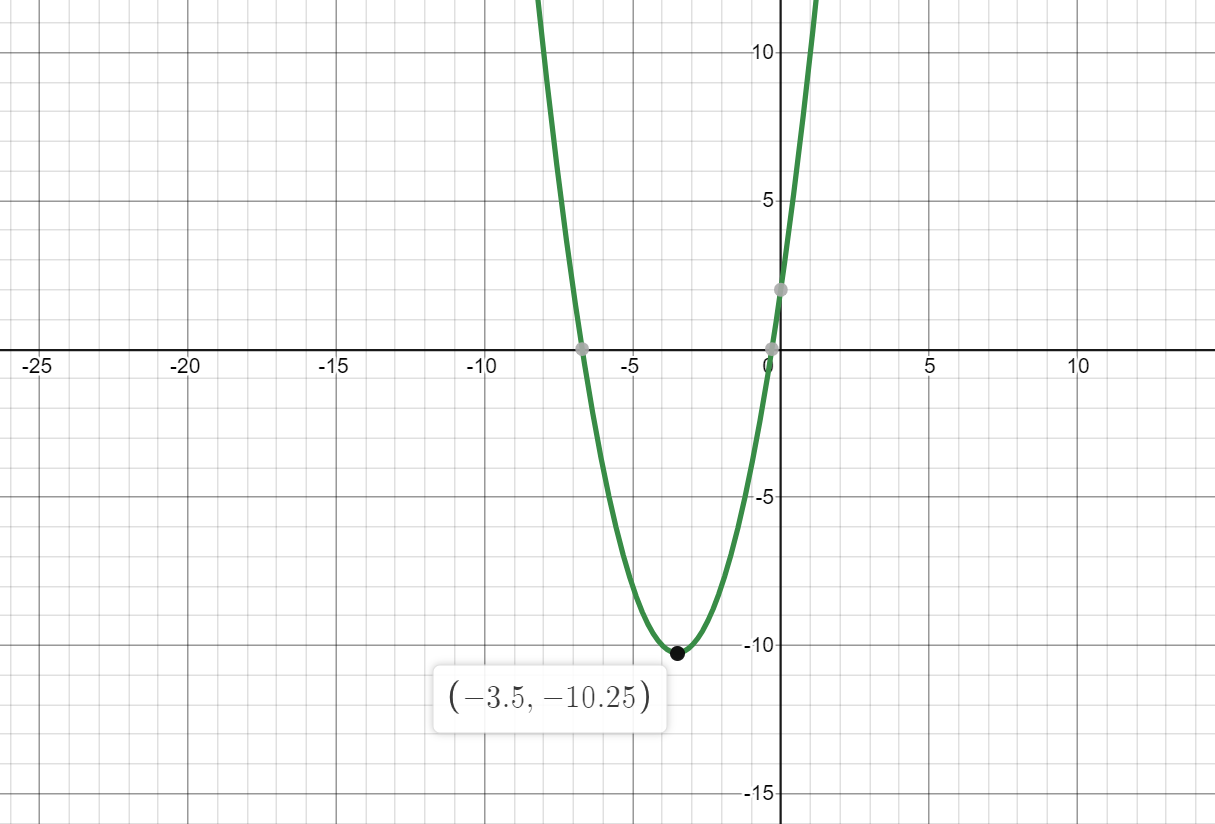
$$
begin{align*}
y&=2x^{2}+16x \
y&=2(x^{2}+8x+16)-32 \
y&=2(x+4)^{2}-32 \
end{align*}
$$
Thus, the vertex of the equation from the graph mentioned below is $(-4,-32)$.
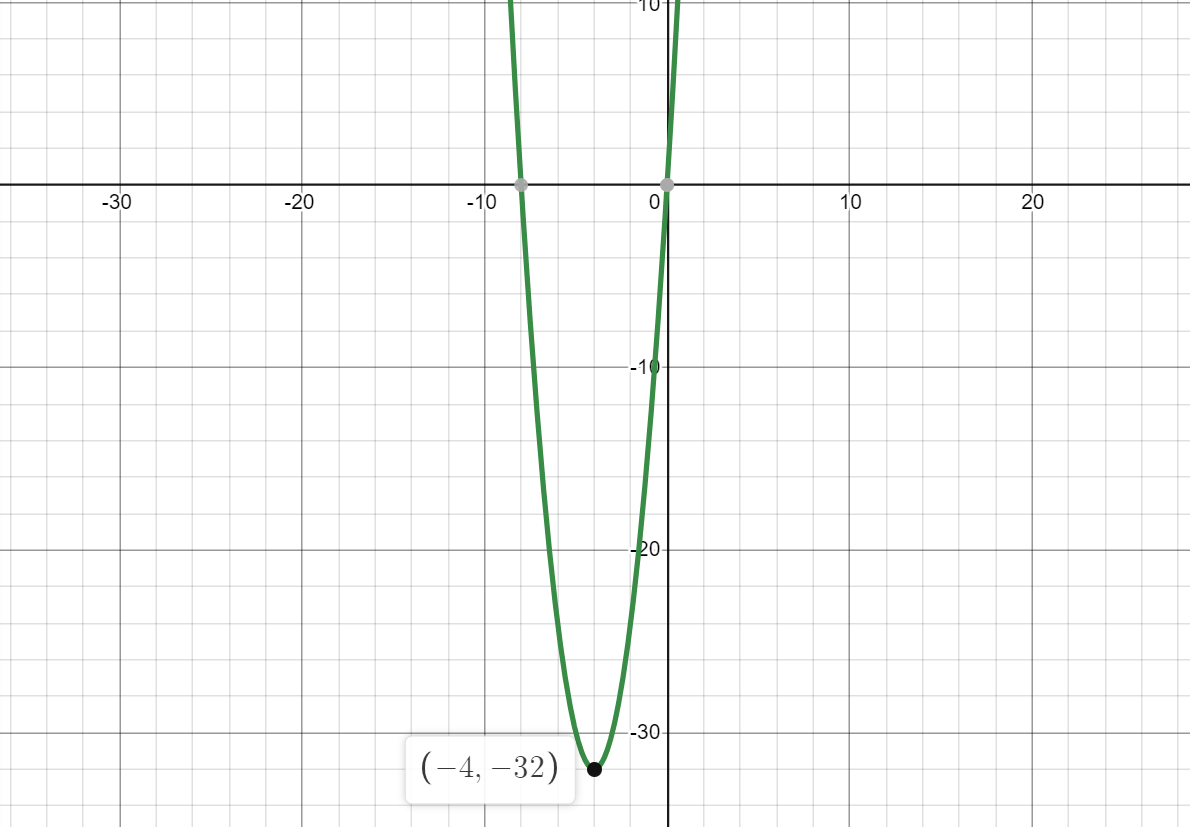
$$
begin{align*}
x^{2}+y^{2}+y+2&=8 \
x^{2}+(y^{2}+y+dfrac{1}{4})-dfrac{1}{4}+2&=8 \
x^{2}+(y+dfrac{1}{2})^{2}&=8+dfrac{1}{4}-2 \
x^{2}+(y+dfrac{1}{2})^{2}&=dfrac{25}{4}\
x^{2}+(y+0.5)^{2}&=6.25\
end{align*}
$$
Thus, the center and the radius of the equation from the graph mentioned below is $(0,-0.5)$ and radius$= sqrt{dfrac{25}{4}} = dfrac{5}{2} = 2.5$ respectively.
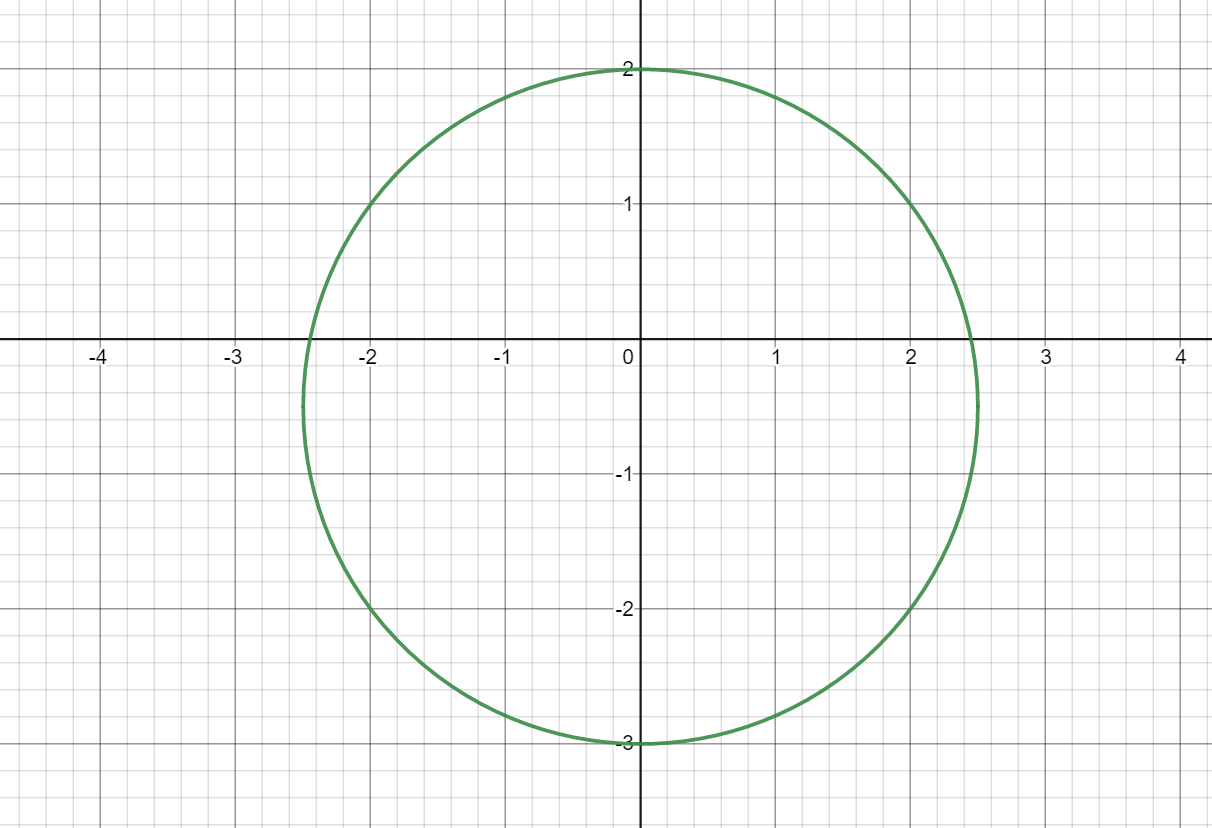
Steps by Raymond and Hannah,
$$
begin{align*}
(1) y&=4x^{2}-24x+7 \
(2) y-7&=4x^{2}-24x \
(3) y-7&=4(x^{2}-6x) \
(4) y-7+4(3^{2})&=4(x^{2}-6x+3^{2})\
(5) y+29&=4(x-3)^{2} \
(6) y&=4(x-3)^{2}-29\
end{align*}
$$
Steps by Aidan and Sarah,
$$
begin{align*}
(1) y&=4x^{2}-24x+7\
(2) y-7&=4x^{2}-24x\
(3) y-7&=4(x^{2}-6x)\
(4) y-7+9&=4(x^{2}-6x+9)\
(5) y+2&=4(x-3)^{2}\
(6) y&=4(x-3)^{2}-2\
end{align*}
$$
In order to find who is correct among the two teams, we will first bring the given equation in the graphing form
$$
begin{align*}
y&=4x^{2}-24x+7\
y-7&=4x^{2}-24x \
y-7&=4(x^{2}-6x)\
y-7+4(3^{2})&=4(x^{2}-6x+3^{2})\
y+29&=4(x-3)^{2} \
y&=4(x-3)^{2}-29 \
end{align*}
$$
Thus Raymond and Hannah are correct as the graphing form is equivalent to the original equation.
$$
begin{align*}
text{ a.} y&=2x^{2}-8x+7 \
text{ b.} y&=5x^{2}-10x-7 \
end{align*}
$$
$$
begin{align*}
y&=2x^{2}-8x+7 \
y-7&=2x^{2}-8x \
y-7&=2(x^{2}-4x) \
y-7+2(2^{2})&=2(x^{2}-4x+2^{2})\
y+1&=2(x-2)^{2}\
y&=2(x-2)^{2}-1\
end{align*}
$$
So, the vertex of the given equation is $(2,-1)$ and the axis of symmetry is $x = 2$
$$
begin{align*}
y&=5x^{2}-10x-7 \
y+7&=5x^{2}-10x \
y+7&=5(x^{2}-2x) \
y-7+5(1^{2})&=5(x^{2}-2x+1^{2}) \
y+12&=5(x-1)^{2} \
y&=5(x-1)^{2}-12 \
end{align*}
$$
So, the vertex of the given equation is $(1,-12)$ and the axis of symmetry is $x = 1$
$b$. $(1,-12)$ and $x = 1$
$$
begin{align*}
f(x)&=x^{2}+1\
end{align*}
$$
And,
$$
begin{align*}
f(-x)&=f(x) tag{1}\
end{align*}
$$
$$
begin{align*}
f(x)&=(-x)^{2}+1\
end{align*}
$$
So,
$$
begin{align*}
f(x)&=(-x)^{2}+1=(-x)^{2}+1=f(x)\
end{align*}
$$
Thus the graph of $f(x)$ is mentioned below,
So, the graph of $f(x)$ as it is symmetrical across the $y$- axis
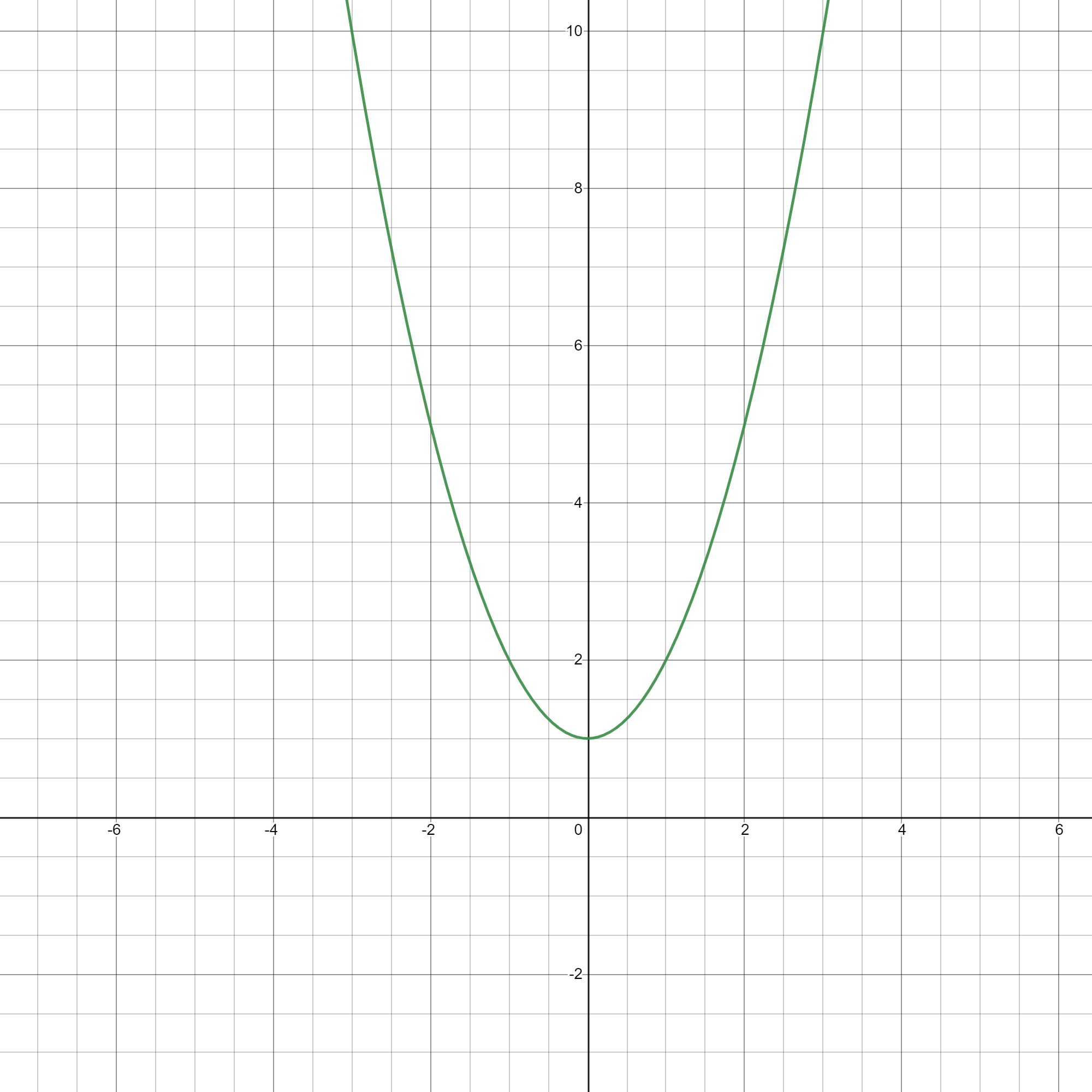
setlength{tabcolsep}{10pt}
renewcommand{arraystretch}{1.5}
begin{center}
begin{tabular}{|c | c | c |}
hline
x & y=f(x) & (x,y) \
hline
-3 & 10 & (-3,10) \
hline
-2 & 5 & (-2,10) \
hline
-1& 2 & (-1,2) \
hline
-0 & 1 & (0,1) \
hline
1 & 2 & (1,2) \
hline
2 & 5 & (2,10) \
hline
3 & 10 & (3,10) \
hline
end{tabular}
end{center}
So, the function $f(x)$ is even as its table contains the pair $(x, y)$ and $(-x, y)$,\
$$
begin{align*}
P(s)&=-s^{2}+10s \
end{align*}
$$
In order to find the what is maximum profit the model predicts for each company and which company can sell their apps for less to make a maximum profit, we will first bring the given equation in the graphing form.
$$
begin{align*}
P(s)&=-s^{2}+10s \
P(s)&=-(s^{2}-10s+25)+25 \
P(s)&=-(s^{2}-5)+25 \
end{align*}
$$
So, the vertex is $(5,25)$
Therefore the maximum profit for Math Starz is $25$ and the maximum profit for Comet Math is also $25$.
$$
begin{align*}
text{ A}(3,2) \
text{ B}(-2,0) \
text{ C}(-1,4) \
end{align*}
$$
$$
begin{align*}
text{ AB}&=sqrt{(-2-3)^{2}+(0-2)^{2}} \
text{ AB}&=sqrt{29}\
end{align*}
$$
Then, we determine $BC$ using the distance formula
$$
begin{align*}
text{ BC}&=sqrt{(-1-(-2))^{2}+(4-0)^{2}}\
text{ BC}&=sqrt{17}\
end{align*}
$$
Now, we determine $CA$ using the distance formula
$$
begin{align*}
text{ CA}&=sqrt{(3-(-1))^{2}+(2-4)^{2}}\
text{ CA}&=sqrt{20}\
end{align*}
$$
Now, we check if the triangle is a right-angle scalene triangle by using the Pythagorean theorem.
$$
begin{align*}
text{ AB}^{2}&=text{ BC}^{2}+text{ CA}^{2} \
(sqrt{29})^{2}&=(sqrt{17})^{2}+(sqrt{20})^{2} \
29&ne37\
end{align*}
$$
Thus the triangle is a scalene triangle.
$$
begin{align*}
y&=sqrt[3]{x}-2 \
end{align*}
$$
Thus the graph is mentioned below,
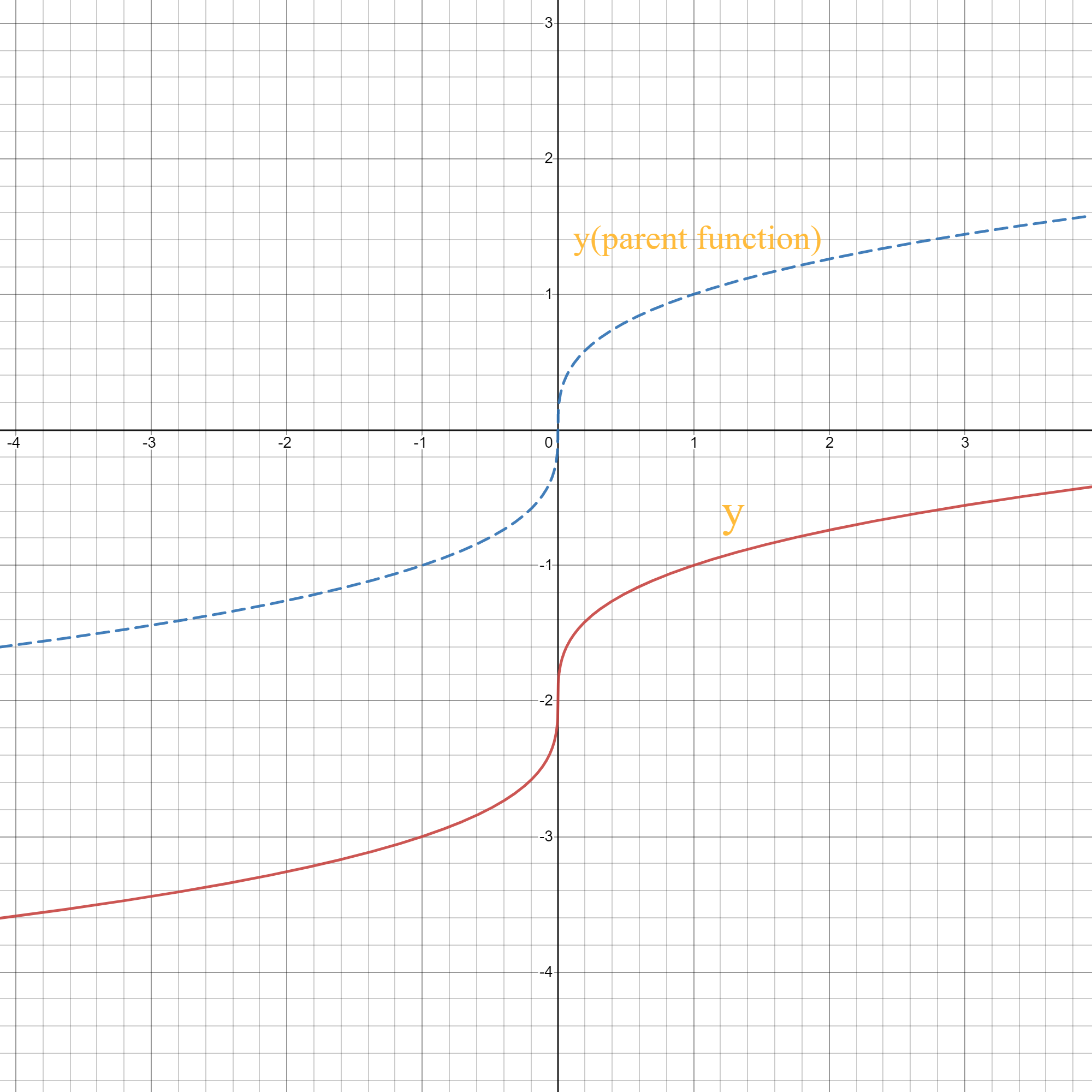
There is no asymptote.
The left end goes down while the right end goes up.
The function is continuous and increasing, the intercept of is,
In the given function when $y$ is equals $0$
$$
begin{align*}
y&=sqrt[3]{x}-2 \
0&=sqrt[3]{x}-2\
2&=sqrt[3]{x}\
x&=(2)^{3}\
x&=8\
end{align*}
$$
In the given function when $x$ is equaled $0$
$$
begin{align*}
y&=sqrt[3]{x}-2\
y&=sqrt[3]{0}-2\
y&=-2\
end{align*}
$$
Thus the intercepts are $( 8, -2)$

We can see in $triangle$MAX
$overline{MA}$ = 7 Units
$overline{AX}$ = 4 Units
$angle{MAX}$=100$degree$
and
We can see in $triangle$NJO
$overline{NJ}$ = 7 Units
$overline{JO}$ = 4 Units
$angle{NJO}$=100$degree$
For this, we need three sides or either sides or angles in the combinations SAS (S represents corresponding Sides of the triangles and A represents the corresponding Angles of the triangles) or ASA or AAS of both these triangles to be equal or congruent. Since we are given 2 sides and 1 angle we will check the congruency by applying the SAS rule.
As we can observe from the diagrams,
$overline{MA}$ $ncong$ $overline{JO}$
$angle{MAX}$$ncong$$angle{JON}$
$overline{AX}$ $ncong$ $overline{ON}$
This implies
$triangle$MAX $ncong$ $triangle$JON
Thus the statement is incorrect.
As we can observe from the diagrams,
$overline{MA}$ $cong$ $overline{NJ}$ = 7 Units
$angle{MAX}$$cong$$angle{NJO}$ = 100$degree$
$overline{AX}$ $cong$ $overline{JO}$ = 4 Units
This implies
$triangle$MAX $cong$ $triangle$NJO
Thus the statement is correct.
As we can observe from the diagrams,
$overline{JO}$ $ncong$$overline{AM}$
$angle{OJN}$$cong$$angle{MAX}$ = 100$degree$
$overline{JO}$ $ncong$ $overline{AM}$
Here although one angle is congruent, the sides are not congruent. This implies
$triangle$JON $ncong$ $triangle$AMX
Thus the statement is incorrect.
$$triangle MAX cong triangle NJO$$
And when two triangles are congruent they will have congruent or equal corresponding angles and equal corresponding sides.
From this, we can say
$overline{MX}$ $cong$ $overline{NO}$
Thus, this statement is correct.
